
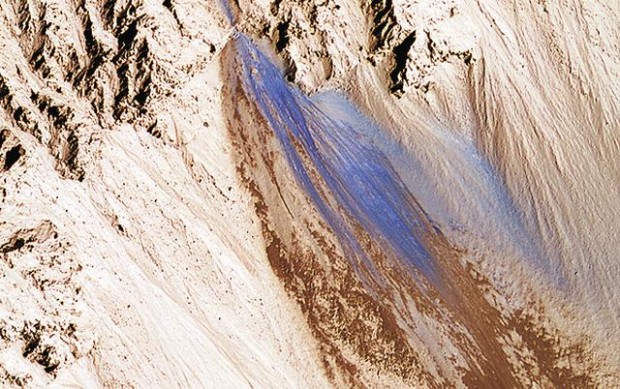
People would probably stand in line and pay to look through a telescope to see the Mars images available for free on the University of Arizona space camera's Web site.
But until recently, Web users had to navigate a cumbersome and homely home page to find the pictures being sent back by HiRISE (High-Resolution Imaging Science Experiment), or "The People's Camera." The nickname reflects the NASA-funded UA Lunar & Planetary Lab project's mission to make its imagery accessible to everyone.
The new and vastly more attractive Web page for the orbiting Mars camera also makes it easier for users with relatively slow Internet connections to see the high-quality images being released to the public each week.
HiRISE, essentially a digital camera with a powerful telescope for a lens aboard the Mars Reconnaissance Orbiter (MRO), has been circling Mars from pole to pole since last year, sending back the most detailed images of the planet yet.
People are also reading…
According to the UA Lunar and Planetary Laboratory's staff, HiRISE can show surface details as small as 40 inches across from its 155- to 196-mile high orbit.
Last week 1,200 of the images HiRISE has sent back were released to NASA's Planetary Data System, which can be used by scientists, students, writers, textbook publishers or anyone with an interest in the photos.
In addition to weekly Wednesday morning additions of the latest HiRISE images to the page, HiRISE principal investigator Alfred McEwen said staffers have reprocessed some of the earlier pictures to remove streaks and make the images uniformly bright.
The new site's designer, Yisrael Espinoza, said the site can make highly detailed images available, even over relatively slow Internet connections, through the use of a program called IAS Viewer (IBM, Mac and Linux). He said the program works much like video streaming, not requiring a large download before an image can be viewed.
"I'm not a scientist," Espinoza said. But he said he's been awed by the results obtained by HiRISE.
"We're looking at the surface of another planet. You're seeing something that human beings have never seen up to this time. It's crazy," Espinoza said. "We wanted to make it available to everybody."