

WASHINGTON — Scientists have now proved what patients in dentists' chairs have often thought: Drilling teeth is downright prehistoric.
Dentists drilled nearly perfect tiny holes in the teeth of live patients between 7,500 and 9,000 years ago, according to carbon-dating of skulls unearthed in a Pakistani graveyard.
That means dentistry is at least 4,000 years older than first thought — and far older than the useful invention of anesthesia. The discovery of the dental work is described today in the journal Nature.
This was no mere tooth tinkering. The 11 drilled teeth found in the remote graveyard were hard-to-reach molars. And in at least one instance, the ancient dentist managed to drill a hole in the inside back end of a tooth, boring out toward the front of the mouth.
The holes went as deep as one-seventh of an inch.
People are also reading…
How it was done is painful just to think about.
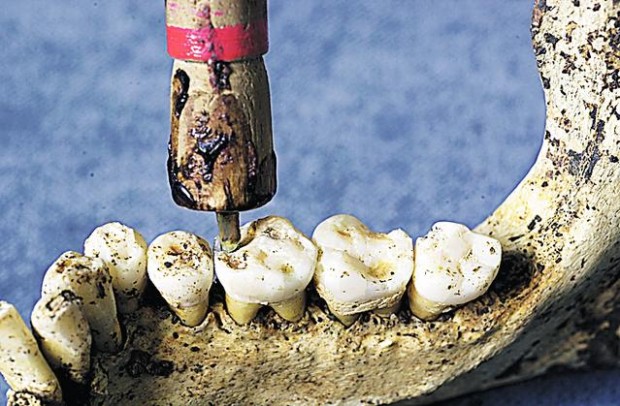
Flint drill heads were found on site, so researchers believe a small bow was used to drive the drill tips into patients' teeth. Lead author Roberto Macchiarelli, an anthropology professor at the University of Poitiers, France, and his colleagues simulated the technique and drilled through human (but no longer attached) teeth in less than a minute.
Macchiarelli said the drilling likely was done to reduce the pain of cavities.
Dr. Richard Glenner, a Chicago dentist and dental history author, said drilling could have been to release "evil spirits."


