

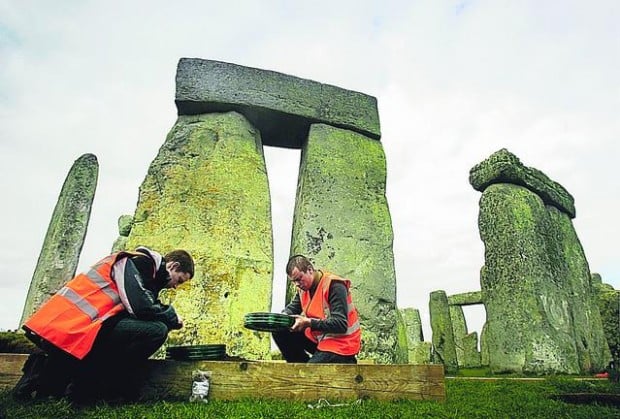
The mysterious circular stone monument at Stonehenge was a "domain of the dead," researchers said Thursday, a burial ground downriver from a separate circle of wooden pillars that marked the "domain of the living."
The researchers studying England's famous circle of standing stones reported that the enigmatic structure served as a burial place from its beginning, possibly for a single prominent family.
The first radiocarbon dating for remains at Stonehenge shows cremated burials there as early as 3000 B.C. and continuing for at least 500 years, said Mike Parker Pearson of England's University of Sheffield.
The continuing research also uncovered an ancient village at nearby Durrington Walls, where the remains of a circle of wooden pillars has been dubbed the Southern Circle. Both the Southern Circle and Stonehenge connect by avenues to the River Avon.
People are also reading…
"The Southern Circle and stone circle are very similar indeed, even though they are made of very different materials," said Julian Thomas of Manchester University in England. "They are oriented to the river, so it becomes a process of transformation of the living or the dead moving between those two sites."
But while Stonehenge is oriented to the midsummer sunrise, the Southern Circle faces the other way, welcoming the midwinter sunrise, the researchers pointed out.
Burials continued for at least 500 years, to the time when the giant stones that mark the mysterious circle were being erected, they said.
"It's now clear that burials were a major component of Stonehenge in all its main stages," said Parker Pearson, head of the Stonehenge Riverside Archaeological Project.
In the past, many archaeologists had thought that burials at Stonehenge continued for only about a century, the researchers said.
"Stonehenge was a place of burial from its beginning to its zenith in the mid-third millennium B.C. The cremation burial dating to Stonehenge's sarsen stones phase is likely just one of many from this later period of the monument's use and demonstrates that it was still very much a domain of the dead," Parker Pearson said.
And it's been a ceremonial site for much longer, Parker Pearson said.
Adding to the mystery are three 10,000-year-old pits for wooden pillars now covered by the parking lot at Stonehenge, he said.
"Why are they there, that's a really big mystery," Parker Pearson said. "They are among the earliest monuments on the planet."
Another two similar pits were recently found beneath the gift shop at the monument, he added.
Durrington Walls "is a quite extraordinary settlement, we've never seen anything like it before," Parker Pearson said.
There were at least 300 and perhaps as many as 1,000 homes in the village, he said.


