

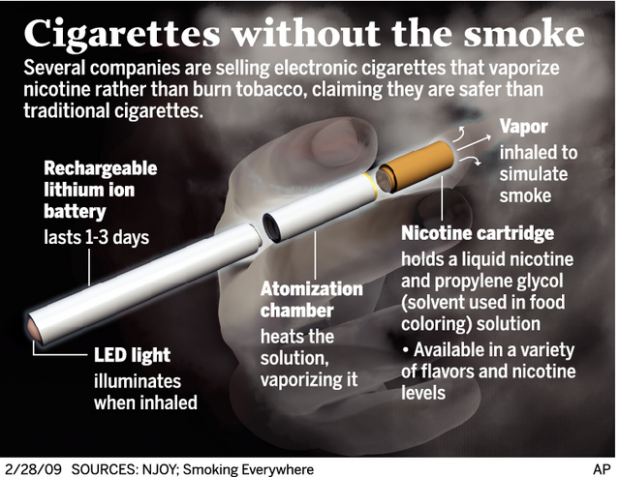
BEIJING — With its slim white body and glowing amber tip, it can easily pass as a regular cigarette. It even emits what look like curlicues of white smoke.
The Ruyan V8, which produces a nicotine-infused mist absorbed directly into the lungs, is just one of a rapidly growing array of electronic cigarettes attracting attention in China, the U.S. and elsewhere — and the scrutiny of health officials.
Marketed as a healthier alternative to smoking and a potential way to kick the habit, the smokeless smokes have been distributed in swag bags at the British film awards and hawked at an international trade show.
Because no burning is involved, makers say there's no hazardous cocktail of cancer-causing chemicals and gases like those produced by a regular cigarette. There's no secondhand smoke, so they can be used in places where cigarettes are banned, the makers say.
People are also reading…
Health authorities are questioning those claims.
The World Health Organization issued a statement in September warning there was no evidence to back up contentions that these new cigarettes are a safe substitute for smoking or a way to help smokers quit.
"There is not sufficient evidence that (they) are safe products for human consumption," Timothy O'Leary, a communications officer at the WHO's Tobacco Free Initiative in Geneva, said this week.
The laundry list of WHO's concerns includes the lack of conclusive studies and information about electronic-cigarette contents and their long-term health effects, he said.
Ruyan — which means "like smoking" — introduced the world's first electronic cigarette in 2004. It has patented its ultrasonic atomizing technology, in which nicotine is dissolved in a cartridge containing propylene glycol, the liquid that is vaporized in smoke machines in nightclubs or theaters and is commonly used as a solvent in food.
When a person takes a drag on the battery-powered cigarette, the solution is pumped through the atomizer and comes out as an ultrafine spray that resembles smoke.


