

AMSTERDAM, Netherlands — Most of us are taller than our parents, who probably are taller than their parents. But in the Netherlands, the generational progression has reached new heights.
In the last 150 years, the Dutch have become the tallest people on Earth — and experts say they're still getting bigger. It is a tale of a nation's health and wealth.
Prosperity propelled the collective growth spurt that began in the mid-1800s and was interrupted only during the harsh years of the Nazi occupation in the 1940s — when average heights actually declined.
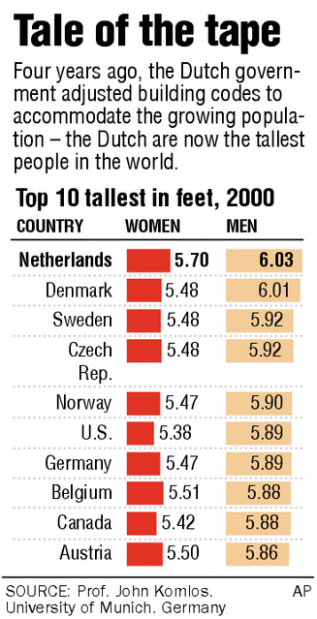
With their protein-rich diet and a national health service that pampers infants, the Dutch are standing taller than ever. The average Dutchman stands just over 6 feet, while women average nearly 5 feet 7 inches.
Ask Pieter Gijselaar about the problems of the very tall.
People are also reading…
At more than 6 feet 10 1/2 inches, he spends a lot of time ducking through doorways and guarding against minor head injuries. In an economy-class airline seat, he fits only in the emergency exit row. He had to have the seat of his Volkswagen Golf specially fitted, and had blocks put under the legs of his office desk.
But Gijselaar, a 28-year-old real-estate agent, says he has it easier than his father, who is 6 feet 5 inches.
"Buying clothes and shoes is not a problem anymore. You can always find stores that sell large sizes," he said. "But it's not cheap. I don't get any discounts off the rack."
Though people tend to stare, Gijselaar says being head, shoulders and trunk above everyone else makes an impression. "People don't forget me. If you meet me a year from now, you'll remember who I am."
The Dutch were not noted for their height until recently. It was only in the 1950s that they passed the Americans, who stood tallest for most of the last 200 years, said John Komlos, a leading expert on the subject who is professor of economic history at the University of Munich in Germany.
Many Dutch are much taller than average. So many, in fact, that four years ago the government adjusted building codes to raise the standards for door frames and ceilings. Doors must now be 7 feet 6 1/2 inches high.
For years, the Dutch national air carrier had an agreement with the Tall People's Club to give preference to club members for front seats with extra leg room. The airline scrapped the deal last year because of complaints of discrimination by more normal-sized people, club spokesman Paul van Sprundel said.
Though that was a setback, the national railway did ask the club to try out seats for new railway cars.
"More and more people are becoming aware of our needs," van Sprundel said.
The club has a membership of 2,000 individuals and families, or about 4,500 people including children.
But van Sprundel said the requirements are minimal, to conform with similar clubs in other countries — about 6 feet 3 inches for men and 5 feet 11 inches for women.
By those standards, he estimates about 800,000 people would qualify in this country of 16 million.
It wasn't always this way.
In 1848, one man out of four was rejected by the Dutch military because he was shorter than 5 feet 2 inches. Today, fewer than one in 1,000 is that short.
George Maat, an anthropologist at Leiden University Medical Center, cites a study done in 1861 correlating the height of conscripts to the availability and price of rye, then the main food crop.
One year after a poor crop, the number of men rejected as too short shot up.


