

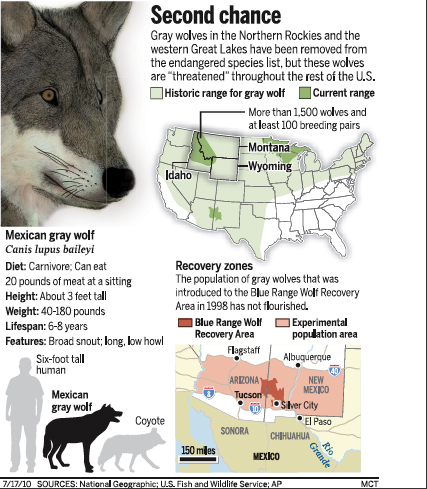
Another endangered Mexican gray wolf was found shot to death this week in Arizona - and one of the possibilities authorities are looking into is that ranchers or others may have used radios to track and target radio-collared wolves.
Environmentalists are pushing the feds - "as a precaution" - to take back the radios loaned to ranchers and others in Arizona and New Mexico that allow the wolves to be tracked.
Ranching groups deny the "ridiculous" suggestion that any ranchers would use the radios to target wolves for shootings. They say they only monitor the wolves to try to keep them from attacking their cattle or getting too close to homes.
Agents for the U.S. Fish and Wildlife Service have drawn no conclusions as to whether the receivers are being used to target wolves, said Nicholas Chavez, the service's Southwest law enforcement chief.
People are also reading…
"We put everything into the realm of possibility. We always look into that but we have not confirmed that at all," said Chavez, whose agents have investigated more than 30 Mexican wolf shootings.
The radios are loaned to two groups of people: those wishing to protect livestock against wolf attacks and those wishing to protect their property against nuisance wolves, says a document written by officials with the federal wolf reintroduction project.
The latest dead male wolf, a yearling, was found Thursday near Big Lake, in Eastern Arizona, about two miles from where an adult alpha male from the same pack - the Hawks Nest Pack - was found shot to death June 18.
On June 24, another adult alpha male - the leader of its pack - was found dead in southern New Mexico under "suspicious circumstances." Authorities won't know if that one was shot to death until a necropsy is done.
The latest wolf to be found dead had a bullet wound, a U.S. Fish and Wildlife Service spokesman, Tom Buckley, said Friday.
"It's a tremendous hit" to the recovery program, he said. Thirty-three wolves have been shot to death since wolves were first reintroduced into Arizona and New Mexico in 1998.
At about the same time this wolf was found, authorities found a cow shot to death in an area close by. The cow also died of a gunshot wound, sometime during the preceding 24 hours, and was not fed upon by wolves, the wildlife service investigation indicates.
The wolf death leaves the Hawks Nest pack with two females - an adult and a yearling - to care for seven pups born to the pack this spring, Buckley said. The outlook isn't good for the adults to find enough food for the pups, said Bruce Sitko, an Arizona Game and Fish Department official in Pinetop. "Taking the alpha male out is a blow. Taking two of four adults out is really hard," said Sitko.
Also on Friday, 16 environmental groups released a letter they had sent last month to Interior Secretary Ken Salazar, urging that the wildlife service take back the radios capable of tracking the radio-collared wolves that the agency has loaned cattle ranchers for years. The environmentalists said the radios make the wolves vulnerable to poaching. Salazar's office hasn't yet responded to the letter.
"Given the high rate of illegal shooting of Mexican wolves, as well as the large number of wolves disappearing under suspicious circumstances, wolf-frequency-programmed receivers should only be in the hands of government employees responsible for protecting and recovering the wolves, and in the hands of scientists studying them," said the letter.
The letter cites one case linking the use of a radio to a wolf death. It recounted a 2007 article in the environmental magazine High Country News that quoted a Southwest New Mexico rancher as saying he tracked a wolf down with a receiver. The rancher was quoted as saying - a quote he later denied making - that he then branded cattle less than a half-mile from a wolf den, to lure a wolf to come after a cow. Federal authorities then shot the wolf at the rancher's behest. The wolf, which had previously eaten two cattle, ate two more, which under federal rules allowed the animal to be shot by authorities.
The Arizona and New Mexico Cattle Growers associations say there is no evidence of a rancher ever killing a wolf. To say that the radios should be seized, "I find that ridiculous," said Caren Cowan, director of the New Mexico Cattle Growers Association.
While New Mexico ranchers have opposed the wolf program, the Arizona group says its members are as upset as anyone at the latest death.
As for the radios, "Very few of our ranchers have them in hand," said Patrick Bray, executive vice president of the Arizona cattlemen's group. "They normally only use them during the release period, when a pack is first introduced into an area, so they can properly manage that pack to keep them away from homes."
Contact reporter Tony Davis at tdavis@azstarnet.com or 806-7746.


