

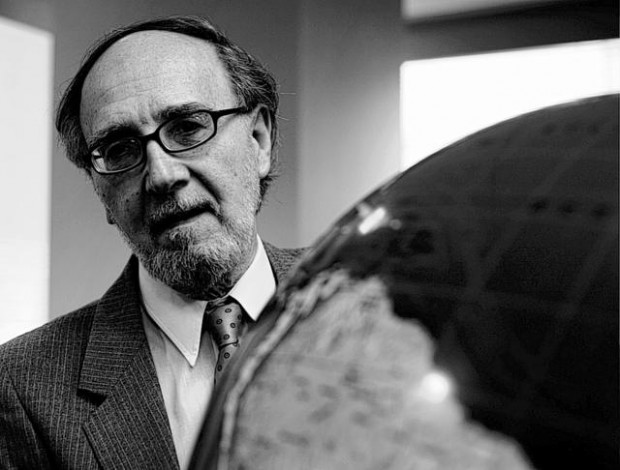
WASHINGTON — Ron Ace says that his breakthrough moments have come at unexpected times — while he lay in bed, eased his aging Cadillac across the Chesapeake Bay Bridge or steered a tractor around his rustic, five-acre property.
In the seclusion of his Maryland home, Ace has spent three years glued to the Internet, studying the Earth's climate cycles and careening from one epiphany to another — a 69-year-old loner with the moxie to try to solve one of the greatest threats to mankind.
Now, backed by a computer model, the little-known inventor is making public a U.S. patent petition for what he calls the most "practical, non-toxic, affordable, rapidly achievable" and beneficial way to curb global warming and a resulting catastrophic ocean rise.
Spray giga-tons of seawater into the air, mainly in the Northern Hemisphere, and let Mother Nature do the rest, he says.
People are also reading…
The evaporating water, Ace said, would cool the Earth in multiple ways: First, the sprayed droplets would transform to water vapor, a change that absorbs thermal energy near ground level; then the rising vapor would condense into sunlight-reflecting clouds and cooling rain, releasing much of the stored energy into space in the form of infrared radiation.
McClatchy Newspapers has followed Ace's work for three years and obtained a copy of his 2007 patent petition for what he calls "a colossal refrigeration system with a 100,000-fold performance multiplier."
Although it might sound preposterous, a computer model run by an internationally known global warming scientist suggests that Ace's giant humidifier might just work.
Kenneth Caldeira, a climate scientist at the Carnegie Institution's Department of Global Ecology at Stanford University, roughly simulated Ace's idea in recent months on a model that's used extensively by top scientists to study global warming.
The simulated evaporation of about one-half inch of additional water everywhere in the world produced immediate planetary cooling effects that were projected to reach nearly 1 degree Fahrenheit within 20 or 30 years, Caldeira said.
"In the computer simulation, evaporating water was almost as effective as directly transferring . . . energy to space, which was surprising to me," he said.
Ace said the cooling effect would be several times greater if the model were refined to spray the same amount of seawater at strategic locations.
He proposes to install 1,000 or more devices that spray water 20 to 200 feet into the air, depending on conditions, from barren stretches of the West African coast, bluffs on deserted Atlantic Ocean isles, deserts adjoining the African, South American and Mediterranean coasts and other arid or windy sites. To maximize cloud formation, he'd avoid the already humid tropics, where most water vapor quickly turns to rain.
"It does seem like evaporating water outside the tropics would be more effective," Caldeira said.
The spraying would be targeted mainly at higher, northern latitudes, where Ace thinks that air currents known as Ferrel cells could deliver heavy snow to the Arctic, offsetting the melting of the polar icecap.
Several scientists who reviewed Ace's patent petition for McClatchy Newspapers reacted with caution to outright derision over its possibilities, but some softened their views upon learning of the computer model.
Ace's invention rests on some unconventional theories.
He contends that the planet is 5 to 6 degrees Fahrenheit too hot to stop the meltdown from the last ice age 20,000 years ago, not a couple of degrees too warm, as government scientists say. He proposes to lower the temperature by 3.5 degrees to 4 degrees, leaving a cushion to avoid tipping toward another ice age and always retaining the option of turning the sprayers down or off, if needed.
He suspects deforestation is a major cause of global warming, not just because trees absorb carbon dioxide, but also because a large-leaf tree can wick up and evaporate hundreds of gallons of water in a single day.
It would be relatively easy to design the spraying equipment, but it would take a major international effort to install 1,000 large spraying devices, or thousands of smaller ones. The 15,800 cubic meters of sprayed water per second would be equivalent to the flow at the mouth of the Mississippi River.


