

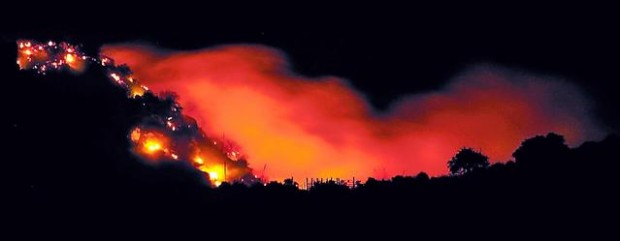
When the Guthrie Fire started on July 11 just north of Redington Pass, it could have been quickly extinguished with "four buckets from a helicopter," Stan Helin said.
Helin, a ranger for the Santa Catalina District of the Coronado National Forest, made the decision to "manage the fire for resource benefit," allowing it to burn under close supervision until Mother Nature put it out.
Then he spent two sleepless weeks as it rained "everywhere but on the fire," and the Forest Service received calls from people concerned about their property atop Mount Lemmon, miles away but directly uphill.
The fire grew to nearly 5,000 acres before receiving its first good soaking Wednesday night. Helin lighted a celebratory cigar.
"Here's the courage I'm trying to get," Helin said, "to let smoke be in the air throughout the year here."
People are also reading…
Our national forests are a well-documented mess. For more than 100 years, their managers stomped out every fire and changed the forest ecology.
Without frequent, low-intensity fires, forests became choked with trees, shrubs, downed timber and duff. Then came drought, and bark beetles and encroaching civilization. The resulting high-intensity fires of recent years have denuded landscapes and burned through mountain communities in Arizona and across the country.
The road to restoration of those forests is long, and the tools are costly.
Thinning, or selectively logging, is labor-intensive and slow. It's the weapon of choice on the wildland-urban interface, where the forests meet the land that has been built upon. In coniferous and woodland areas, it costs anywhere from $150 to $1,500 an acre to thin, said Randall Smith, forest-restoration staff officer for the Coronado Forest.
Prescribed burns — deliberately set when conditions are right for removing fuels without burning down the whole forest — require planning, standby firefighting forces and environmental assessment. They can be thwarted by the weather — an uptick in humidity or a windy day. Costs range from $5 to hundreds of dollars an acre, with most prescribed burns falling in the $30-to-$50 range, Smith said.
Fire managers now want to make more frequent use of the other tool in the box — naturally caused fires.
Instead of stomping them out, they want to let them burn within a manageable area. Pete Gordon, fire management officer for the Coronado Forest, said the Guthrie Fire "treated" nearly 5,000 acres for about $8 an acre.
The Coronado National Forest, which manages about 1.8 million mostly mountainous acres in Southern Arizona, has managed six fires for resource benefit on 24,000 acres during this fire season, Smith said.
Five were in fairly remote areas of the Peloncillo, Santa Teresa, Santa Rita and Chiricahua mountain ranges.
Guthrie was in the Santa Catalina District, where Helin must balance the needs of the forest with the concerns of a metropolitan population of nearly a million.
He knew smoke would occasionally drift into Tucson, as it did a week ago Saturday night.
He knew he would be blamed for the haze Wednesday morning, even though it was caused by dust, not smoke.
He knew some folks atop Mount Lemmon would be concerned, with the memory of two major fires still fresh.
In 2002, the Bullock Fire burned 30,563 acres and was stopped at the Catalina Highway, sparing Summerhaven. The following year, the Aspen Fire roared through the village atop Mount Lemmon, leveling 314 buildings. It took out an additional 20 summer homes at Fern Ridge and Willow Canyon, and eventually it burned 84,750 acres of coniferous forest.
"Aspen and Bullock are in our DNA," Helin said.
Helin knew this fire was much different from those two. Aspen and Bullock started in dry June and were actively fought from the moment they were spotted.
The Guthrie Fire began when the area was well into monsoon conditions, Gordon said. He knew it would burn slowly and with low intensity.
He, too, thought it would be extinguished by rain before it grew too much, but the plan for the fire did not count on that.
"The fact it went so long without a rain shower on it is amazing," he said.
Gordon chafes a bit when people say he is simply letting fires burn.
They are managed, he said, from start to finish, and crews are ready to jump in at any time.
Only areas that have a previously approved fire-management plan are allowed to burn. That means the forest already has identified environmental factors, safety and property risks and potential resource benefits. They also have identified natural barriers and access points.
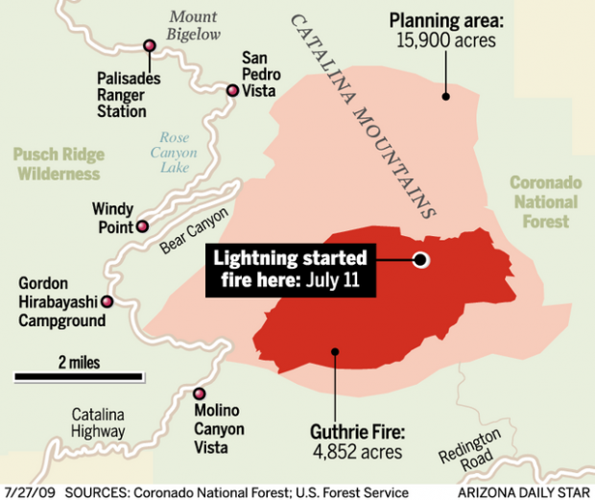
Fire managers then draw up a planning area, previously known as the maximum manageable area. Within that perimeter, they identify points at which action must be taken.
On the Guthrie Fire, Gordon said, crews went into action twice — when winds from thunderstorms pushed it too close to state land on the east side of the fire and when flames neared the management perimeter on the west side, near Molino Canyon. They used standard wildfire-fighting techniques — cold-trailing and back-burning along previously chosen trails or roads.
Guthrie didn't get rain, but it received the negative effect of the unsettled weather in the form of wind and the benefit of the additional humidity. The fire burned slowly, Gordon said.
The Guthrie Fire started in the grass and oak-studded hills near Bellota Ranch, north of Redington Pass, which divides the Santa Catalina and Rincon mountains.
The general rule of thumb in that area, Helin said, is that you let things burn south of Redington. On the north side, Helin said, "everything goes uphill to Summerhaven" where homes, businesses and collections of scientific and communications equipment represent "$1 billion at risk."
But this fire was pretty far south on the north side, there were plenty of places to stop it before it got away and the weather was moist.
It worked. Helin said he had every confidence that it would.
But he vowed to never draw a line that close to Catalina Highway again, and he didn't break out that cigar until he received a text message in his office at Sabino Canyon early Wednesday evening letting him know it had rained on the fire for 40 minutes.
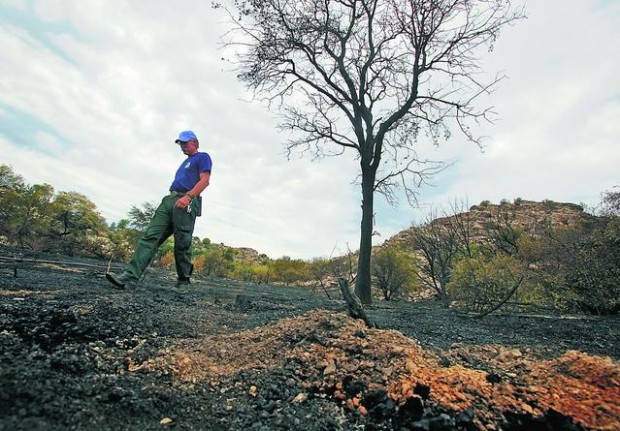
On StarNet: See more photos of the damage caused by the Guthrie Fire at azstarnet.com/slideshows
Why let fires burn?
• It saves money. Calling in a helicopter or a tanker plane is the biggest cost of fighting a fire. Mechanical thinning (logging) and prescriptive burns can be 10 to 100 times more expensive than letting a naturally caused fire run its course when conditions for doing so are safe.
• It reduces built-up fuel loads.
• It restores forest ecology. Most forested areas in Arizona are "fire-adapted," with fire playing a beneficial role in development of plant communities. The Coronado National Forest and the National Park Service draw the line at the desert, where plant species such as saguaros and palo verdes have not adapted to fire over the years.


