

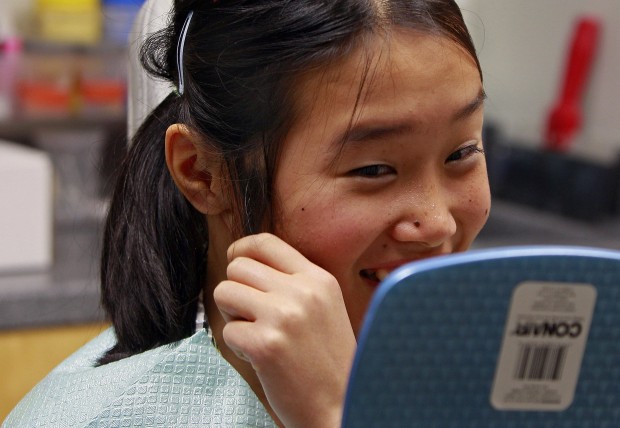
WASHINGTON - Elise Lutz never let her friends see what was left of her ear.
She'd carefully style her long hair into a one-sided ponytail, or swelter under a swim cap for hours at meets, to cover the molten lump from a severe burn as a toddler in her native China.
But as a teenager, the North Carolina girl expressed her desire to be whole again with a simple request: She really wanted pierced earrings. Thus began a months-long quest for a new right ear, one made of silicone but so lifelike that it even glows a bit in the sun like real skin.
Elise benefited from a little known field called anaplastology, where medical artists make Hollywood-like special effects come alive to fix disfigurements that standard plastic surgery cannot.
"It kind of took forever, but it was worth it," said Elise, 14, as she headed to show her transformation to her dad and sisters. "I'm so excited, I'm more than 100 excited."
People are also reading…
No messy glue-on prosthetic that she might accidentally knock off. Elise had tried that once and hated it. This time, she would go under the knife to have rods implanted in her skull to snap her new ear into place - and hold it even when this passionate swimmer dives into the pool.
"People who have implant-retained ears or noses or whatever usually think of them really as their own body," said Jerry Schoendorf, who with his colleague at The Anaplastology Clinic in Durham, N.C., - and surgeons at nearby Duke University Medical Center - created Elise's ear.
"It's the Rolls Royce of what we can offer," adds fellow anaplastologist Jay McClennen.
Facial prosthetics - made to counter damage from cancer, trauma, birth defects - haven't gained the attention of artificial legs and arms. The specialists who craft them can be hard to find: The International Anaplastology Association counts just 150 members worldwide.
But facial prosthetics are becoming more realistic and longer-lasting, and Elise's journey offers a glimpse of the tricks that help: Titanium rods adapted from dentistry that bond with bone to hold them in place. More flexible silicones. Even "flocking," using those nylon particles that make the velvety insides of jewelry boxes can help give silicone "skin" more dimension - and not in flesh tones, but flecks of bright reds, plums, blues, oranges.
No one knows for sure how Elise was burned. Probably, boiling water sloshed down her head and right side, said Kim Williams of Wake Forest, N.C., who with her husband adopted Elise from a Chinese orphanage at age 9. Plastic surgery enabled hair to cover the scar-riddled right side of her scalp, a shield as Elise learned English and met new friends.


