

WASHINGTON — The alarm sounded with two sneezy children in California in April. Just five months later, the never-before-seen swine flu has become the world's dominant strain of influenza, and it's putting a shockingly younger face on flu.
So get ready. With flu's favorite chilly weather fast approaching, we're going to be a sick nation this fall. The big unknown is how sick. One in five people infected or a worst case — half the population? The usual 36,000 deaths from flu or tens of thousands more?
The World Health Organization predicts that within two years, nearly one-third of the world's population will have caught it.
"What we know is it's brand-new, and no one really has an immunity to this disease," Health and Human Services Secretary Kathleen Sebelius said.
A lot depends on whether the swine flu that simmered all summer erupts immediately as students crowd back into schools and colleges — or holds off until millions of vaccine doses start arriving in mid-October.
People are also reading…
Only this week do U.S. researchers start blood tests to answer a critical question: How many doses of swine flu vaccine does it take to protect? The answer will determine whether many people need to line up for two flu shots — one against swine flu and one against the regular flu — or three.
The hopeful news: Even with no vaccine, winter is ending in the Southern Hemisphere without as much havoc as doctors had feared, a heavy season that started early but not an overwhelming one. The strain that doctors call the 2009 H1N1 flu isn't any deadlier than typical winter flu so far. Most people recover without treatment; many become only mildly ill.
Importantly, careful genetic tracking shows no sign yet that the virus is mutating into a harsher strain.
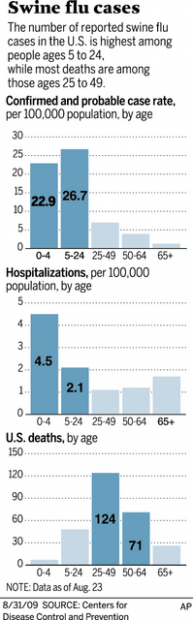
We're used to regular flu that, sadly, kills mostly grandparents. But the real shock of swine flu is that infections are 20 times more common in the 5- to 24-year-old age group than in people over 65. That older generation appears to have some resistance, probably because of exposure decades ago to viruses similar to the new one.
Worldwide, swine flu is killing mostly people in their 20s, 30s and 40s, ages when influenza usually is shrugged off as a nuisance.
Especially at risk are pregnant women. So are people with chronic conditions such as asthma, diabetes, heart disease and neuromuscular diseases, including muscular dystrophy. Some countries report more deaths among the obese.
Still, some of the people who've died didn't have obvious health risks.
"People who argue we're seeing the same death rates miss the point — they're in young adults. To me, that shouldn't happen," said one infectious-disease specialist, Dr. Richard P. Wenzel of Virginia Commonwealth University. He spent the past few months visiting South American hospitals to help gauge what the Northern Hemisphere is about to face.
Children, however, are the flu's prime spreaders. Already, elementary schools and colleges are reporting small clusters of sick students. For parents, the big fear is how many children will die.
In the U.S., regular flu kills 80 to 100 children every winter, and the Centers for Disease Control and Prevention has reports of about three dozen child deaths from swine flu.
Even if the risk of death is no higher than in a normal year, the sheer volume of ill youngsters means "a greater than expected number of deaths in children is likely," said Dr. Anne Schuchat, director of the CDC's National Center for Immunization and Respiratory Diseases. "As a society, that's something that's much harder for us."
Prevention measures
Wash your hands; sneeze into your elbow; stay home so you don't spread illness when you're sick. That's the mantra until vaccine arrives.
This week brings a key milestone. Hundreds of U.S. adults who rolled up their sleeves for a first shot in studies of the swine flu vaccine return for a blood test to see if they seem protected. It will take government scientists a few weeks to analyze the results, but the volunteers get a second vaccine dose right away, in case the first wasn't enough.
The vaccine, merely a recipe change from the usual flu vaccine, seems safe. Federal authorities two weeks ago gave the go-ahead to start children's-vaccine trials.
In the U.S., Britain and parts of Europe, vaccinations are set to begin in mid-October, assuming those studies show they work. First in line:
• Pregnant women. Despite accounting for about 1 percent of the U.S. population, they've been accounting for 6 percent of the swine flu deaths.
• Children and young adults from 6 months to 24 years. Babies younger than 6 months can't get flu vaccine, so their parents and other caregivers should be inoculated to protect the infant.
• Health-care workers.
• Younger adults with risky health conditions.
The government has bought 195 million doses and will ship them a bit at a time, starting with 45 million doses or so in October, to state health departments to dispense.
Number of shots needed: Possibilities
Doctors don't know yet if it will take one dose or two of vaccine to protect against the new swine flu. Add that to vaccine for the regular winter flu, and it could be a multi-shot season for a lot of people — or a multi-squirt season for those who choose the FluMist nasal-spray version.
The possibilities:
• One shot: Older adults currently aren't on the priority list to get swine flu vaccine, but they should get the seasonal vaccine, which is available.
• Two shots: There's a potential for the regular vaccine in one arm and the swine flu vaccine in the other, if that one requires just one dose.
• Three shots: The swine flu vaccine might require two doses three weeks apart, plus the regular vaccine.
• Four shots: There's even this possibility for some children. Youngsters under 9 who are getting their first-ever regular flu vaccination need two doses of it.
The Associated Press


