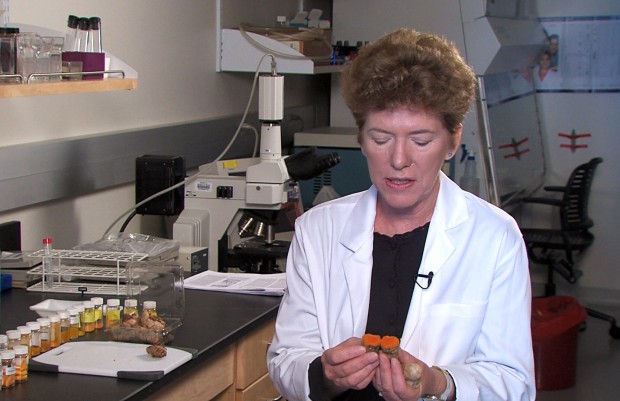
Turmeric might have uses in more than curries.
UA researchers Janet Funk and Leslie Ritter said the spice, used in India for thousands of years as an anti-inflammatory agent, could help prevent the third leading cause of death in the United States - stroke.
"We are always struggling to find preventative treatments for stroke because we don't have many," said Ritter, a professor at the University of Arizona College of Nursing. "In fact, we have zero."
Ritter and Funk recently completed a three-year clinical trial that shows turmeric can reduce the severity of stroke in rats if administered during a stroke.
In studies, rats were injected with turmeric extract to speed absorption, said Funk, a professor at the UA School of Medicine, but eating it seems to also work.
They hypothesize that regularly consuming turmeric could also reduce the likelihood of stroke for those most at risk.
People are also reading…
"Now we are asking questions no one has asked," Ritter said. "In a high-risk population such as people with diabetes, could a long-term treatment of turmeric reduce the likelihood of stroke?"
Funk said she started looking into turmeric as a potential treatment for arthritis. "After we identified that it did work, we realized it might have some benefits for other kinds of inflammatory disorders, namely stroke."
The benefits were easy to see in lab rats, Ritter said. "The studies that we have just finished indicate turmeric reduces inflammation of blood vessels during and after a stroke."
Stroke occurs when a clot or buildup of material blocks blood flow to the brain. "No blood is a bad thing," Funk said.
"The only treatment we have now is a clot-bursting drug that open vessels and restores blood flow."
The major drawback of clot-bursting drugs, Funk added, is something called reperfusion injury.
"This is when all hell breaks loose," she said.
After a clot is cleared, the white blood cells that are responsible for fighting off infection rush to the damaged, oxygen-starved blood vessels.
Inflammation causes the cells to stick to the walls of an artery, she explained. The white blood cells secrete proteins that inadvertently increase inflammation, often leading to another block and sometimes death.
During the study, funded by the Arizona Biomedical Research Commission, researchers blocked arteries in rats with a filament, triggering a stroke, and then withdrew the filament.
When the rats were then injected with refined turmeric, it drastically reduced reperfusion, Funk said.
A compound in turmeric called curcuminoid is thought to produce turmeric's anti-inflammatory properties, Funk said, but curcuminoids are not absorbed well by the human body. "Turmeric also contains essential oils," she said. "When you combine them with the oils, they are better absorbed. So maybe cooking with it works better."
Both Ritter and Funk emphasized that turmeric might have an even greater effect in diabetics and others at risk for stroke. They are seeking grants for further studies.
Funk said diabetics' blood vessels are always slightly inflamed, which increases the chance of stroke.
They want to study whether adding turmeric to their diets would lower the odds.
Will Ferguson is a NASA Space Grant intern. Email him at ferguson@azstarnet.com