

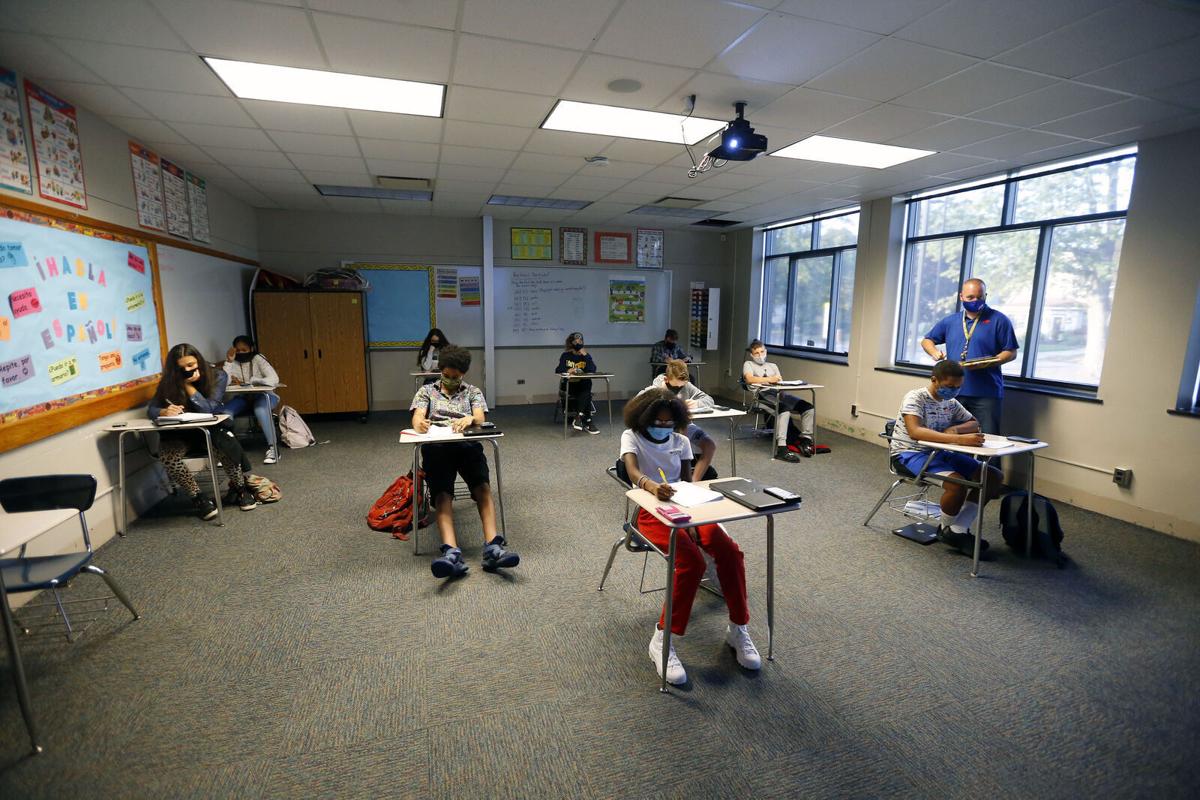
Public and private schools in most of Erie County must end all in-person classes in their buildings because of the orange zone designation announced Wednesday by Gov. Andrew Cuomo.
The orange zone encompasses schools in these districts: Amherst, Buffalo, Cheektowaga, Clarence, Cleveland Hill, Depew, East Aurora, Eden, Frontier, Grand Island, Hamburg, Iroquois, Kenmore-Town of Tonawanda, Lake Shore, Lancaster, Lackawanna, Maryvale, Orchard Park, Sloan, Sweet Home, Tonawanda, Williamsville and West Seneca.
The orange zone designations for schools go into effect Monday, according to Erie County Executive Mark C. Poloncarz.

New York State moved Erie County's yellow zone to an orange zone Wednesday, as well as adding a part of Niagara County as a yellow zone.
Schools in an orange zone may resume in-person classes in school buildings after Covid-19 testing all students and staff who will be on campus.
People are also reading…
"If we have to try to reopen, under the current orange and red designation requirements, it would be logistically very difficult to do that volume of tests," said Hamburg Superintendent Michael Cornell.
All the Erie County towns in the yellow zone announced last week will now be in the orange zone, and the governor added the towns of Evans and Eden to the orange zone.
The governor on Wednesday also designated the rest of Erie County, as well as North Tonawanda and parts of Wheatfield in Niagara County, as a yellow zone.
The new yellow zone encompass schools in Akron, Alden, Holland, Iroquois, Lake Shore, North Collins and Springville-Griffith school districts in Erie County. It appears the only schools in the Niagara County yellow zone are in the North Tonawanda City School District.
Schools in yellow zones must test 20% of their in-person students, staff and teachers biweekly, unless the positivity rate is less than the yellow zone's current seven-day positivity rate. In that case, they do not have to continue testing. If it is higher, schools are required to test 20% of those in school buildings every two weeks.
Orange zone schools must remain closed for at least four days, but can reopen on the fifth day after the designation, providing they comply with testing requirements, according to guidance issued by the New York State Health Department Nov. 3.
The orange zone requirements include:
• All students, teachers and staff cannot return to in-person classes unless they get a Covid-19 test that is negative. The test must be taken after the school closed. The school could provide a testing event, or accept test results from other providers. The school also must ensure contact tracing takes place for those positive cases.
• The school also must submit to New York State on their daily report the names, addresses, date of birth, result of lab test, lab performing test, ordering physician and test date for all those returning to the school building.
• After the school reopens to in-person learning, 25% of the students, teachers and staff must be tested weekly, and the results reported to New York State.
Under New York state's new "microcluster strategy," orange zone hot spots would have to adhere to the following restrictions.
If the zone the school is located in becomes a yellow zone, the testing requirement drops, and 20% of those on-site must be tested for the virus.
Superintendents of the 18 school districts in towns and cities designated as a yellow zone last week were making plans to pursue testing. Some had contracted with outside agencies and applied for temporary testing licenses. School districts also reached out to parents to see if they would consent to have their children tested.
And while thousands of students who had been attending school will now learn from home, the transition is expected to be far easier than when schools closed in March for the rest of the year. Schools have extensive plans on how to provide instruction, distributed Chromebooks and other supplies to students, and they have been providing remote learning all year for those who requested it.


