

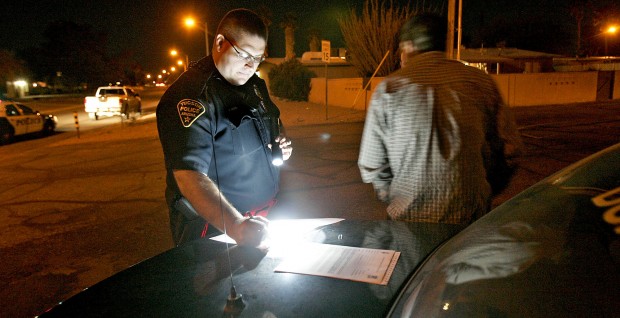
PHOENIX - Beginning today, if you're pulled over for drunken driving, odds are you won't be able to argue your case to a jury.
But if you're convicted of DUI, part of the penalty could be less than it is now.
A wide-ranging measure that takes effect today eliminates the right to a trial by jury for people charged with simple drunken driving - a blood-alcohol content of more than 0.08 - who have not been convicted before. Instead, it will be up to a judge to decide whether to handle it alone or allow for a jury.
But the same law also reduces the amount of time - from 12 months to six months - those convicted have to use an ignition interlock device on vehicles they drive.
That device prevents the vehicle from starting if a breath sample shows intoxication. It also can be programmed for random checks during an outing.
People are also reading…
And the new law also eliminates the requirement for anyone convicted of simple drunken driving to serve at least 24 consecutive hours in jail. Effective with the new year, the law will read "one day," which could mean simply being locked up overnight.
State Sen. Linda Gray, R-Glendale, architect of the changes, said they are designed to promote greater efficiency and compliance.
Most basic of those is elimination of the right to demand a jury trial.
Gray said that these jury trials are costly to not only the state but also to defendants who have to pay the legal fees for representation. Jury trials can take longer, if for no other reason than attorneys get to question each prospective juror.
Gray suggested that lawyers do not like the change because "maybe it cuts into them being able to make money off their clients."
The new law is likely to face a legal challenge.
Attorney Clifford Girard said he and others who defend clients accused of DUI believe that it is a constitutional violation to deny a jury trial in these circumstances. But Girard said he will have to wait until he has a client whose request for a trial by jury has been turned down before filing suit.
Nothing in the new law eliminates the right to a jury trial for repeat offenders or those charged with "extreme" DUI, meaning a blood-alcohol content of at least 0.15.
Jury trials also will remain for anyone charged with "aggravated" DUI. That includes those driving drunk with a suspended license, with someone younger than 15 in the vehicle, or who are supposed to have an interlock.
That last category has been a particular problem according to Gray. And she said that's why she agreed to alter the laws about how long one has to be installed.
Under current law, anyone convicted of driving drunk can operate a motor vehicle for the next year only if it is outfitted with an interlock. The idea is to prevent those who have a drinking problem from again driving while intoxicated.
The problem, said Gray, is that probably only about 40 percent of those who are required to have the interlocks actually get them installed.
"This would be an incentive, if they qualify, to be able to get that on there," she said, as the interlocks cost not only from $50 to $200 to install but companies charge a monthly fee that can be as high as $100.
That last point goes to what Gray said may actually improve the chances of catching repeat offenders. That's because the interlocks are designed to record all efforts to start the vehicle.
The new law says anyone convicted of drunken driving who is legally intoxicated and attempts to operate a vehicle with an interlock at least twice will have to keep the interlock in place for an additional six months.
And if during that extension there is even a single try to start the vehicle while intoxicated, that adds another six months to the interlock requirement.
Not everyone will be eligible for the reduced interlock requirement.
Gray said anyone who has been convicted of drunken driving in the last seven years has to have the device for the full year. The same is true for anyone involved in an accident that resulted in physical injury or property damage.
There is one change in the law that Gray conceded she accepted only to get the package approved: Altering that requirement that first-time offenders spend at least 24 hours behind bars.
It's not unusual for someone charged with drunken driving to have to spend the night in jail. Gray said some justices of the peace, who routinely handle these cases, count that as time served rather than imposing a new sentence after conviction.
"I'd like for them to be actually sober when they have to go back to jail to serve that 24 hours," she said.
But Gray acknowledged the additional cost of having to incarcerate someone a second time to meet the current requirements of the law. So the senator said she'll have to settle for the deterrent effects of an overnight stay.


