

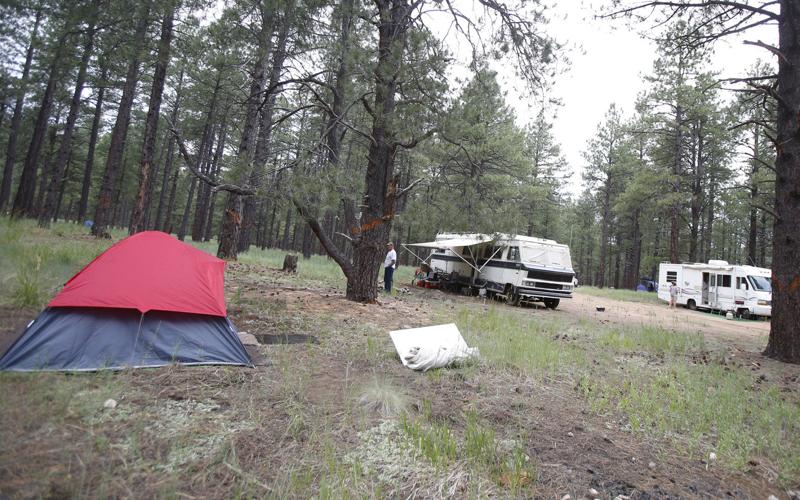
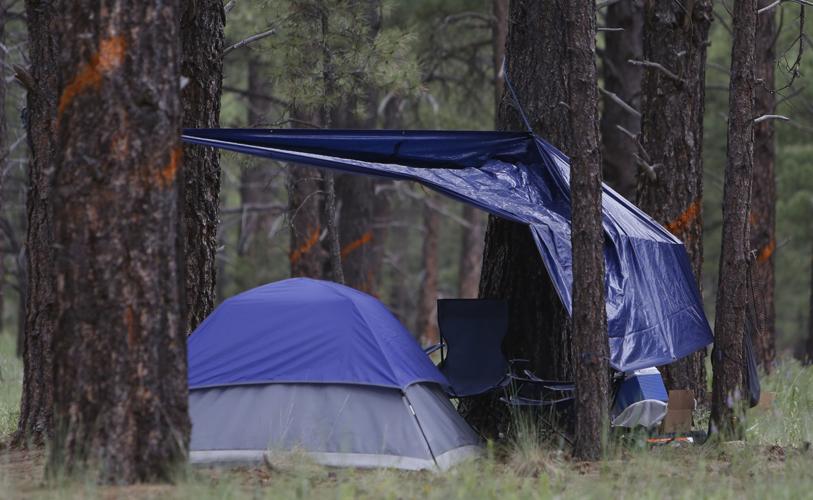
FLAGSTAFF — Just beyond town, a dirt road leads to a scattered group of tents and RVs.
There’s a bike tied to a tree near one tent belonging to Kevin Andrew, who is trying to get back on his feet after going through an alcohol-recovery program. There’s a table and chairs set up outside an RV owned by Cindy Samuelson, a former Forest Service employee staying here for the summer to be close to her aging father.
Farther down, there’s a small grill outside the van of a man named Doug, a Vietnam War veteran who calls himself a gypsy and prefers the quiet of the forest to a hotel room in town.
These three, like many others, have made the forest outside Flagstaff a temporary home for anywhere from a few days to several weeks.
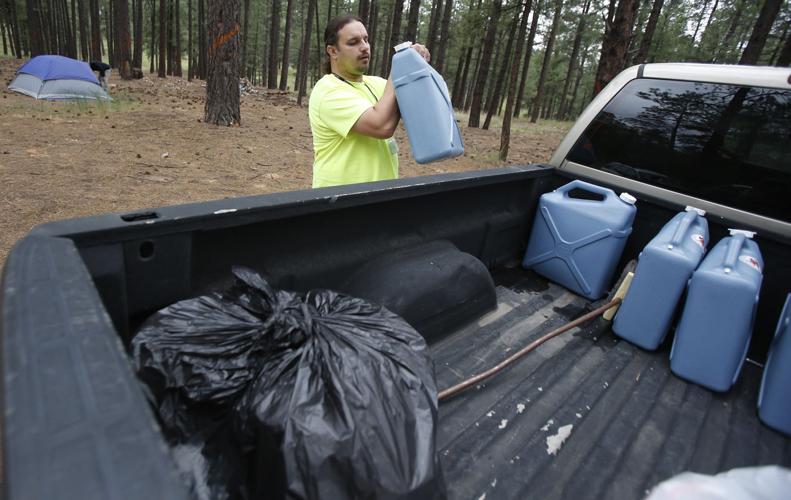
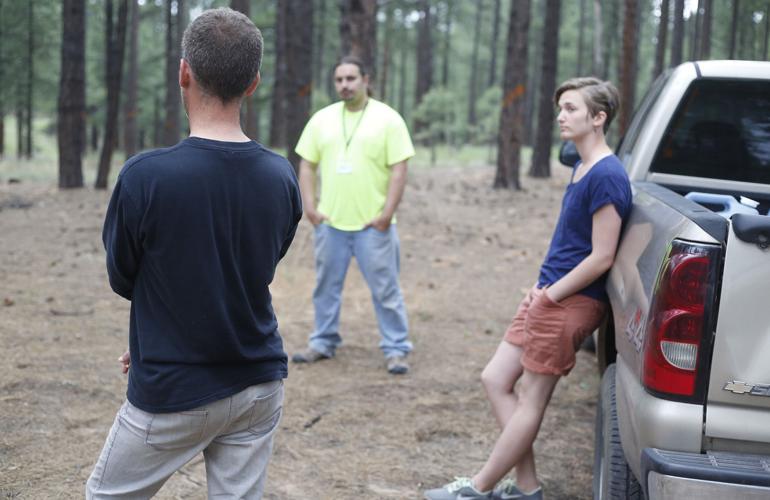
Rick Brust, with the nonprofit Catholic Charities’ PATH program, visits these temporary residents as part of a mission to help people with serious mental illness who are homeless. Brust talks with anyone he can find, trying to identify people who could qualify for the program while also providing plastic jugs of water, picking up trash and handing out supplies like tents, sleeping bags and bus passes.
People are also reading…
The organization says it provides a much-needed helping hand to dozens of people experiencing homelessness, but it also enables them to stay in the forest longer, which goes against at least two Forest Service rules against camping for longer than 14 days within any one-month period and using the forest as residential property.
It’s a situation that the Forest Service has been forced to confront with a balance of strict policy and practicality. Those living in the forest for extended periods of time create undue trash, human waste, and enforcement and wildfire problems, it says.
At the same time, people who make a temporary home in the forest say they keep a watchful eye over the area and help clean it up. And for their part, PATH employees provide a much-needed service of cleaning up campsites, keeping trash picked up, bringing water that can be used to help put out campfires and monitoring campers to mitigate environmental damage and medical emergencies.
PATH employees teach people how to stir campfires to effectively put them out, try to help them locate in areas away from dense vegetation and inform them about fire bans, Brust said.
“We want to make sure they are being good stewards and following rules of forest,” he said.
There’s no doubt that long-term campers, many coming up from the state’s desert communities for the summer, make a big impact on Northern Arizona’s forests, said Jon Nelson, law enforcement officer with the Coconino National Forest.
The problems with long-term camping include sanitation and sewage issues from individuals going to the bathroom in the forest or dumping RV wastewater among the trees.
Wildfires caused by campfires become a bigger worry and interpersonal conflicts seem to spring up more frequently, said Michael Loughton, a Coconino law enforcement officer who patrols the area.
“We get disturbing-the-peace calls from various camps and a variety of other issues and complaints from residents and forest users,” he said.
In an effort to perhaps mitigate some problems, this spring Brust handed out papers for longer-term campers to put in their windows that stated their affiliation with Catholic Charities and their commitment to being respectful of other people and the forest.
What Brust emphasizes and tries to make clear to campers, however, is that PATH doesn’t have the authority, nor does it have any formal arrangement with the Forest Service, to allow people to stay in the forest.
“It’s not a partnership in any way or form; I guess it’s more built on goodwill. It’s totally up to forest rangers in these areas, they have all the power,” he said.
If an officer finds someone who looks to be violating the 14-day limit or the residential restrictions, it’s up to the officer to determine whether a citation is appropriate, Nelson said.
Similarly, if a forest ranger tells someone to leave, they need to leave, Brust said. If that does happen, PATH tries to help people find another place to go, he said.
Loughton said his view is that while PATH may be doing temporary good, helping people stay longer than allowed in the forest is shortsighted.
“We have talked to Catholic Charities on previous occasions saying you can’t house people on the forest, then force law enforcement contacts because of their actions,” Loughton said. “I know it’s a difficult situation and there are not a whole lot of options, but it’s a temporary solution for something that is a much bigger social issue.”
Brust emphasized that the forest is one of the only options for people who can’t handle the dynamics of other shelters, families who want to stay together, people who have pets and vehicles that they want to keep with them.
Andrew, for example, who received a bike and a tent from the PATH program, said he’s doing his best to stay away from the shelter in town.
“Everybody is drunk there and fighting,” he said. He said he has never had an issue with a forest ranger asking him to leave his campsite and recently helped one clean up a couple abandoned campsites.
Several others suggested the Forest Service consider a long-term camping option like what’s available on BLM land in Southern Arizona and California. The sites have gray- and black-water dumping services, trash removal and restroom facilities, and for a $180 permit, people can stay at the site for as long as needed between September and April.
Brust would like to create a similar area locally that doesn’t have limits on camping. The problem of homelessness is immediate, he said, and in a place like Flagstaff there are only so many options.
“We don’t want to create a bad relationship with anybody, but at the same time there is homelessness out there, and where is everybody going to go if we’re surrounded by an entire forest?” he said.


