

Acadia Klain wasn't even a glimmer in her parents' eyes when one of her enduring passions was invented.
Klain is co-captain of Carnegie Mellon University's Ultimate Frisbee women's team, in which the plastic disc is used in a game that combines the skills of basketball and outdoor soccer.
The senior architecture major is 23. The Frisbee itself turned 50 this year.
Tucson has a bustling Ultimate Frisbee scene. Tucson Ultimate, a Frisbee league, has about 150 people playing in its city league, according to member Chris Mogan.
"People thought Frisbees were just for hippies running around, and no one really sees the real competitive nature of the sport," Mogan said.
Walter Frederick Morrison, the man credited with inventing the Frisbee, said this month that he got the idea as a teenager in the 1930s after his family began flinging popcorn can lids around to burn off the tryptophan from a Thanksgiving dinner.
People are also reading…
It wasn't until 1955, though, that he invented the plastic disc, which he originally named the Pluto Platter in honor of all the UFO sightings being reported at the time.
Two years later, Morrison sold the rights to the disc to Wham-O Inc., which patented it as the Frisbee. The name was changed to evoke the pie tins made by the Frisbie Pie Co. of Bridgeport, Conn., which Yale students had been tossing around for years. Even though all of this predated Klain's appearance on the globe, she does own a piece of Frisbee history.
It was her sport, Ultimate Frisbee, which caused the disc to become more than just a U.S. phenomenon and start spreading around the world in the 1970s, said Phil Kennedy, a Frisbee aficionado and co-author of "Flat Flip Flies Straight: True Origins of the Frisbee."
Today, the Frisbee is almost as popular in Scandinavia, Australia, Japan, China, Italy and Germany as it is in America, he said.
The platter has spawned not just Ultimate Frisbee, but Frisbee Golf, in which the discs are thrown into baskets that function as holes (there is even a Professional Disc Golf Association); Freestyle Frisbee, which combines gymnastics and midair Frisbee tricks; the telegenic Canine Frisbee; Guts, a sort of Frisbee dodgeball in which teams fire the disc at each other from digit-threatening distances; and even attempts to set records in distance and time aloft, all governed by the World Flying Disc Federation.
For the average family or student gang headed to the park on a weekend, though, these organized permutations of Frisbeeology are the last things on their minds.
Many of them have a more fundamental question: How do I throw the darn thing so that it won't dive-bomb into the grass six feet after it leaves my hand?
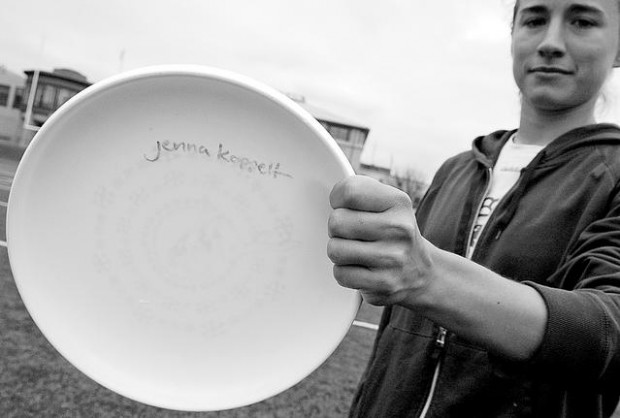
Klain has the answers, and she was happy to demonstrate the three basic Frisbee throws one morning recently at Carnegie Mellon's stadium.
First, there is the standard backhand. The key, she said, is to grip the disc tightly, fingers curled under the lip of the disc, thumb on top. That will ensure a good spin, which is critical to the Frisbee's flight path.
Many people make the mistake of putting their index finger on the leading edge of the disc in an attempt to keep it level, she said, but that just acts as a brake on its velocity.
Second is the forehand flip. In this throw, the index and middle fingers are extended under the rim, with the thumb on top and the other two fingers curled into the palm. The crucial movement on the forehand flip is sharply flicking the wrist, she said.
Finally comes the hammer, an overhand throw least likely to be used in recreational Frisbee. Designed to get the Frisbee over top a defender, it is gripped the same way as the forehand flip, but the Frisbee starts out in a vertical position next to the thrower's face.
Done correctly, it ends up rotating into a flat, upside-down spin. "It's the real crowd pleaser," she said.
Klain has perfected her backhand to the point that she was able to effortlessly fling it 55 yards in the stadium last week. "I really need to get that up to 60 yards or more," she said.
The Frisbee world distance record is currently held by Christian Sandstrom of Sweden, who hurled one about 820 feet (nearly three football fields) in 2002.
The flattest Frisbees can now be thrown so far, Kennedy said, that experienced disc golf players are considering competing on real golf courses, instead of the smaller customized courses they currently use.
Disc golf also has generated nearly 100 different types of Frisbees — thin, flat ones for "drivers," heavier ones for "irons" and smaller, domed ones for "putters."
Aside from these embellishments, though, no one is attempting to alter the basic Frisbee design, the experts said. "I mean, how do you improve on simplicity?" asked inventor Morrison.
"People thought Frisbees were just for hippies running around, and no one really sees the real competitive nature of the sport."
Chris Mogan
Member of Tucson Ultimate, a Frisbee league


