


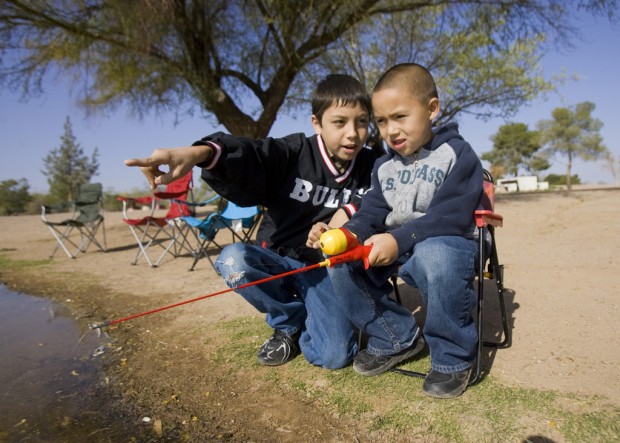
Fishing in Southern Arizona starts with a kid with a Huck Finn bamboo pole, a cork and a worm at an urban pond. At the other end of the experience are guys tying species-specific flies and bass fanatics plowing around rural lakes in expensive boats.
Our part of the state may not have natural lakes, but it has many artificial ponds, small lakes and reservoirs formed by damming creeks, streams and rivers. The Arizona Game and Fish Department stocks four urban Tucson-area lakes - Silverbell, Lakeside, Kennedy and Sahuarita - and several rural lakes, including Rose Canyon, Arivaca, Peña Blanca, Patagonia and Parker Canyon.
The allure of these spots goes beyond the fishing. Water, especially in the desert, almost guarantees an abundance of life. These lakes, small and large, also have populations of birds and other creatures, particularly in the early morning hours - often the best time to fish.
People are also reading…
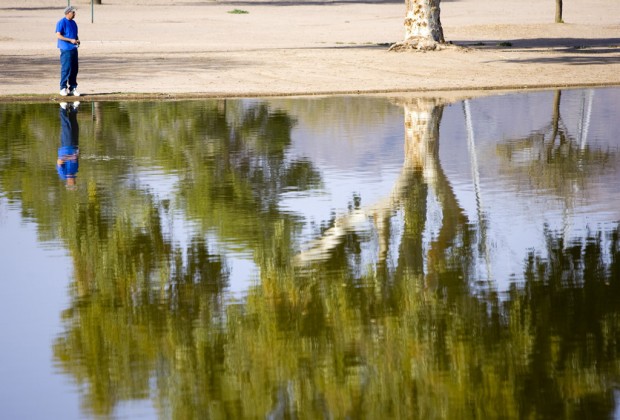
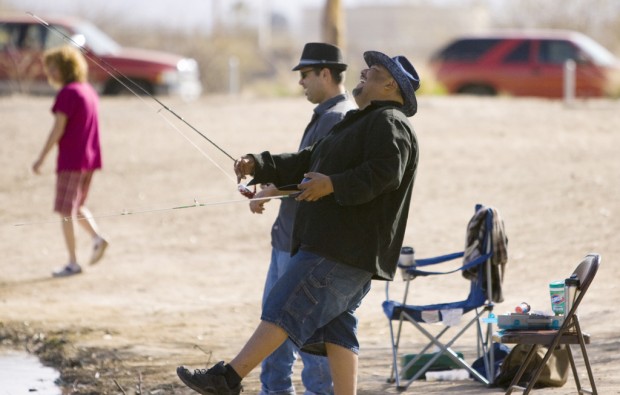
"We come two or three times a month," says Larry Callis, 44, standing in the shade on the edge of Silverbell Lake, cranking his spinning reel to find a fish has helped itself to his bait.
Callis is fishing with an open spinning reel rigged with a sinker at the end of the line, a hook with a nightcrawler about a foot from the end, and another hook with a mill worm about foot above that.
He's had a few bites. Then he reels in a tiny bluegill, not quite hand-sized. Callis holds it up, tosses it back in and flatly declares, "It was about 12 inches," then pauses. "OK, it was a fishing story."
Callis comes with his wife, Annette Briseno, and father-in-law, Gates Briseno. He says his father-in-law, a few feet to his left and within earshot, "tries to out fish me."
Annette Briseno sits in a folding chair reading today. "I just love being outside. I let them sit there and fish and compete."
They won't be dining on what they caught today, but that's clearly not what the outing is about to this fishing party.
"It's easy to get to," Callis says of Silverbell. "You don't have that city effect. It's nature, but you're only 10 minutes away (from home). We like to go to Mount Lemmon (Rose Canyon Lake), but you've got to load up and it's cold up there now."
Later, after it warms up on the mountain and the parking lot closer to Rose Canyon Lake reopens, Callis says they'll make some trips up there.
Across town at Lakeside Lake, near East Golf Links and South Sarnoff roads, John Sebastian, 53, is fishing from the steep banks of the starkly landscaped lake. There's little cover here, not much shade for fishermen nor fish. But the state just stocked the lake the day before and Sebastian's pulled in one decent-sized trout.
The ex-Air Force man says, "I come out about three times a week," but that he's not getting much today.
He's using Power Bait, a brightly colored, dough-like stinky bait that is wadded up in a ball and put on a hook.
"Sometimes I use worms. Depends on what (I'm) fishing for. A lot of times you come just for the sport. But, if they're good-sized, yeah, I take 'em home and eat 'em. I'm from the country, Tennessee. I pretty much eat 'em all, unless they're goldfish."
A couple minutes later two men in a small aluminum boat with an electric trolling motor reel in a 16-18-inch trout, ask if anyone wants it, and come to shore and hand it over to Sebastian.
Nearby, Me Cook says he's had better days at Lakeside.
"Yesterday," he says, "we got the limit when they stocked trout." This is about the end of the trout fishing for the year, at least at the urban lakes, says Cook, 60. The water will soon be too warm for trout in the shallow lakes and he's heard that the next stocking is going to be catfish.
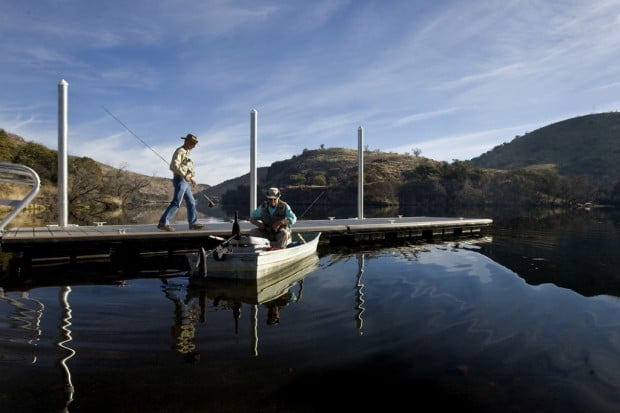
"We've got one of those folding boats, but I think we can catch just as many fish off this dock," said Joe Wilson, after hauling in a foot-long rainbow trout not long after sunrise at Peña Blanca Lake, northwest of Nogales.
Wilson said he and his wife, Sandy Wilson, have fished the canyon lake for many years.
Retirees from Tubac who have fished in many parts of the country, the Wilsons also were using Power Bait.
"You should have been here the other day when we caught 14," Wilson said, adding that they had to throw two away because they'd hit their limit of six trout each.
A few hours at Peña Blanca is more than fishing for Sandy Wilson, who said the rugged, oak-covered hills and wildlife add a lot to the experience. "It's really shocking to come out to a place so beautiful. It's like you took a big vacation."
Fishing in Southern Arizona isn't dull anywhere, despite the artificial bodies of water and stocked populations, says Arizona Game and Fish Department fishing guru and guidebook author Rory Aikens.
Fishermen in Southern Arizona can go from urban ponds within walking distance of their homes to exotic, exclusive fishing experiences high in the mountains.
"There are trout in the Frye Mesa Reservoir on Mount Graham," Aikens said. "Mount Graham is the only mountain in the world where you can catch Gila trout, an endangered species; a native Apache trout, endangered; a brown trout, a rainbow trout and brook trout. It makes it the only mountain on Earth with those five species. We're calling it the Grand Slam of Mount Graham. Anglers are getting excited about it. I'm getting excited about it."
He's high on Peña Blanca, too, which he says has a beautiful, rugged setting and all new facilities, a vast improvement from being what Aikens said was "one of the worst" facilities in the state.
Ultimately, though, Aikens says it isn't fancy facilities or the latest gear that makes fishing a joy for so many.
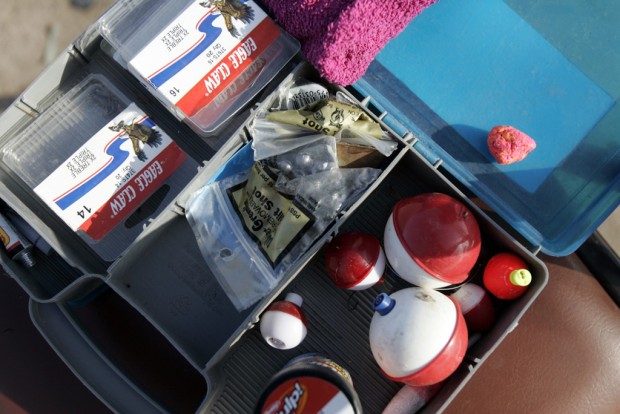
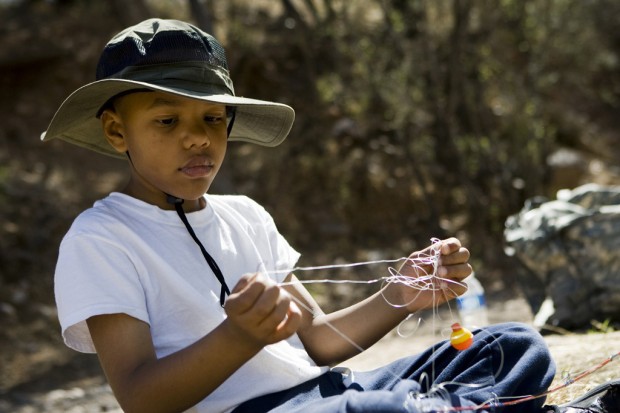
"At its essence, fishing is just a pole, line, hook and bait," says Aikens. "Kids get it automatically. That's the beauty of fishing. It's about a simple as you can get, although guys like me like to make it complicated."
If you go
The Rosie (as in Roosevelt Lake) Fishing Derby
What: An annual fishing tournament benefitting the Special Olympics, sponsored by the Oro Valley Police Fraternal Order of Police Lodge 53. All proceeds from entries and raffles go to Special Olympics. Prizes are donated.
The event brings out families and pairs of fishermen who team up to win prizes for their catch that range from fishing gear to a child's electric ATV.
"I just go and go camping," said Kevin Mattocks, an officer with the Oro Valley Police Department and one of the organizers. "There's usually an entire utility trailer filled with prizes," Mattocks said.
"The neatest part of the whole thing is the huge amount of kids," Mattocks said.
The skill level ranges from serious fisherman with fancy gear and expensive boats, to beginners there for a family camping and fishing weekend.
There is on-site camping near Lake Roosevelt, a big (21,000 acres) reservoir on a dammed-up section of the Salt River within the Tonto National Forest.
When: April 8-10.
Where: Lake Roosevelt, at the Grapevine Group Camping Area, 140 miles north of Tucson.
How much: $90 for a two-person team, includes campsite fee.
Registration/information: www.ovfop53.com
THE URBAN LAKES
Kennedy Lake
3600 S. La Cholla Blvd. in Kennedy Park off South La Cholla Boulevard near West Ajo Way.
The little, 10-acre city park lake is easily accessible and is stocked with seasonal species (trout, bass, sunfish, catfish). It's average depth is only 8 feet, so temperatures are high enough in the warmer months to cut down on all species except the sunfish and catfish.
Licensed small fishing boats and canoes are allowed, but no gas motors.
Lakeside Lake
In Lakeside Park, 8300 E. Stella Road, northwest of the intersection of East Stella Road and South Sarnoff Drive.
Fourteen-acre Lakeside is surrounded by a stark landscape but is a bit deeper (up to 35 feet, average of 15 feet) than the other urban lakes. Trout, bass, crappie, sunfish, carp and catfish are found, though catches, as at most stocked lakes, vary seasonally.
Like the area's other stocked lakes, the trout season is winding down and the next scheduled stocking will be catfish, according to the Arizona Game and Fish Department.
Licensed small fishing boats and canoes are allowed, but no gas motors.
Silverbell Lake
In Christopher Columbus Regional Park, 4600 N. Silverbell Road, west of the Santa Cruz River and north of West Sweetwater Drive.
Silverbell is a scenic lake that's close to the city, but doesn't look it. It's surrounded by trees and is a pleasant place - if you get past the stench from the nearby sewage treatment plant. It's another shallow lake, an average depth of just 5 feet, and the species vary by the month.
It is stocked with catfish for the warmer months, but trout, sunfish, bass and crappie are found there, too.
Licensed small fishing boats and canoes are allowed, but no gas motors.
Sahuarita Lake
15466 S. Rancho Sahuarita Blvd. in the Town of Sahuarita.
The 10-acre lake has a maximum depth of 12 feet. When it gets stocked, there is an encouraging, but probably optimistic, daily catch limit of four catfish, four trout, two bass (13-inch minimum) and 10 sunfish.
Fishing with live bait fish is prohibited.
Boats are permitted, but not gas motors.
Licenses
Anyone 14 years old or older must have a valid state fishing license to fish on public (federal, state, county, municipal) waters within the state, according to a spokesperson for the Arizona Game & Fish Department.
An annual Arizona general Class A fishing license (covers all fish, except trout) is $23.50 for residents, $70.25 for non-residents and covers all public waters within the state, except urban lakes.
An Arizona Urban ($18.50 for residents and non-residents) fishing license or Arizona Super Conservation fishing license ($53 residents/$63 non-residents) is required to fish urban lakes.
An annual trout stamp is $15.75 for residents and $57.75 for non-residents.
A single-day fishing license for residents costs $16.25 and $17.25 for non-residents and does cover urban lake fishing, as well as other state waters.
THE RURAL LAKES
Peña Blanca Lake
Sixty-five miles south of Tucson, about 18 miles northwest of Nogales. From Tucson take Interstate-19 south about 53 miles to exit 12 and turn right (west) at the bottom of the ramp on AZ-289 and follow directions about 10 miles to lake.
This 45-acre lake, in a rugged dammed-up canyon west of I-19 in the Coronado National Forest, was drained a few years ago because of pollution, cleaned out and refilled. It has a new boat ramp and docks.
Peña Blanca is unusually deep for a Southern Arizona lake - an average depth of 65 feet - and is regularly stocked by the state with catfish in warmer months and trout in the cooler months. Boats with gas-powered engines are allowed. It's at about 4,000 feet elevation, in the foothills of Pajarito Mountain, and is usually a bit cooler than Tucson. An Arizona fishing license is required.
It can be a very quiet place on a weekday morning, or packed on holidays and weekends. Wildlife - birds, coyotes, javelina and other indigenous desert creatures, drawn to the water - abound.
Patagonia Lake (Sonoita Creek State Natural Area)
Seventy miles south of Tucson. Take Interstate-10 east to Exit 281/Arizona 83 south. Go 25 miles and turn right onto Arizona 82 west, through the town of Patagonia and continue west another 7 miles and turn right into Patagonia Lake State Park.
There is a park entrance fee for Patagonia Lake of $10 for a car with one to four occupants or $3 per person.
Patagonia Lake has one of the largest varieties of fish in the state. Largemouth bass, channel and flathead catfish, crappie, bluegill, red-ear and green-ear sunfish and rainbow trout are listed by the state as being found there.
The national record green sunfish - a 2.5 pounder - was caught at Lake Patagonia a couple years ago by a 10-year-old Tucson boy fishing from shore, said State Parks spokeswoman Ellen Bilbrey.
The irregularly shaped lake has a marina with a dock for launching boats, a visitor center, camping facilities including restrooms, a convenience store and boat rentals.
An attractive, high-arched foot bridge crosses the inlet to the marina. On a recent visit, one could spot fairly large fish, as well as schools of juveniles, lurking in the weeds from the bridge.
Patagonia Lake is also a hit with hikers and birders. A list posted on the Sonita Creek State Natural Area visitor center near the lake listed 83 bird species spotted in the Sonoita Creek State Natural Area in just two weeks - between Feb. 28 and March 14. The list included several species of hummingbirds, flycatchers, vultures, osprey, an oriole, elegant trogan, warblers and wrens.
Rose Canyon Lake
Take Catalina/Mount Lemmon Highway to milepost 17 and look for turnoff to Rose Canyon Lake.
Arguably the most scenic lake in Southern Arizona, Rose Canyon Lake is 7,000 feet in the Santa Catalina Mountains just over an hour's drive and about 32 miles from midtown Tucson, in the Catalina Ranger District of the Coronado National Forest.
The seven-acre lake is popular, especially in the summer, as it's usually at least 10 degrees cooler than Tucson.
The lake is stocked with rainbow trout. No boats are allowed.
There's an $8 parking fee.
Drive-in access to the lake opens April 15.
Arivaca Lake
Sixty miles south of Tucson in the Nogales Ranger District of the Coronado National Forest. Take Interstate-19 south to Exit 48 for Arivaca Road, follow West Arivaca Road for 21 miles and follow signs to the lake, approximately 8 miles.
A bit remote, and with almost no facilities, 90-acre Arivaca Lake is one of the prettier of Southern Arizona's lakes. Largemouth bass, sunfish and channel catfish are commonly reported catches. It's surrounded with big trees and set in beautiful country south of Green Valley and west of I-19.
Boats and canoes are allowed, but gas motors are prohibited. The roads are rough and unpaved around the lake.
Parker Canyon Lake
Eighty miles southeast of Tucson. Take Interstate-10 east to Exit 281/Arizona 83 and travel 26 miles south to Sonoita, turn left to stay on Arizona Arizona 83 and go 28 miles to Parker Canyon Road and continue one mile to lake.
Parker Canyon - in the Canelo Hills of the Sierra Vista Ranger District of the Coronado National Forest - is larger (130 acres) and higher (5,380 feet), and so cooler, than most Southern Arizona Lakes.
Stocked rainbow trout and resident largemouth bass, channel catfish and sunfish are found in the lake.
It's one of the most popular of Southern Arizona's lakes with serious fishermen.
There is a fishing pier and boats with small motors (a single 10 horsepower or less) are allowed. There's a paved boat ramp, restrooms and drinking water and a small store. There's a concessionaire marina that rents powered and unpowered boats.
There is no entrance fee, but a $10 per night fee for a camping site.
Where to find conditions, stocking reports
Additional sources of information:
You can download fishing regulations, see stocking schedules, learn about the conditions at the state's lakes and find out about programs at the Arizona Game & Fish Department's website, www.azgfd.gov
Click on the "Education" link for information on Arizona Game and Fish Department fishing education programs.
The U.S. Forest Service offers information on the lakes in the Coronado National Forest by going to its national website, www.fs.fed.us, and following links to "Coronado," "Recreation" and "Lakes."
Contact reporter Dan Sorenson at dsorenson@azstarnet.com or 573-4185.


