

FLAGSTAFF - Stop for a Diablo Burger in the center of this city's revitalized downtown and you'll find that even the burger joints have an environmental vibe, serving meat from local ranches committed to sustainable grazing and stewardship practices.
The restaurant suggests that you order your lean, grass-fed beef cooked rare and chase it down with a regionally brewed beer.
Flagstaff, in the middle of a massive ponderosa pine forest, sits at 7,000 feet, beneath the towering San Francisco Peaks, 250 miles north of Tucson.
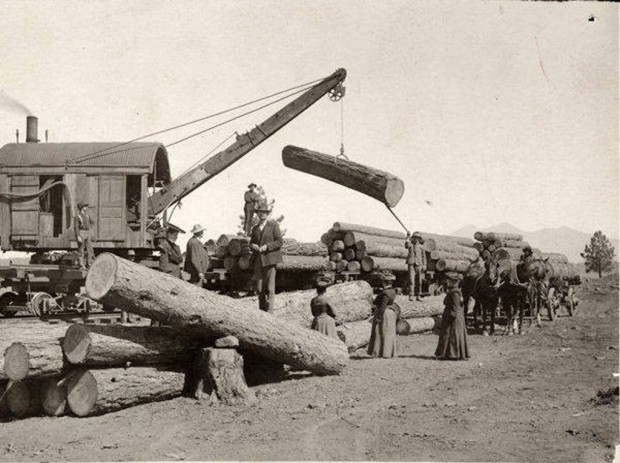
It prides itself on being green and sustainable, which is somewhat ironic in a place founded on exploitation of vast hay fields for sheep and cattle and the denuding of its pine forests for what was once the world's largest mill town.
But Flagstaff managed to outlive its extractive past.
People are also reading…
Unlike towns founded on industries that later declined or died, Flagstaff used its location along the continental railroad and, later, Route 66 to keep its tourism industry rolling.
It further prospered by cultivating science and education, and managed to avoid the runaway growth of less desirable places, though its 24 percent increasein population in the last decade has some of its residents concerned.
Flagstaff at statehood
Flagstaff was already a place of bright promise in 1912, when Arizona became the 48th state.
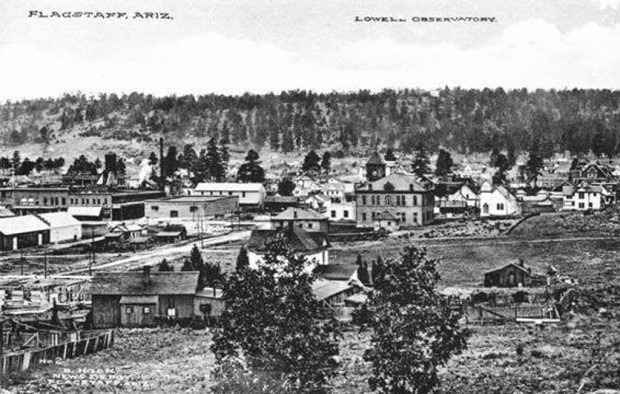
The Atlantic and Pacific Railroad had arrived in 1882, preceded by the first of three large lumber mills. It became the seat of government for newly created Coconino County in 1891. Percival Lowell chose it as a site for his astronomical observatory in 1894. The Territorial Legislature created the Northern Arizona Normal School in 1899.
Most homes had running water, and many were wired for electricity. A brick "new town" was mostly built, beside the railroad tracks. Cattle ranchers had joined the sheepherders in the area's grasslands.
Its population in the 1910 census was 1,663.
The early days
Settlers had begun moving through this stretch of Northern Arizona shortly after Lt. Edward Beale blazed an east-west road in 1857. Most were headed for California.
Nearly 20 years later, some sheepherders, remembering the lush grasses of the region and stung by three years of drought in California, backtracked to set up ranches.
When a party of travelers - "the Second Boston Party" - came through on July 4, 1876, they celebrated the nation's centennial by delimbing a tall ponderosa pine and nailing an American flag to it.
Next, in 1880, came the railroad crews and the contractors who followed them. A community was set up and in 1881, when it was given a post office, it was named "Flag Staff." "Flag Pole" was a consideration.
For a brief time, Flagstaff was as rowdy as any Western town, said local historian Richard Mangum, with saloons, prostitutes and gambling to serve the 2,000 railroad workers, along with growing populations of mill workers and cowboys.
Lumber takes over
The mill workers would remain when railroad construction was completed. The Riordan Brothers of Chicago bought out original mill owner E.E. Ayer and continued to harvest timber from the world's largest ponderosa pine forests. Swaths had been given to the railroad as an incentive. Later, the Riordans would buy timber rights from the Coconino National Forest, created in 1908.
Two brothers, Tim and Michael Riordan, owned and operated the mill. They married the Metz sisters (cousins of the Babbitts) and built a home together - matching stone and wood mansions, joined by a common area where their two families would gather each evening. It was designed in Arts and Crafts style by Charles Whittlesey, who designed El Tovar hotel at the Grand Canyon.
It is now Riordan Mansion State Historic Park.
The Riordans, in lumber, and the Babbitt brothers, in cattle and trading, helped Flagstaff advance beyond a mill-town whistle stop on the continental railroad, said Mangum. The Riordans built the first hospital and the electric company. They lured Percival Lowell and the observatory that still bears his name and lobbied for the normal school that would eventually become Northern Arizona University. They created a permanent source of water with the dam that created Lake Mary, named after Tim Riordan's daughter.
It was a "paternalistic" arrangement, said Kathy Farretta of the Museum of Northern Arizona. The Riordans were known for treating their workers fairly and promoting civic life.
Their business model was a bit more cutthroat, said research anthropologist David Willcox: "You cut down the trees as fast as you can and you make a lot of money."
Tourism sustains
"The thing that is misunderstood about Flagstaff is that it's always been a tourist town," said Leslie Roe, director of the Pioneer History Museum and Riordan Mansion.
Roe doesn't discount the profound effect of cattle, sheep and lumber on Flagstaff's early development, but he points out that those things rose and fell in importance over the years and tourism was a constant.
In its earliest days, Flagstaff was the gateway to the Grand Canyon. The railroad, in an effort to attract passengers to an under-subscribed section of its line, threw in a stagecoach ride to the South Rim with each ticket. The Coconino Cycling Club organized rides that took a day and a half to complete.
Beale Road became part of Route 66 in 1926 and motor tourism took over. Remnants of that pre-interstate era remain along Route 66 through town, with many of the motel and service stations signs now refurbished and "historic."
These days, more modern hotels and resorts attract visitors, especially in summer, when an army of Phoenicians makes the quick jaunt up Interstate 17 each weekend.
The university leads
In 1965, Flagstaff's former normal school became a full-fledged university. The impact of Northern Arizona University and its 20,000 or so students, faculty and staff cannot be overstated.
To have a proportional impact on Tucson, the University of Arizona would need a population of 200,000.
Flagstaff is a university town and its university both reflects its traditions and sets its tone. Its mascot is a Lumberjack.
NAU is heavily invested in the study of forests, natural resources and sustainability.
Its Applied Research and Development Building, designed by Tucson's Burns Wald-Hopkins Shambach Architects, earned a "platinum LEED rating" and three other recent buildings met the gold standard. It is not a campus, or a town, where you would think about tossing that plastic bottle in the trash - or drinking from a plastic bottle in the first place.
Urban bike paths traverse the campus, ring the city and lead to longer trail rides outside it.
Environmental activism is readily apparent.
On an evening this summer, as patrons enjoyed their sustainable Diablo Burgers in a downtown courtyard, demonstrators marched through the streets, demanding an end to plans to spray snow made from wastewater on the sacred San Francisco Peaks.
Contact reporter Tom Beal at tbeal@azstarnet.com or 573-4158.


