

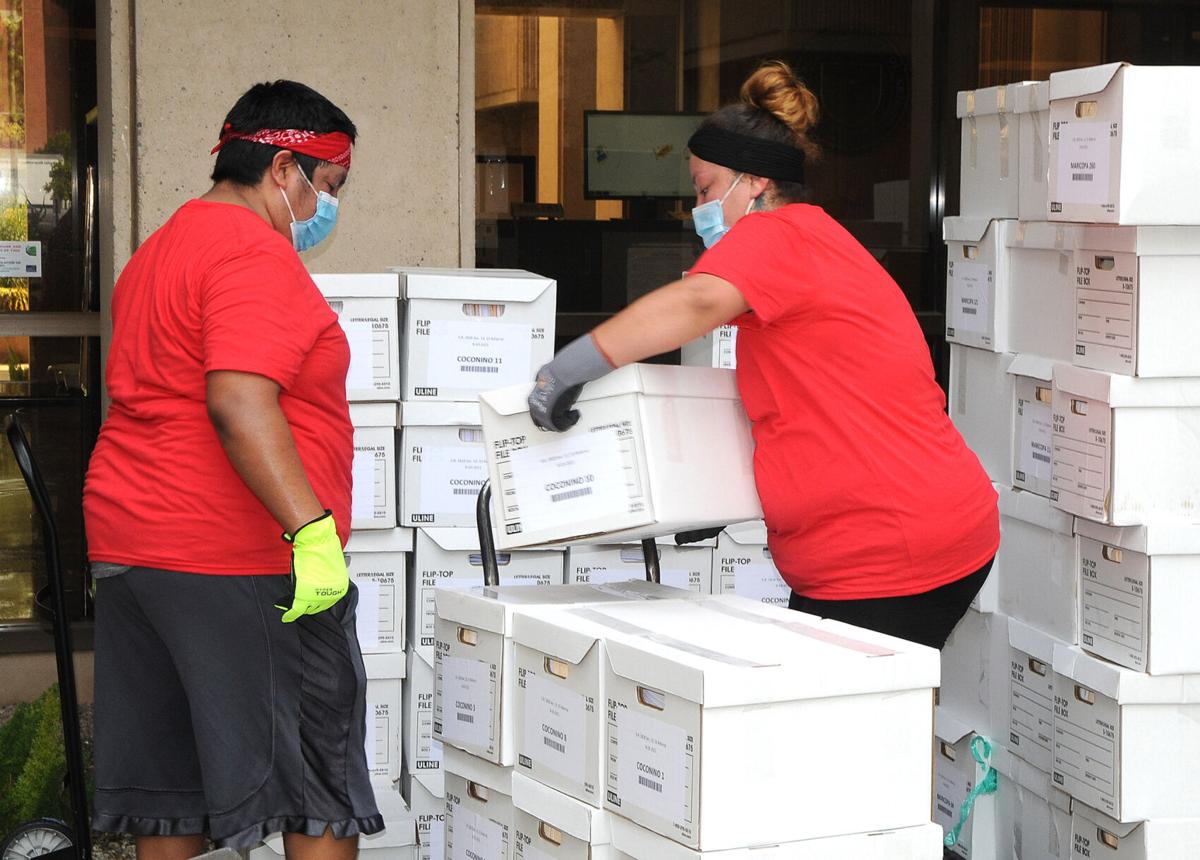
PHOENIX — Petition-circulating companies are allowed to pay workers a bonus based on how good they are at gathering signatures, without violating state law, the Arizona Supreme Court ruled Wednesday. But they can’t pay on a per-signature basis.
In a unanimous decision, the justices said there’s nothing inherently unconstitutional about a 2017 state law approved by the Republican-controlled Legislature making it a crime to pay circulators on a per-signature basis. Justice Clint Bolick said there is a basis for such a restriction because paying people based on how many signatures they turn in may be susceptible to abuse.
But the high court rejected arguments by former Attorney General Mark Brnovich that the 2017 law also prohibits any form of payment that provides incentives for circulators to gather more signatures. Instead, the justices said the law is violated only when circulators are compensated based solely on how many signatures they collect.
People are also reading…
“As we clarify here, the statute forbids on per-signature compensation, leaving other productivity-based compensation intact,’’ wrote Justice Clint Bolick for the court.
Brnovich had brought criminal charges under the law against a company named Petition Partners.
Drew Chavez, the company’s owner, acknowledged the ruling does remove one tool that firms like his have used in the past to hire and compensate circulators. But he called Wednesday’s ruling a significant victory, not just for petition-circulating companies, but also for their clients who, lacking sufficient volunteers to collect hundreds of thousands of signatures, hire them to help place issues on the ballot for voters to consider.
Initiative successes in Arizona
Initiatives provide an avenue for Arizona voters to craft their own measures that lawmakers won’t enact.
That process paved the way for medical use of marijuana and, more recently, allowing marijuana to be possessed for recreational purposes.
It was only because of initiatives that Arizona has a minimum wage of $13.85 an hour versus the $7.25 figure in federal law.
The process has also led to things like a ban on leghold traps, snares and poisons on public lands; and to the outlawing of cockfighting in the state.
“This is so good for Arizona because they (lawmakers) were really close to wiping this industry off the map in Arizona,’’ Chavez said of the ruling. He noted that Brnovich brought 50 individual criminal charges against his firm, which could have resulted in a $5 million fine.
He also said the law could have been used against not just firms that hire petition circulators, but the circulators themselves, subjecting them to a potential year in jail and a $20,000 fine for each offense.
“And if a circulator gets charged then it’s over because no one’s going to want to do the business,’’ Chavez said. “And that was the whole point from the very beginning, of trying to scare people.’’
A spokesman for current Attorney General Kris Mayes said the office is still studying the decision.
The 2017 law was proposed by then-Rep. Vince Leach, R-Tucson, at the behest of the Arizona Chamber of Commerce and Industry. Leach, during his time at the Legislature, authored several measures designed to create new hurdles for individuals to exercise their constitutional rights to propose their own laws.
It does not make it illegal to pay people to gather signatures. But it spells out that payment cannot be on a per-name basis, the method that, until that time, had been used by companies to encourage people to get as many signatures as necessary to qualify measures for the ballot.
“It reforms the incentive for fraud and forgery,’’ Leach said at the time.
His measure applies only to ballot measures, however. It does not limit how political candidates can pay petition circulators.
Charges brought against company
All this became an issue when Petition Partners was hired to put Proposition 208 on the 2020 ballot.
That measure, which voters eventually approved by a margin of 51.7% against 47.3%, sought to impose a 3.5% surcharge on incomes of more than $250,000 for individuals and $500 for couples, to raise about $900 million a year for K-12 education. That initiative eventually was voided by the state Supreme Court for other reasons.
After the voter approval, Brnovich brought charges against the company for programs known as “Duel for the Dollars’’ and “Weekend Warriors.’’ He said they violated the law because circulators could get extra payments of $20 to $150.
In a ruling last year the state Court of Appeals voided criminal penalties for anything that sounded like compensation based on signatures.
The judges brushed aside claims by Brnovich that the law is needed to reduce the possibility of fraud in gathering petition signatures. Appellate Court Judge Michael Brown cited already existing laws against forgery and bans against signing a petition for profit.
“And, of course, signatures obtained in violation of Arizona’s initiative process laws are void and thus not counted toward the validity of an initiative,’’ the judge said.
But Bolick, writing for the Supreme Court, said Wednesday that the Court of Appeals, in voiding the 2017 law in all its possible forms, was using an overly broad reading of the statute.
Instead, he said, it is only necessary to look at the wording of the law: A person shall not pay or receive money or any other thing of value based on the number of signatures collected on a statewide initiative or referendum petition.
Bolick said it applies only to a fee-per-signature compensation, and not to anything else that might provide an incentive to circulators. That limited restriction does not infringe on First Amendment rights, he said.
To back that up, he cited a ruling last year by a federal appeals court upholding a Montana law which, like the one at issue here, bans per-signature compensation.
“The court held that prohibiting payment by the signature furthers Montana’s important regulatory interest in preventing fraud in the initiative process,’’ Bolick wrote. “It reasoned that by merely banning one type of payment scheme while leaving numerous other options available the law does not impose a severe burden on First Amendment rights.’’
Lee Stein, an attorney for Petition Partners, said he doubts the new ruling gives Mayes any chance of taking his client back to court and pursing charges of violating the 2017 law based on its incentive program. He said that Brnovich, in his own legal filings, admitted there was no evidence Petition Partners was compensating its circulators on a per-signature basis.
Other hurdles to initiatives
The 2017 law was not the lone effort by Republican lawmakers to impose new hurdles on the initiative process.
This year, for example, they put a proposal on the 2024 ballot that, if approved, will require not just that circulators get the correct number of signatures to propose new laws — 225,867 using current formulas — but that a certain number must be gathered from each of the state’s 30 legislative districts.
That would mean something unpopular in just one legislative district could not be placed on the ballot, regardless of how much support there is in the rest of the state.
Sen. J.D. Mesnard, R-Chandler, who sponsored that proposal, sought by the state Chamber of Commerce, said any measure should have a certain amount of statewide buy-in before going on the ballot.
Get your morning recap of today's local news and read the full stories here: http://tucne.ws/morning
Howard Fischer is a veteran journalist who has been reporting since 1970 and covering state politics and the Legislature since 1982. Follow him on Twitter at @azcapmedia or email azcapmedia@gmail.com.


