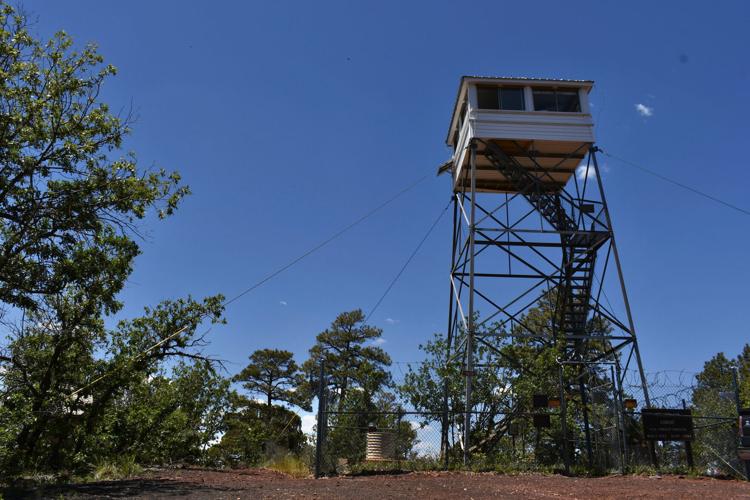
PINETOP-LAKESIDE — On the first day of wildfire season, Jane Croxen drives seven miles from her house down a winding, red-dirt road to a rickety-looking tower on a hill. She ascends the switchback staircase, opens a hatch in the tower’s floor and climbs through.
Inside, panoramic windows overlook the Apache-Sitgreaves National Forests. Smokey Bear — carved into sculpture, cross-stitched onto a pillow, emblazoned on a wooden placard and printed on Croxen’s sweatshirt — peers out at the rolling landscape.
Just as she has every day since her first lookout shift in 1992, Croxen begins with a weather report.
“Wind direction, speed, temperature, relative humidity, dew point,” she said, taking in the blue expanse of sky surrounding her on all sides. She sends the report to a U.S. Forest Service dispatch center via radio.
People are also reading…

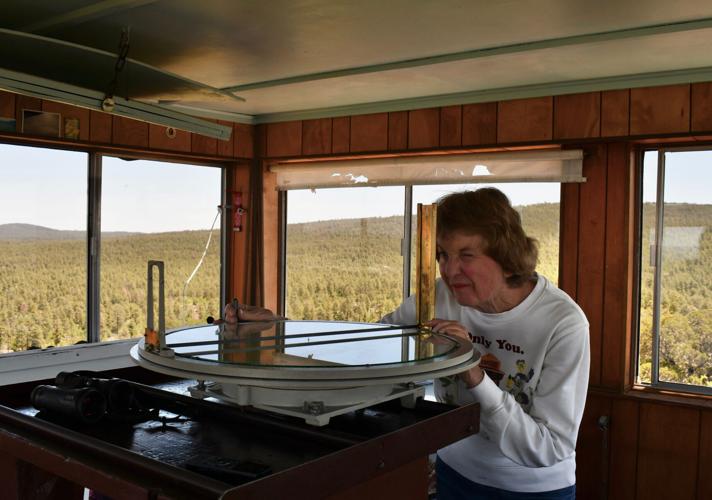
Jane Croxen mans the Springer Mountain fire lookout station last month near Pinetop-Lakeside.
For 34 years, Croxen, a third-generation lookout, has climbed the Springer Mountain fire lookout station, watching for smoke rising up from the horizon.
”I keep an eye on not only what's going on Forest Service land, but I'm right up against private land, too,” she said. Croxen’s post overlooks the nearby towns of Pinetop-Lakeside, cabins nestled in the woods and the Fort Apache Reservation.
She’s one of 24 paid Forest Service fire lookouts in the state, according to Ivan Knudsen, a Southwest communications officer for the agency. Once, the Forest Service employed over 8,000 staffed posts across the country, but advancements in aircraft and satellite monitoring means the agency needs fewer people up in towers. This wildfire season there are only 140 in operation.
Now, artificial intelligence could reduce their numbers further.
This year the Arizona Department of Forestry and Fire Management installed seven new AI cameras, joining over 70 already operated by the state's utilities. The cameras are stationed in remote regions, providing more coverage where there are fewer human eyes. Across increasingly dry and fire-prone forests, Western states are investing in AI as an opportunity for continuous monitoring.
But some fire lookouts worry what the cameras could mean for their future, even while they feel sure they provide a public service far beyond fire detection. Losing lookouts could mean losing outposts to the natural world and to public lands, leaving algorithms to take their place.
AI cameras are watching 24/7
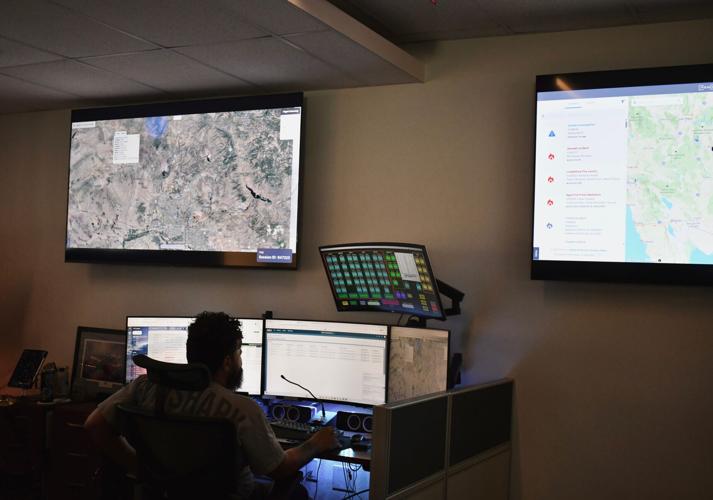
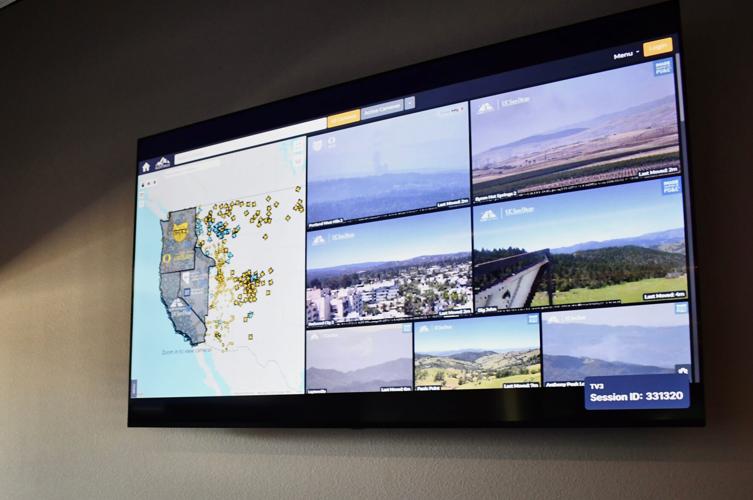
At the Arizona Department of Forestry and Fire Management Phoenix dispatch center, live feeds from AI cameras light the walls of a dark room.
This fire season, the state agency partnered with Pano AI, a California-based company offering artificial intelligence-powered wildfire detection. Currently, the company operates in 17 states, working with local governments, utilities and private landowners.

Dispatchers track live fires last month using AI cameras at the state forestry department in Phoenix.
In Arizona, the new cameras are stationed at seven posts, mostly in areas of high fire frequency but low human accessibility, according to John Truett, the fire manager for the state agency.
AI cameras have a few key advantages over people: They operate 24/7 and year-round. From mountaintop vantage points, Pano’s cameras can see at least a 10-mile radius into the distance, by conservative estimates, according to John Gale, Pano AI’s head of U.S. government affairs.
When a smoke signal is detected, employees at Pano’s intelligence center review it for accuracy. They send it along to their customers who get a text reading “PANO ALERTS.” From there, local agencies decide how to respond.
Pano AI started in 2020. Now, it’s one of dozens of companies using artificial intelligence to prevent and mitigate wildfires. It’s also recently partnered with Western Weather Group, which provides data on wind speed, relative humidity and temperature.
Customers like the state fire agency and APS can use that information to coordinate their response, Gale said. “That facilitates firefighter safety, public safety, and ultimately helps them suppress the fire as quickly as possible and contain it to the smallest geography possible.”
Sometimes, cameras flag signals that end up being dust or fog.
“The AI is trained really well. It can differentiate between those things but sometimes it gets tricked,” he said. “We have it set to alert us for things that may or may not be smoke. We don’t want to miss anything.”
That’s why Pano’s human moderators review every signal before alerting customers. Still, some slip through the cracks. The Phoenix dispatch center has received a few false positives, said Michael Hale, the center manager.
The agency said it's too soon to tell how successful the cameras have been — they’ve only been using them since March. Arizona Public Service and Salt River Project have been using AI cameras for over a year. APS partnered with Pano in 2025. Altogether, the state now has 60 live Pano stations and will likely have 88 by the end of the year, Gale said. SRP uses SmokeD and has since 2023. They have three stations with cameras near Forest Lakes and plan on adding three more locations this year.
Fire watchers are like 'forest sentries'
At 72, Mark Moak is heading into his 44th season as a fire lookout. He spent his first 15 years around Arizona’s Mollogon Rim and the state’s border with New Mexico. Now he works in Montana’s Bitterroot Mountains.
“I don’t know anybody who lives in the woods as much as lookouts,” he said. “We are always watching, we’re always listening on the radio. We are scanning other forests nearby.”
That familiarity gives human lookouts an edge that AI cameras lack, he said.
“There’s a kind of synthesis that happens with lookouts, particularly those who have been there awhile,” Moak said. “You have a sense of what’s going on. You look at this landscape every day.”
Lookouts observe their surroundings in all kinds of conditions — in dappled light and direct sunlight, on overcast days and foggy mornings.
“You tend to notice when something’s different," he said. "It’s almost a sixth sense about things.”

Dispatchers track live fires last month using AI cameras at the state forestry department in Phoenix.
They know how to tell between a dust “rooster tail” and real smoke, said Michael Guerin, a volunteer lookout in the Angeles and San Bernardino National Forests in California. California no longer pays lookouts. Instead, it relies on volunteers to man the posts over the summer.
In 2023, The New York Times reported that Randy Moore, chief of the U.S. Forest Service at the time, told lawmakers the agency was moving away from its lookout program. Instead, he said, the future of wildfire detection is technology.
The current chief, Tom Schultz, has not spoken publicly about the agency’s investment in AI technology or about the future of lookouts.
In an email to The Arizona Republic, Knudsen, the Forest Service communications officer, said paid lookout positions are funded on a forest-by-forest basis at the discretion of the Fire Management Officer.
“While the Forest Service continues to use staffed lookouts where they provide effective coverage, we continue to emphasize investments in wildfire readiness, fuels reduction, and modern detection technologies," he said. "As with many programs, decisions about staffing and maintaining lookouts vary by forest based on geography, risk, current fire danger and available technology."
In Arizona, the Forest Service partnered with APS this past winter, installing 26 AI cameras in and around the Coconino National Forest. Sixteen of those are stationed on fire lookout towers across the three forest districts, Knudsen said, but the Coconino has no immediate plans to replace human lookouts.
Pano has explored the possibility of taking over a few lookout towers, Gale said — but only those that aren't staffed or have been abandoned. He grew up in Idaho, where his mother and great-grandfather worked in lookouts, so he knows those jobs are important.
“ In those circumstances, where there's nobody looking for a fire, having Pano AI up there is better than nothing,” Gale said.
When the Forest Service started its fire lookout program, people staked out the landscape in tall trees with only ladders to scramble up and down. The original intent, Guerin said, was to find smoke that was “no bigger than the size of a man’s hat.” Over time, their role evolved beyond just reporting “smokes.”
Lookouts became something like forest sentries — guarding against disaster and guiding wayward adventurers.
Last year, around 1,000 people visited Croxen’s tower, and 502 showed up at Moak’s more remote outlook in the Bitterroots. Hikers and families stumble upon the stations, which are sometimes the only shelter for dozens of miles. Lookouts offer first-aid to injured visitors and give directions to lost travelers — including firefighters navigating their way to active burns.
“We are the overwatch for first responders,” Guerin said, recalling a time that he redirected a truck-full of fire crew members heading down the wrong road. “Without me, or somebody like me, there’s valuable time that could be wasted.”
Out on the Bitterroot, Moak considers himself an “ambassador” for public lands. Lookouts engage with visitors about why national forests are important and educate them on the places they’re exploring.
That role could be increasingly coveted as funding for public land agencies is slashed, environmental protections are rolled back and public land agencies undergo unexpected shake-ups.
Looking for a balanced approach in fighting fires
Federal agencies have been slower to adopt the new artificial intelligence technology, Gale said. That could leave gaps in coverage — the federal government manages most of the public land in the country under the Department of the Interior and the Department of Agriculture.
Since President Donald Trump took office again, public land agencies have seen significant changes in funding and wildfire management.
Last year, budget cuts and layoffs left the Forest Service operating at a reduced capacity. In January, The Republic reported that among the 5,860 workers who left the agency because of deferred resignations, terminations and early retirements, 4,500 worked in firefighting roles. In 2025, an estimated 35% fewer acres were treated for hazardous fuels last year compared to 2024, according to recent analysis from NPR.
That’s left forests more prone to catastrophic fires.
In September, Interior Secretary Doug Burgum signed an order directing the creation of a unified wildfire agency — the U.S. Wildland Service. Where Interior used to oversee firefighting for the National Park Service, the Bureau of Land Management, the Fish and Wildlife Service and the Bureau of Indian Affairs, it’s now consolidated that responsibility under one roof as a response to increasingly extreme wildfires across the country.
This year, during what’s anticipated to be a significant fire year in many parts of the country, the federal government is changing tactics, using the newly created agency to emphasize fire suppression.
But scientists and ecologists are asking for a more balanced approach.
”In the United States, we have a long history of being suppression-forward in our response to wildfire, meaning we focused on putting fires out wherever they start,” said Jessica Blackband, a senior manager of environmental and climate policy at the Federation of American Scientists. “Over time, this has resulted in an accumulation of fuels on the landscape, which has actually increased fire risk in a lot of ecosystems, especially in forests in the West.”
Fires have become more frequent and severe. They’ve also become harder to manage, she said.
“Our understanding of the science and our understanding of the policy space is that we are over-investing in suppression and under-investing in reducing the risk of fire,” Blackband said, which means prioritizing other kinds of risk reduction work like prescribed burns.

Jane Croxen, a third-generation fire lookout, peers through her firefinder at Springer Mountain last month.
Pano’s cameras aren’t just a fire suppression tool, Gale said, they are also a preparedness and mitigation tool.
While AI can be used to respond quickly to flare-ups in forests and suppress fires, it could also be used to track patterns in ignitions over time, Blackband said.
In January, Congress denied the administration’s request for $6.5 billion to fund the new Wildland Fire Service, which might be one reason why the federal government hasn’t invested in AI detection tech yet, Gale said — even though it’s expressed an interest.
In an email to The Republic, a press officer for the Wildland Fire Service said that the new agency is focused on understanding which tools genuinely improve early detection and support its mission — but it plans to use new technology, including remote detection cameras.
The president’s 2027 budget proposal cut overall funding for Interior even further by 13%. Still, it sets aside nearly $1.4 million for wildfire suppression resources and around $850,000 for fuel reduction.
Even as artificial intelligence can improve how we detect wildfires, Blackband said, fire managers need to match the right tool to the problem. In many places, there’s a lack of fundamental data about the way fire moves through a community, she said. Without that data, using artificial intelligence tools effectively could be difficult.
If there is a fire on the mountain and no one is around to see it…
Over the last century, lookouts have become part of the fabric of the landscape. Moak doesn’t think they are going anywhere.
“They are still a substantial part of the West,” he said. They inspired writers like Jack Kerouac, Norman Maclean and Arizona’s own Edward Abbey.
Abbey might be the state’s most famous lookout, but he wasn’t always well-suited to the task.
“Today, this afternoon, this hour, I am in a blue funk of loneliness and boredom,” he wrote while working in the Coronado National Forest in 1966, according to archived journal entries at the University of Arizona’s Special Collections Library. “I can easily understand why solitary confinement is the cruelest of all tortures.”
In between musings on the “big issues” in his life, he marveled at the forest around him.
“Woke up this morning on an island in the sky surrounded by clouds,” Abbey wrote in 1968. He noted golden eagles flying beneath his windows, infestations of ladybugs and rumors about mountain lions.
Sometimes his writing detracted from his lookout duties.
”Whether (Abbey) was even in the tower, no one could say. He was a writer, and the only smokes he reported were the ones in his novels,” fire historian Stephen Pyne wrote in his 1989 autobiography “Fire on the Rim.”
But being a lookout gave Abbey a proximity to nature that fueled his writing, including various essays and his novel “Black Sun,” set around the Bright Angel Lookout on the Grand Canyon’s North Rim, where he worked for four seasons.
Unlike Abbey, Moak doesn’t mind the solitude. He also thinks that the competition between AI and lookouts is a “false dilemma.”
Technology has always been a part of the job, he said. Before it was cameras, it was crank telephones, radios, fire finders and thermo-hygrographs, which he described as “like an old piece of steampunk machinery.”
Still, he said, he would challenge any AI camera to a season-long duel.