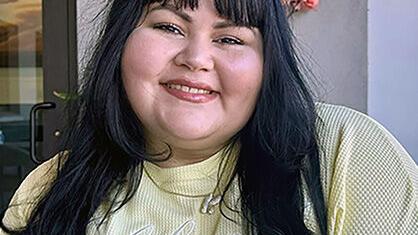
A 71-year-old great-grandmother was released from federal immigration custody on Friday, after spending more than 10 months locked up at the detention center in Eloy.
Maria Cristina Tapia Cornejo, an undocumented immigrant from Mexico, was released the day after The Arizona Republic published a story online about her prolonged detention and how ICE officials had refused numerous requests from family members and religious leaders that she be released on humanitarian grounds, considering her age, her many years of living in the United States, and her declining memory.
She is deaf in one ear and partially deaf in the other, family members said.
Tapia Cornejo was dropped off just before 1 p.m. at a Phoenix church, where a daughter, a grandson and a granddaughter had been waiting with bouquets of flowers for her to arrive.
People are also reading…
Wearing gray detention garb and black sneakers with no laces, Tapia Cornejo, looking frail, exhausted, and unshowered, strolled weakly off the van onto the church property.

Maria Cristina Tapia Cornejo hugs her daughter, Maria Jaynet Cardenas Friday at Mount of Olives Lutheran Church after being released from the a federal immigration detention center in Eloy after 10 months. Looking on are her granddaughter, Edith Lopez, and Iracema Paredes, who had been held at the same detention center.
Her daughter, Maria Janet Cardenas; grandson, Brian Lopez, 22; and granddaughter, Edith Lopez, 17, rushed forward and enveloped Tapia Cornejo in their arms, all of them breaking into sobs. Tapia Cornejo wore a thick black GPS tracking monitor placed on her right ankle by ICE officials before her release.
Also there to welcome Tapia Cornejo was a 44-year-old former detainee named Iracema Paredes, who said she had become close with Tapia Cornejo during the more than six months they were locked up together at the 1,500-bed Eloy Detention Center, about 50 miles north of Tucson. Paredes had been released about a month earlier.
"This is a miracle," Paredes told Tapia Cornejo in Spanish as the two embraced.
In an interview inside the church, Tapia Cornejo said three or four detention officers came to her cell about 9 p.m. Thursday, May 28, and asked for her address because she was going to leave.
But it wasn't until the next morning on Friday, May 29, when detention officers returned at 4:30 a.m. that she believed she was actually leaving after so many months.
When she shared the news with her fellow detainees, "they all began to cry," Tapia Cornejo said, fighting back tears. "We cried and cried."
Tapia Cornejo was working as a dishwasher at the Colt Grill restaurant in Cottonwood in northern Arizona on July 15, 2025, the day federal immigration enforcement officers carried out an operation at the restaurant and three other Colt Grill locations in Yavapai County and a fifth location in Foley, Alabama.
Tapia Cornejo was one of 22 undocumented workers swept up in the raid by Immigration and Customs Enforcement and taken into custody for being unlawfully present in the United States, a civil violation under federal immigration laws.
The main targets of the immigration raid were husband-and-wife owners of the restaurants, Robert and Brenda Clouston, who were arrested on multiple criminal charges accusing the couple of conspiring to smuggle undocumented immigrants from Mexico to work at their popular restaurants at below minimum wage and harboring them in apartments they owned.
After pleading not guilty, they were released last July on their own recognizance and are awaiting the start of their trial, now set for November. A federal judge had granted Robert and Brenda Clouston's requests to travel out of Arizona on five separate occasions to care for relatives in California and tend to business matters in Foley, Alabama.
Meanwhile, Tapia Cornejo had remained locked up at the Eloy Detention Center since last July. Tapia Cornejo has lived in Cottonwood for more than 25 years, and has four adult children in the United States along with 18 grandchildren and one great-grandchild, most of whom live in Cottonwood, said a daughter, Carina Cardenas, 31.
ICE officials did not immediately respond to a request for comment, including why Tapia Cornejo was released Friday, May 29, the day after The Republic's article was published.
ICE officials previously said an immigration judge on Jan. 16 at the Eloy Detention Center ordered her deported to Mexico. Tapia Cornejo filed an appeal to the Board of Immigration Appeals. ICE officials said she would remain in ICE custody pending her appeal, and told family members she did not qualify for humanitarian parole because of a final order or removal.
Tapia Cornejo was previously encountered at the Nogales port of entry around Sept. 5, 2000. She was arrested for violating U.S. immigration laws and removed to Mexico that same day, ICE officials said.
At some point after that date, Tapia Cornejo re-entered the United States without admission or parole, a felony, ICE officials said previously.
Legal service providers said Tapia Cornejo was among an alarming increase in older and medically vulnerable immigrants without criminal records who have been detained for long periods under the Trump administration's mass deportation campaign, resulting in a rise in deaths of immigrants in ICE custody.
Under previous administrations, older people or people with medical conditions were not detained or were routinely released on humanitarian parole, legal service providers said.
More than 60,000 immigrants were detained as of April 4, up 52% since January 2025.
Tapia Cornejo was one of 11 detainees dropped off at the Phoenix church on May 29 after being released from the Eloy Detention Center and the Central Arizona Florence Correctional Center, both run under a contract with ICE by the for-profit CoreCivic private prison company.
Among them was a 53-year-old Maria de la luz Monzon Gaxiola, who sat at a table shaking noticeably. Her daughter, Marisol Monzon, 20, who came to pick her up, said her mother has Parkinson's disease.
She also takes medication for a thyroid issue and high blood pressure, said another daughter, Sarahi Monzon, 26.
Monzon said her mother told her she received her medications while at the Eloy Detention Center, but sometimes the medications were not given on time.
"It should be every four hours. Sometimes she'd mention she gets it every five to six hours," Sarahi Monzon said. "So when that would happen, she'd get very weak, and start shaking. She's never used a wheelchair out of here, but when she was in there, she would have to use a wheelchair."
Marisol Monzon said her mother had been detained for one month and two days after she was arrested by the Border Patrol in April. Monzon, a U.S. citizen, said she and her parents were on their way to their home in Gila Bend with a car full of cushions after a shopping trip when they were stopped.
Monzon said her mother and father were both taken into custody even though they lived in the U.S. for 30 years, have no criminal records, are in the process of legalizing their immigration status and have work permits.
"Even having the right documentation, having employment authorization, they still detained them," Monzon said. "And the Border Patrol even mentioned that with this process, it would take one to two days to verify the process and they will be able to be free. Well, that was not the case."
Her father was released on Saturday, May 23, from the same facility. Both were released after their family filed habeas corpus petitions in federal court seeking to force ICE to release them, Sarahi Monzon said.