Law enforcement agencies across Arizona conducted more than 110,000 searches of a license plate reader database operated by Flock Safety without purchasing the company’s cameras or holding paid contracts with the company, according to an AZCIR analysis of search logs and government records.
The findings reveal how agencies can quietly access the largest nationwide license plate camera network with little public input or oversight. That access allows officers to search vehicle records far beyond their own jurisdictions, significantly expanding their ability to track people’s movements.
Flock Safety has faced growing scrutiny over how agencies collect, share and search information from the company’s more than 120,000 cameras after some officers misused the system to track romantic partners and stalk strangers. The backlash has led at least 11 agencies in Arizona alone to cancel their Flock contracts and prompted Arizona Attorney General Kris Mayes to investigate the state’s use of license plate readers.
People are also reading…
Yet AZCIR found that at least eight Arizona law enforcement agencies, from police in Phoenix to sheriff's offices in Yavapai and Pima counties, gained access to Flock’s network through no-cost deals with the company or through other agencies.
In some cases, Flock approached law enforcement agencies directly and offered free access to its database, officials told AZCIR.
The network also includes cameras owned by private businesses and community groups that have opted to make their Flock data available to law enforcement.
To tally the searches, AZCIR analyzed roughly four years of Flock audit logs obtained via public records requests and compiled by the website Have I Been Flocked. The total is likely a significant undercount because the website only has logs from a fraction of the agencies using the system.
“(Law enforcement) can backdoor a whole surveillance network,” said Dave Maass, head of investigations at the civil liberties nonprofit Electronic Frontier Foundation.

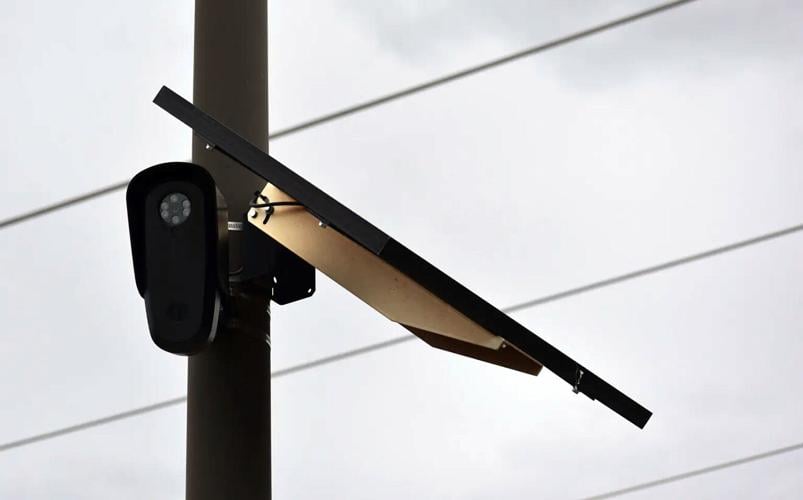
Arizona law enforcement agencies searched data off of Flock Safety’s license plate reader, like this one pin Scottsdale, more than 110,000 times without paid contracts, an AZCIR investigation found. Critics say the practice raises privacy and public oversight concerns.
Critic: Flock agreements a 'massive loophole'
The Phoenix Police Department accounted for more than 100,000 of the searches AZCIR identified statewide, with an estimated 200-plus officers accessing Flock’s network under a no-cost agreement that never went before the City Council.
Then-Phoenix Police Chief Jeri Williams signed the memorandum of understanding with Flock Safety on June 21, 2021, despite Phoenix Police already having license plate reader cameras from Motorola Solutions and access to the company’s national lookup tool, Vigilant.

A city spokesperson said Flock cameras helped police solve missing persons cases and violent crimes, including murders. Police used Flock cameras to identify suspects accused of shooting a police officer, for instance, and to locate a suspect in a shooting outside city limits, the spokesperson said.
The department chose not to renew its agreement with Flock this summer but continued to search the database for months after the agreement expired. The spokesperson said Flock was slow to remove the department’s access, adding that the company has since done so.
Sen. Lauren Kuby, a Democrat who represents parts of Maricopa County and greater Phoenix, called these agreements a “massive loophole” that reflects “a breakdown in basic transparency.”
“Any agreement that lets an agency track where people go should require open public debate and a vote by elected leaders—period,” Kuby said.
Phoenix Mayor Kate Gallego and city council members did not respond to repeated requests for comment.
At least three other agencies—Yavapai County, the Maricopa County Attorney’s Office and police in Pinetop-Lakeside—signed similar no-cost agreements with Flock, giving the agencies search privileges for five years.
Chad Marlow, senior policy counsel at the American Civil Liberties Union, said he’d never come across arrangements like these in his work on privacy, surveillance and technology issues. He questioned whether Flock was trying to build relationships with potential customers by “giving away people’s data for free,” which he called “extremely troubling.”
“It's magnifying the risk, and it's magnifying the privacy violation,” he told AZCIR.
Flock Safety did not respond to repeated requests for comment.
Police cite lack of misuse
Unlike in Phoenix, elected officials in Yavapai County greenlit the county’s agreement with Flock. But it passed without public discussion: The Board of Supervisors approved the no-cost memorandum of understanding on its consent agenda in 2022.
The sheriff’s office has conducted more than 2,000 searches using the platform since, according to the audit logs, with some of them returning license plate sightings from as far away as Cobb County, Georgia and West Seneca, New York.
Police in Pinetop-Lakeside, a town of about 4,000 in Arizona’s White Mountains, signed an agreement with Flock in 2022. Police Chief Dan Barnes said the agreement came about after Flock notified police that a private subdivision in town had installed the company’s cameras.
With the subdivision's approval, the agency signed an agreement with Flock that provided access to those cameras as well as Flock’s national database. Police then ran hundreds of searches of the database between September 2023 and April 2025, audit logs show.
Barnes said Flock later ended the agency’s national lookup privileges because it wasn’t a paying customer, citing a new company policy. It’s unclear why other agencies in Arizona retained access.
Police in Pinetop-Lakeside still have access to the cameras in the subdivision.
The Maricopa County Attorney’s Office, which prosecutes criminal cases, signed its own memorandum of understanding with Flock in 2023 after detectives couldn’t locate a suspect using other license plate readers and had to ask Tempe Police for Flock camera access. Tempe has since canceled its contract with Flock and become the first city in Arizona to ban license plate reader cameras.
The attorney’s office said internal audits found no instances of misuse. But the ability of law enforcement to search a nationwide database of vehicle movements has raised constitutional concerns.
“The Fourth Amendment is not a suggestion, nor is it an invitation for the government to find creative workarounds intended to circumvent its warrant requirements,” said Sen. Jake Hoffman, a Republican representing parts of Maricopa and Pinal counties.
At least 4,000 Flock searches in Pima County
AZCIR found that at least four other Arizona law enforcement agencies accessed Flock’s database without agreements of their own.
Pima County was able to run at least 4,000 searches of Flock cameras, according to audit logs, after the company provided free access to its database without a memorandum of understanding.
Flock approached the sheriff’s office two years ago and offered to install license plate reader cameras at high-traffic intersections.
Though the county decided not to install the cameras, detectives retained use of the database.
Pima also used other law enforcement agencies’ access to view license plate reader information from Motorola Solutions, according to a county spokesperson.
Three smaller police departments, in Marana, Globe and Superior, were also able to rely on other agencies already using the system to conduct searches over just a handful of days, most recently in 2024.
Police chiefs in Marana and Globe said officers have to provide a case number to conduct a search, that department policies require searches to have a legitimate law enforcement purpose, and that they found no instances of misuse in their audits.
Superior Police Chief Joaquin Manuel said the agency has not used Flock during his tenure, but that a detective may have previously partnered with a county to use Flock for an investigation.
The arrangements documented by AZCIR underscore how difficult it can be for communities to know which law enforcement agencies have access to license plate reader data, much less exercise oversight over how that information is used.
“If a community really wants to protect itself from this pernicious surveillance technology, it has to be an across-the-board removal of (automated license plate reader) access," Maass said. “Not just, ‘Let's take down a few cameras.’”
This article first appeared on Arizona Center for Investigative Reporting and is republished here under a Creative Commons Attribution-NoDerivatives 4.0 International License.