PHOENIX — Democratic Secretary of State Adrian Fontes acted illegally in using the word "vouchers'' to describe the program that gives tax dollars to parents to send their children to private and parochial schools, a judge has ruled.
Maricopa County Superior Court Judge Julie Ann Mata acknowledged Fontes' arguments that, in preparing a legal description of the effect of voter approval of Proposition 212, he was using the term "vouchers" because that has been the common understanding of the Empowerment Scholarship Account program. Fontes also noted that the term appears in Black's Law Dictionary as representing public funds that may be used to pay tuition at private schools or for home schooling.
But Mata pointed out that the word "voucher'' does not appear in an Arizona law governing ESAs.
People are also reading…
She also noted that the Arizona Supreme Court more than a decade ago drew a legal distinction between what it considered to be vouchers — which the high court said are unconstitutional — and the system that replaced them.
That makes use of the word "misleading'' when telling voters what Prop. 212 would mean, Mata said. She has ordered Fontes to reword it.
There was no immediate comment from Fontes on whether he will appeal.
Arizona law requires the secretary of state to prepare a brief description of every measure that goes to voters as well as an explanation of the effect of a "yes'' or "no'' vote. Both of those go directly on the ballots that either are mailed to individuals or received at polling places.
Under the category of what approval of Prop. 212 would mean, Fontes said it would amend "Arizona's Empowerment Scholarship (ESA) school voucher program,'' listing various changes the initiative would make. These changes include placing limits on how the funds can be spent, and denying benefits to students whose parents earn more than $150,000 a year.
But the Arizona Free Enterprise Club, which has advocated to protect and expand the program, said the ESA program is "definitely not'' a voucher program, and Mata agreed.
Arizona lawmakers first set up what they acknowledged was a voucher program in 2006. But it was voided three years later by the Arizona Supreme Court, with the justices saying it ran afoul of provisions in the Arizona Constitution that ban appropriating public funds in aid to private and parochial schools.
In 2011, however, lawmakers came up with "empowerment scholarships.''
A key essential difference is that the state set up a special account that parents can tap to pay tuition and fees for their children at private or parochial schools or for other educational instruction.
The state Court of Appeals said these accounts do not amount to tax dollars being used to subsidize private schools. The judges said that's because, technically speaking, it is the parents who decide where the money goes, and not the state.

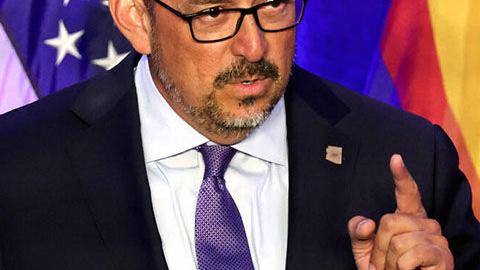
Arizona Secretary of State Adrian Fontes
That ruling ultimately was upheld by the Arizona Supreme Court in 2014.
Since its inception, the new program expanded from one that simply provided funds for students with special needs, to later include students in schools rated D or F, foster children, children in military families and children living on reservations.
And, in 2022, lawmakers removed all limits. That ballooned the program from about 12,000 students to more than 100,000, with the annual cost now surpassing $1 billion.
Backers of Prop. 212, including the Arizona Education Association and Save Our Schools, said Prop. 212 will curb the costs of the universal program without affecting students who were considered eligible prior to 2022.
Mata's ruling does not deal with the merits of the initiative. Instead, she said, it was wrong for Fontes to use the more common — but she said legally incorrect — term.
"Because the phrase may cause voters to treat legally distinct programs as the same, the court concludes that the use of 'school voucher programs' is misleading,'' the judge wrote.
All this is occurring against the backdrop of two other lawsuits over Prop. 212.
In another courtroom, supporters of ESAs are trying to convince a judge that initiative supporters did not collect 255,949 valid signatures to put the measure on the ballot. They claim many of the more than 400,000 turned in are invalid because many petition circulators were not legally qualified to collect signatures.
Separately, another judge ruled that the Republican-controlled Legislative Council acted improperly in writing what he called a biased explanation of Prop. 212 designed to convince people to vote against the measure. This explanation, unlike the one prepared by Fontes, goes into brochures mailed to the homes of all 4.3 million registered voters.
Howard Fischer is a veteran journalist who has been reporting since 1970 and covering state politics and the Legislature since 1982. Follow him on X, Bluesky and Threads at @azcapmedia or email azcapmedia@gmail.com.