A company that runs mobile home parks definitely wants to see Arizona Senate President Warren Petersen be the next state attorney general after running afoul of the current officeholder.
New financial disclosure reports show that The BoaVida group and its subsidiaries have given more than $600,000 to the Restore Order Arizona political action committee. That organization, in turn, has spent more than $1.2 million in advertising promoting Petersen's candidacy in the Republican primary and attacking Rodney Glassman, his foe.
BoaVida is an investment company that owns mobile home parks across the country, including in Arizona.
More to the point, the firm was sued last year by incumbent Democratic Attorney General Kris Mayes for failing to repair the air conditioning system at the Redwood Mobile Park in Tucson it owns, which her office said left residents without air conditioning during the summer months.
People are also reading…
While some changes have been made, an aide to Mayes said they are not to the satisfaction of the office, and the case is still pending.
BioVida founder Eli Werner, speaking through a spokesman, said it is clear that he and the company want Mayes ousted in the November election.

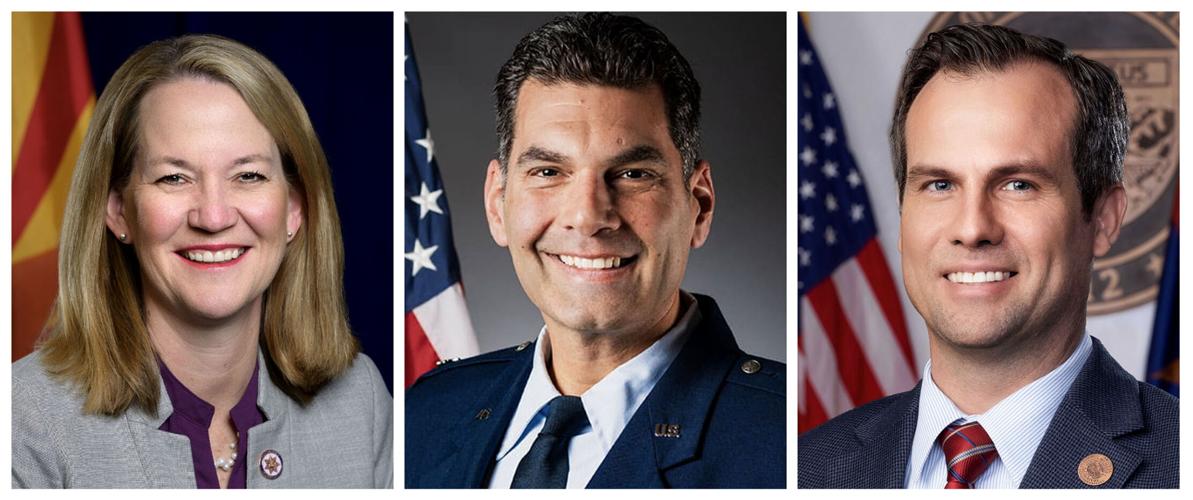
From left to right, Kris Mayes (D), incumbent, Rodney Glassman (R) and Warren Petersen (R), candidates for Arizona attorney general.
"We're not a fan of the AG's practices,'' Werner said. "It seems like she's looking for targets of publicity.''
On the flip side, Werner said Petersen has shown himself to be a fan of affordable housing, something BoaVida believes includes mobile homes, by promoting favorable legislation and using his position as Senate president to kill other bills.
Also on the list of those who have given money to Restore Order Arizona to promote Petersen's candidacy — and against Glassman becoming the nominee against Mayes — is the Geo Group, which operates four private prisons in the state.
Another $50,000 came from Blue Sky Vantage, a consulting group managed by Jack McCain, son of the former senator, and $100,000 was donated by Services Group of America, which invests in food companies and property development.
Among the commercials the PAC ran was one pointing out that Glassman used to be a Democrat — he even ran, unsuccessfully, to be the party chairman — and claiming he "can't be trusted.''
The advantage of political action committees is that they can take individual contributions beyond the $5,500 limit, as well as corporate money, which is forbidden to candidates.
Arizona law, however, prohibits candidates from coordinating the expenses of these PACs with their own expenditures.
Separate and apart from the outside funding, Petersen reports contributions to his campaign of $1.8 million. He had about $524,000 cash on hand as of June 30, the end of the latest reporting period.
Glassman's report shows $3.6 million in income. He also reports $2.4 million in available cash that, while not broken out in his latest report, apparently includes $1 million he gave to his own campaign.
He also has not been shy about attack ads, including a new one paid for with his own campaign funds about Petersen's 2021 divorce — and how he later went on to back legislation to limit how long a spouse was entitled to maintenance after a breakup. Petersen did not dispute that he got Republican Sen. Wendy Rogers to sponsor the 2026 measure but said it would not have benefited him because his wife had since remarried.
Incumbent Mayes, not facing a primary foe, listed income so far of $4.3 million, with $2.3 million in the bank for the November general election. There so far have been no reports of outside money spent for or against her.
Race for secretary of state
In another high-profile — but less expensive — Republican race, state Rep. Alexander Kolodin reported he has collected more than $398,000 in his bid to be the party nominee for secretary of state. After expenses, Kolodin said he had nearly $292,000 cash on hand.

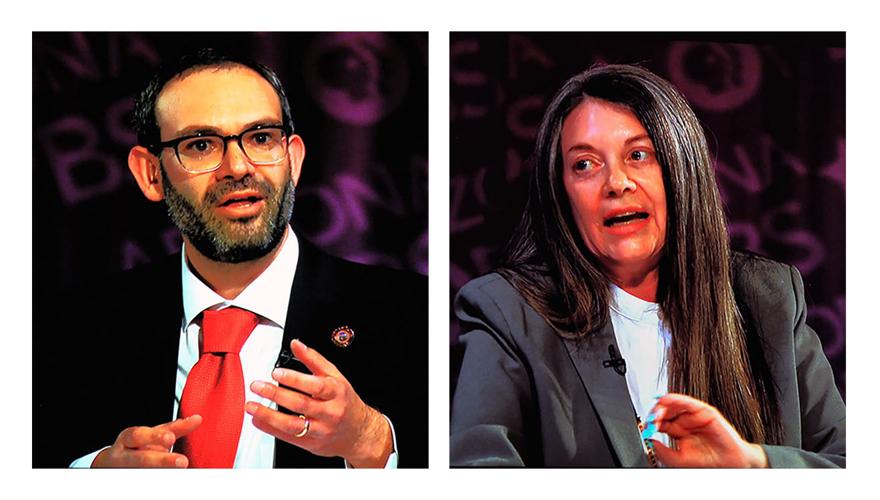
Alexander Kolodin and Gina Swoboda, the Republican candidates for Arizona secretary of state.
Gina Swoboda, former chair of the Arizona Republican Party, said she collected about $227,000 since entering the secretary of state race after giving up on a congressional bid. That also includes nearly $54,000 in personal loans.
All that leaves her with about $22,600 in the bank.
But she also has something else: A history of backing by President Donald Trump, including a specific endorsement when she was first considering weighing a run for Congress this year.
So far, Trump has made no formal endorsement in the secretary of state race. But he did repost on his Truth Social account an endorsement Swoboda got from the Arizona Police Association.
Superintendent of schools race
In another GOP race, Tom Horne is attempting to hang on to his post as superintendent of public instruction for another four years.

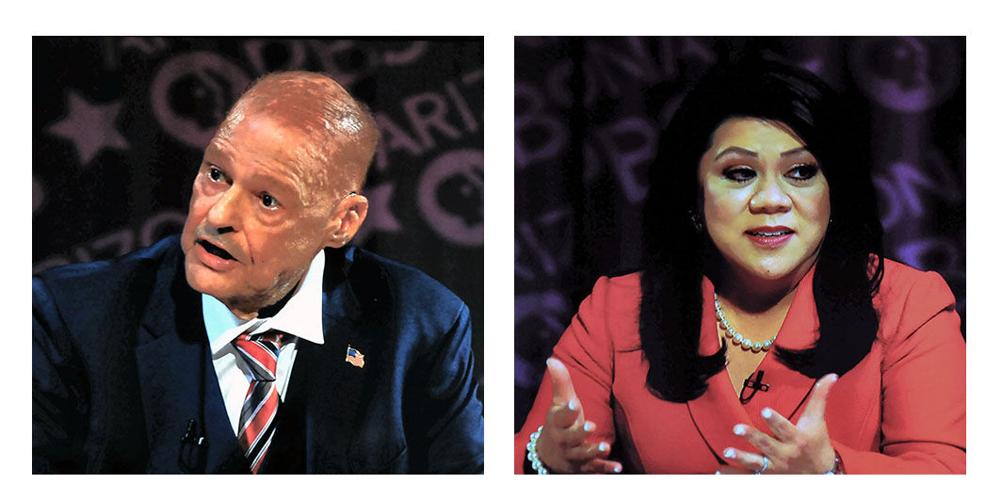
Incumbent state schools chief Tom Horne and challenger Kimberly Yee, both Republicans.
Like some others with a close primary, his $474,500 in spending for the past three months far exceeds the $34,200 he took in. Still, that leaves him with almost $390,000 in the bank, with Horne's campaign aided by $561,000 of his own money.
State Treasurer Kimberly Yee, trying to oust Horne, had a more balanced cash flow in the last reporting period, with receipts pretty much equaling expenses. Her cash on hand is listed at nearly $246,000.
But there's another player in this two-way election.
A group called Arizonans for Election Integrity spent close to $200,000 on a TV commercial that, given its music and graphics designed to look Chinese, was interpreted by Yee to mock her heritage.
Horne denied any role in the ad and condemned it himself.
Campaign finance reports show that Arizonans for Election Integrity got all of its funds from another group, Citizens for Effective Government. But there is no record in the Secretary of State's Office of any such registration.
On the Democratic side, Brett Newby's campaign for schools chief is pretty much self-funded with $125,000 of his own money. His latest report listed less than $19,000 in expenses, leaving him with about $109,000 cash on hand.
Teresa Ruiz, the other Democrat in the race, has reported raising nearly $283,000, with about $146,000 in the bank.
Treasurer race
The race to replace Yee as treasurer has set up a Republican primary between Elijah Norton and Katherine Haley.
Norton is also largely running a self-funded campaign, with $2.7 million of the nearly $3 million coming from his own pocket. After expenses so far, that leaves him with close to $302,000.
Haley also has put her own money into the race, though only $75,000 of the $301,000 in revenues. She reports nearly $82,000 in cash on hand.
Nick Mansour, running unopposed in the Democratic primary, reports having raised more than $1.25 million, leaving him with almost $822,000 after expenses.
Corporation Commission races
In races for two seats on the Arizona Corporation Commission, incumbent Republicans Nick Myers and Kevin Thompson are looking to run with public funding after agreeing not to take special interest dollars. That entitles them to $147,836 for the primary and another $221,754 if they advance to the general election.
One of them will, with Ralph Heap the only GOP challenger, who also intends to run with public funds.
The same is true of Democrats Jonathon Hill and Clara Pratte, who are also publicly funding their campaigns.
Howard Fischer is a veteran journalist who has been reporting since 1970 and covering state politics and the Legislature since 1982. Follow him on X, Bluesky and Threads at @azcapmedia or email azcapmedia@gmail.com.