Gov. Katie Hobbs stood in the backyard of a north Phoenix home, urging over 100 Democrats to help get out the vote in the final push before Election Day. She talked about what was at stake, offering a dire contrast between herself and her Republican opponent, Rep. Andy Biggs.
"He has spent the last decade in Washington, building one of the most extreme partisan records in Congress. ... Andy Biggs is also an election denier," Hobbs said. "And a pedophile," someone in the crowd shouted, a distorted version of Hobbs' message from attack advertising that Biggs dismissed as an effort at "reputational annihilation."
"We have to win this election to protect the progress that we made and protect our democracy," Hobbs said. "Donald Trump has made this election a top priority for him."
Hours later, Biggs traded his typical button-up and suit jacket for a T-shirt and headed to his regular taco spot in Gilbert. As he delivered orders, he spoke to Republicans and Democrats alike about his plans to eliminate the income tax if he were elected, convincing at least one of the latter to change her vote.
People are also reading…
But one vote wasn't enough.
It would have taken hundreds of thousands to hold back the blue wave voters delivered in the Nov. 3 midterm, which many analysts have said was a national rebuke of President Trump's policies.
Hobbs won a second term in a blowout. As pundits prepared for vote counting to take days and Hobbs' team urged patience during that process, her race was called in a stunning 30 minutes. Democrats declared victory across the nation, flipping even once-unthinkable seats.
Hobbs, once considered one of the nation's most vulnerable Democratic incumbents, benefited from an environment that was toxic for the GOP. The office she claimed by less than 1 percentage point in 2022 will be hers again by about 13 points, as of Nov. 8, though results are still not final.

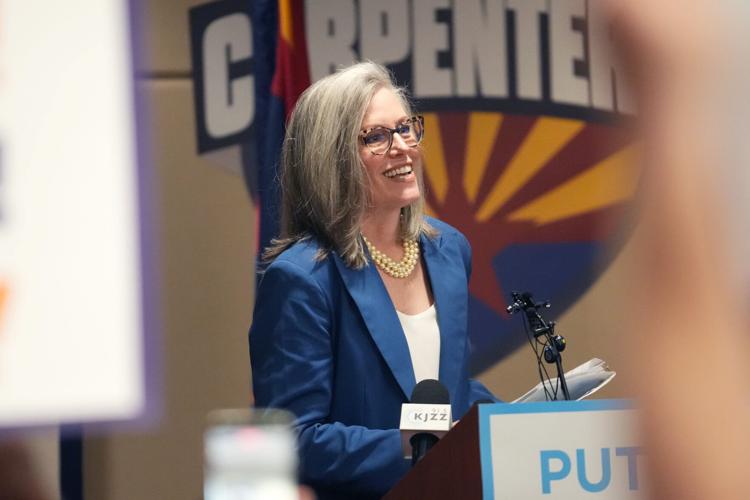
Gov. Katie Hobbs speaks to supporters gathered at the Carpenters Local 1912 Hall in Phoenix a day after her election night victory.
She ran a risk-averse campaign, relying on a disciplined message and amplifying Biggs' baggage with an aggressive and unrelenting advertising blitz that began within minutes of Biggs winning the GOP nomination, and continued for five months.
Biggs struggled to shift the narrative that he was far behind. Or too far right. Or a lackey for Trump. Biggs rarely put Hobbs on defense. His campaign relied on earned media coverage as major Republican donors took their money elsewhere, crippling his ability to get his pitch to voters.
Republicans' November collapse impacted governors across the nation. Democrats flipped five governors' offices away from Republicans, breaking in some cases decades-long streaks of conservative leadership. Texans had not elected a Democrat to the job since 1990. Georgians had not done so since 1998.
"The truth is, it would not have mattered what we did or what she did," Biggs' strategist Sean Noble said. "Because the tsunami was so big that there was no place to hide. There is no safe place when you have a wave at a national level of this magnitude."
"This is the easiest autopsy that you can possibly write about a campaign," he added. "And that is, Donald Trump (expletive) us."
Biggs' campaign couldn't find its message
Biggs entered the race in January 2025 at the urging of his friend, Turning Point USA co-founder Charlie Kirk. His entrance scrambled the primary race, and Biggs ultimately won with over 70% of the GOP vote in July.
His campaign threw a party in Scottsdale. But Biggs was hours late coming back from Aspen, Colorado, where he was courting the deep-pocketed Republican Governors' Association. His flight was late, and that financial lifeline never arrived.
Biggs pledged to Arizona voters that he would cut taxes and root out corruption. But he struggled to stick to his message and do so with intensity, prompting GOP allies at times to remark that Biggs wasn't aggressive enough.
A former state lawmaker and five-term congressman, Biggs had never run statewide before. After his primary in 2016, when he won by just 27 votes after a recount, he had safely won reelection in one of the state's reddest districts — an area that wasn't off limits for the midterm's blue wave. Even Biggs' daughter couldn't continue the dynasty and keep the seat red.
Biggs was a former leader of the ultra-conservative House Freedom Caucus and a top ally of Trump.
Jessica Taylor, who analyzes governors' races for The Cook Political Report, said Biggs' loss could be blamed on the national rebuke of Trump, but she also noted his caliber as a candidate. And Hobbs ran a strong campaign, she said.
"Biggs was a weaker candidate than Republicans could have run. ... But I think that when you look at the state getting a trifecta for the first time in 60 years and just the margin of the vote, certainly the national environment had something to do with it," Taylor said.
"He was so tied to Trump, and then you had his election denialism," she said. "He never was able to raise a lot of money. I think his campaign just never impressed national Republicans to an extent that they were willing to invest in the race."
Biggs didn't — and he couldn't — distance himself from a president whose approvals tanked as he implemented tariffs and launched an unpopular war in Iran.
His day job in Congress meant Biggs kept voting on Trump's controversial policies. He was one of just 32 U.S. House members who opposed a massive housing reform bill in June that passed with overwhelming, bipartisan support. Six times since the conflict began in March, Biggs voted against resolutions to end the war.

Asked about those votes, Biggs doubled down on Trump even as other Republicans were breaking ranks.
"I'm not into embarrassing the president," Biggs said in an interview in June, alleging Democrats put the resolution up for a "gotcha type of vote."
Democratic campaign attorney Roy Herrera said there was nothing Biggs' campaign could have done to win in the national environment, though better fundraising or moderating his message in the general election could have made the race more competitive.
"It's a campaign that just never got off the ground, and it turns out now that it wouldn't have mattered if it did," Herrera said. Herrera has represented Democratic Sens. Mark Kelly and Ruben Gallego's campaigns, and was the Arizona-based attorney for Joe Biden and Kamala Harris' presidential runs.
A string of general election polls universally showing Biggs trailing Hobbs scared off donors. Turning Point's political arm came to the rescue when national funders largely abandoned Biggs.
Turning Point spent over $18.5 million on advertising in the race, much of it attacking Hobbs. Some of it was on-target for voters worried about the economy, like claiming the state had lost jobs. Others seemed to be from left field: One dinged Hobbs over bad reviews when she was a professor. Turning Point also created distractions, like claiming there were "Democrats for Biggs" and forcing Biggs into a position where he was asked to name some.
He couldn't.
Turning Point may have helped move the needle, but not enough. With just $5 million in his own bank account going into the election, Biggs couldn't staff up, and the GOP grassroots began complaining when he wasn't advertising on television. His entire campaign staff was about the size of the team Hobbs hired to do communications.
And while the Republican Governors Association shifted resources to defend incumbent GOP governors in other states and open seats in much redder territory, leaving Biggs out to dry in the desert, the Democratic equivalent stepped in with its war chest and made Hobbs' reelection a top priority.
The GOP group spent over $12 million in battleground Nevada, and even that did not secure a victory. Democrat Aaron Ford ultimately knocked off incumbent Gov. Joe Lombardo by almost 8 percentage points.
The Democratic Governors Association sent an estimated $23 million to Arizona to help Hobbs keep her seat.
"We brought a handshake to a nuclear war," Biggs' spokesman and senior adviser Drew Sexton said Nov. 6.
Hobbs' race at the top of the ticket
With that eight-figure outside help, Hobbs unleashed a barrage of advertising against Biggs. She spent nearly $18 million of her own fundraising stockpiled over four years and built a campaign staff early. The spending figures in this story are according to the latest reports through September, and are likely much higher.
The attacks reminded voters that Biggs blocked a bill to allow a police takeover in Colorado City, home to a corrupt polygamous cult — a scandal made worse by Biggs' shifting response. Biggs didn't have the money to combat the claims and resorted to blaming a few of Hobbs' vetoes that he said protected sex offenders.
Other attacks said Biggs supported a bill to raise the sales tax. And that he opposed the release of the Epstein files — though Biggs pivoted in step with the president's position.
"The night Andy Biggs won the primary, we were already making the case against his record, so Arizonans heard it from us before he could introduce himself," Hobbs' campaign manager Nicole DeMont said. "That messaging defined the campaign early and exposed Biggs as incapable of answering basic questions about his record."
Hobbs' messaging almost always came back to blaming Biggs and Washington, D.C., for high costs, or tying Biggs to pedophiles.
Political observers from both parties praised Hobbs' opening salvos on the airwaves, advertisements in English and Spanish that told voters about her leadership and her own modest upbringing in Tempe — a way to relate to Arizonans frustrated by a high cost of living. Her family at times relied on food stamps. Hobbs and her husband are still paying off his student loans. The ads on television, radio and online began in May. They targeted a record-breaking audience of fans watching the FIFA World Cup, well before an election was on those voters' minds.
Hobbs, a former state lawmaker and secretary of state before she became governor, began touring the state in the fall of 2025. The stops were mostly curated events — speaking to friendly crowds. Hobbs skipped a debate, as she had four years earlier, enduring a negative news cycle but avoiding the risk of an on-stage flub.
The cautious campaign strategy turned out to be a smart one in a year of Trump turmoil.
Hobbs' campaign was clear-eyed in countering Trump's policies and rhetoric by portraying Hobbs as no-drama and the "adult in the room," said Herrera, who is not affiliated with Hobbs' campaign.
"And it ended up being exactly right," he said. "In retrospect, that's what Arizona voters tend to reward. We mostly like the kind of no-drama, the more moderate, you can say risk-averse but really more steady candidates certainly at the statewide level. That's who we tend to elect."
The governor told voters how she had deployed the National Guard to the state's southern border. She talked about tax cuts each year she was in office and erasing medical debt for over 670,000 Arizonans. She talked about utility assistance and repealing a tax on rent.
"In 2022, Gov. Hobbs ran as a bulwark against extremism," said DeMont, who also ran Hobbs' campaign four years ago. "In 2026, she ran as a governor with a record, and we built the whole campaign around it."
And that helped Hobbs win by more than double any Democrat who ran statewide in almost 20 years, and in a state where Republican voters outnumber Democratic ones by almost 300,000, according to DeMont.
"That doesn't happen by accident," DeMont said. "It happens when Arizonans trust a governor who has delivered for them."
Choosing the former Republican mayor of Mesa, John Giles, as her running mate "told Republicans and independents there was a place for them in this campaign, and reinforced Gov. Hobbs’ approach to putting what’s best for the state over a political party," DeMont said.
'So incredibly hopeful'
Manasvi Jagtap, a 21-year-old senior at Arizona State University, said Hobbs did well in her first term. But Jagtap had friends who had not heard of Hobbs — which Jagtap believed was a good sign.
“If you hear a lot about politicians, they're usually doing something really, really crazy, either on the left side or the right side,” she said.
Jagtap said the Trump administration has done damage to the Republican Party and even more moderate conservatives were struggling to reach voters.
“Everything is just so extremely polarized that I feel people are either wanting to vote Democrat or vote for a safer option,” which would be Katie Hobbs, she said.
Marge Dillon hosted Hobbs and Kelly in her north Phoenix backyard that morning two weeks before Election Day.
Dillon, 70, is a retired educator and Arizona native who fears public schools are being "annihilated" by vouchers. She supports Hobbs' positions on public education funding and women's health issues.
"Gov. Hobbs, I think, has been a voice for those of us with the smallest voice," Dillon said. Opening her home for a get-out-the-vote event was a small thing she could do to help the candidates she prefers, Dillon said. And it happened at a pivotal time, she said.
"I think we're right on the cusp of losing democracy in America," she said on Oct. 20.
Dillon lives in a district where voters ultimately ousted incumbent Republican Sen. Shawnna Bolick in favor of Democrat Amelia Gallitano. Hobbs won the county by about 16 percentage points, according to unofficial results.
Dillon praised younger candidates and young voters who helped reelect Hobbs and pushed the state and the nation blue.
"I did not expect it to go the way that it did," she said. "I was so incredibly worried for the next generation, and now I'm so incredibly hopeful."
Reporter Erick Trevino contributed to this story.