

If you drive around downtown or along the Sun Link streetcar line, you’ve probably seen areas of the street painted bright green.
Those green patches have names, believe it or not: City of Tucson transportation officials call them “bike boxes.”
The purpose of the bike boxes is to provide a safe spot for bicyclists in areas of heavy congestion.
Think of them as demilitarized zone for bicyclists where no cars should enter.
“Communities have found that they increase visibility of cyclists,” said Ann Chanecka, Tucson’s Bicycle and Pedestrian Program coordinator.
The city included the green paths and bike boxes when work on laying streetcar tracks was completed, but up until now there’s been little in the way of signage to notify motorists of the intent or how to behave when confronted with these obstacles.
People are also reading…
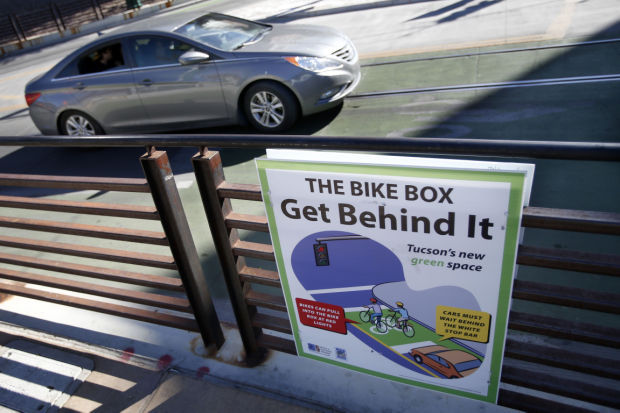
To address that, city officials have begun to install information signs downtown where the bike boxes are in highest concentration.
“With anything new on our roadways, it’s a matter of education,” Chanecka said.
The initial signs are temporary cardboard placards zip-tied to railings to inform drivers and riders of what purpose the boxes serve. Future signs will tell drivers where they need to stop on a red light or at stop signs.
The big thing to remember is that bikes get to go to the front of the line at these areas and take their places in the green bike boxes. Drivers are expected to stop behind the white line at the rear of the bicycle zones.
That’s a good thing as far as cyclists are concerned.
“The more cyclists you have, the more motorists have to see them,” said Wayne Cullop of the Greater Arizona Bicycle Association.
Cullop said in highly congested areas like downtown and along the Sun Link streetcar line, the bike boxes would aid in cyclist safety by allowing riders to easily get to the front of the line.
Being up front allows riders to more easily avoid pinch points like narrowing roads and other obstacles where collisions with cars often occur.
“In areas where the trolley tracks encroach close to the curb, that’s always a dangerous situation,” he said.
Chanecka said she’s unaware of any instances of bicyclists colliding with the streetcar, but she said that’s one of the scenarios the bike boxes are designed to help avoid. So far, the city has installed five bike boxes in the downtown area and a few others near the university. More are planned around the university, and officials could expand their use to other parts of the city as the need arises, Chanecka said.
The idea for bike boxes came from Portland, Oregon, which comes as little surprise, as the city continues to be seen as hub for progressive urban planning.
But Tucson also has earned a reputation in recent years as a bicycle-friendly community. For example, Bicycling magazine in 2014 ranked Tucson at 18 on its list of the top 50 bicycle-friendly communities.
New York City ranked at the top of the list, Portland was fourth and someplace called Tempe was 17.
As our city grows and bikes become more popular as a primary mode of transportation, the city continues to seek ways to maximize the safety of riders while limiting the inconvenience for drivers. Bike boxes seem to be a relatively inexpensive way to achieve that goal.
Down the road
Work continues Monday at Sixth and Toole avenues, where workers will remove sewer bypass pumps and bypass lines.
The intersection will be closed from 10 p.m. to 5 a.m.
The work is part of a project to complete the two-way conversion of Sixth Avenue from Seventh Street to Broadway, which includes installation of traffic signals, sidewalks and disabled-accessible ramps at the intersections of Sixth Avenue and Toole Avenue, and Sixth Avenue and Pennington Street.


