
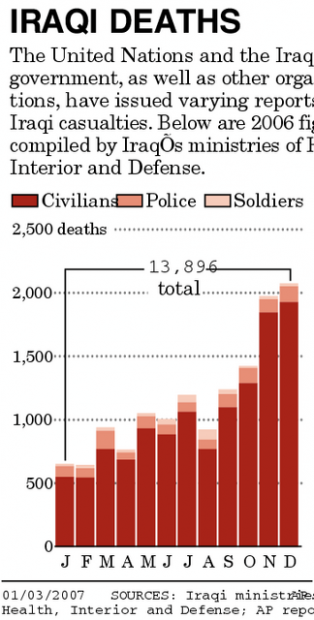
BAGHDAD, — Iraq reported Tuesday that about 12,000 civilians were killed last year — the third full year since the U.S.-led invasion — with a dramatic rise in the last three months, when 5,000 died. Only about half as many Iraqi soldiers died in 2006 as American troops.
But the number of Iraqi security forces killed jumps to 1,539, nearly double the American death count of 823 for the year, when the deaths of police, who conduct paramilitary operations, are added to the number of slain Iraqi soldiers.
In all, the Iraqi ministries of Health, Defense and Interior reported a total of 13,896 Iraqi civilians, police and soldiers died last year, 162 more than the tally kept by The Associated Press.
The AP count, assembled from its daily news reports, was always believed to be substantially lower than the actual number of deaths because the news cooperative does not have daily access to official accounting by the Iraqi ministries. Many deaths were thought to have gone unreported by the AP.
People are also reading…
Counts kept by other groups, including the United Nations, list far higher death tolls, which are disputed by the Iraqi government.
While the U.S. government and military provide no death totals for Iraqis, the U.N. Assistance Ministry for Iraq, UNAMI, does keep a count based on reports it gathers from the Baghdad morgue, Ministry of Health, and Medico-Legal Institute.
The figures for November and December are not yet available from the U.N., but as of the end of October the organization had reported 26,782 deaths in the first 10 months of 2006, nearly double what the Iraqi government and the AP reported for the entire year.
In its last report, the U.N. said 3,709 Iraqi civilians were killed in October alone and that citizens were fleeing the country at the pace of 100,000 each month. The organization estimates at least 1.6 million Iraqis had left since the war began in March 2003.
Life for Iraqis, especially in Baghdad and cities and towns in the center of the country, has become increasingly untenable. Many schools failed to open in September, and professionals — especially professors, physicians, politicians and journalists — are falling to sectarian killers at a stunning pace.
At the time of the last U.N. report, Iraqi government spokesman Ali al-Dabbagh called it "inaccurate and exaggerated" because it was not based on official government reports.
The U.N. report said Iraq's heavily armed Shiite militias were gaining strength and influence and that torture was rampant, despite the Iraqi government's vow to reduce human-rights abuses.
"Hundreds of bodies continued to appear in different areas of Baghdad — handcuffed, blindfolded and bearing signs of torture and execution-style killing," the last UNAMI report said. "Many witnesses reported that perpetrators wear militia attire and even police or army uniforms."
The two primary militias in Iraq are the military wings of the country's strongest Shiite political groups, on which Prime Minister Nouri al-Maliki is heavily dependent.
UNAMI said that while sectarian violence is the main cause of civilian killings, Iraqis also continue to be the victims of terrorist acts, roadside bombs and drive-by shootings. Others have been caught in the crossfire between rival gangs.