Just last week, U.S. intelligence analysts had predicted it would likely take several more weeks before Afghanistan's civilian government in Kabul fell to Taliban fighters. In reality, it only took a few short days.
On Sunday, Taliban militants retook Afghanistan's capital, almost two decades after they were driven from Kabul by U.S. troops.
Although Afghan security forces were well funded and well equipped, they put up little resistance as Taliban militants seized much of the country following the withdrawal of U.S. troops beginning in early July.
People are also reading…
On Sunday, Afghan President Ashraf Ghani fled the country, abandoning the presidential palace to Taliban fighters.
Already, U.S. officials have admitted that they miscalculated the speed at which the Taliban were able to advance across the country, with Secretary of State Antony Blinken saying of Afghanistan's national security forces: "The fact of the matter is we've seen that that force has been unable to defend the country ... and that has happened more quickly than we anticipated."
The Taliban's swift success has prompted questions over how the insurgent group was able to gain control so soon after the U.S. withdrawal from Afghanistan — and, after almost 20 years of conflict in the U.S.' longest running war, what the Taliban want.

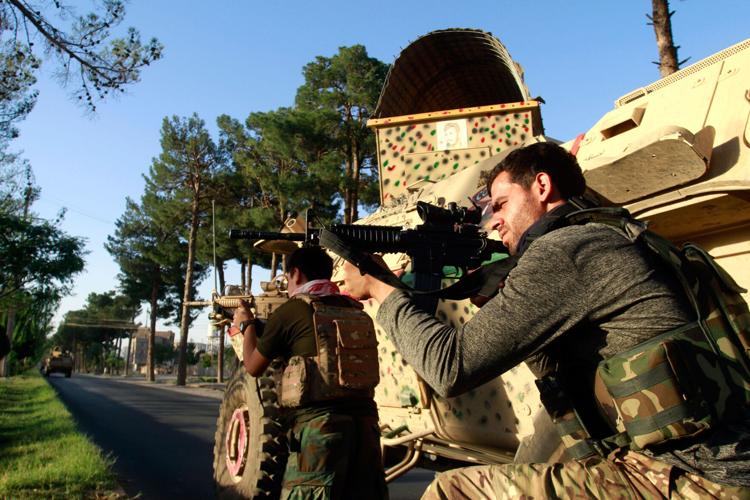
Afghan security personnel take a position during fighting between Taliban and Afghan security forces in Herat province, west of Kabul, Afghanistan, on August 3.
Who are the Taliban?
Formed in 1994, the Taliban were made up of former Afghan resistance fighters, known collectively as mujahedeen, who fought the invading Soviet forces in the 1980s. They aimed to impose their interpretation of Islamic law on the country — and remove any foreign influence.
After the Taliban captured Kabul in 1996, the Sunni Islamist organization put in place strict rules. Women had to wear head-to-toe coverings, weren't allowed to study or work and were forbidden from traveling alone. TV, music and non-Islamic holidays were also banned.
That changed after Sept. 11, 2001, when 19 men hijacked four commercial planes in the U.S., crashing two into the World Trade Center towers, one into the Pentagon, and another, destined for Washington, into a field in Pennsylvania. More than 2,700 people were killed in the attacks.
The attack was orchestrated by al Qaeda leader Osama bin Laden, who operated from inside of Taliban-controlled Afghanistan. Less than a month after the attack, U.S. and allied forces invaded Afghanistan, aiming to stop the Taliban from providing a safe-haven to al Qaeda — and to stop al Qaeda from using Afghanistan as a base of operations for terrorist activities.
In the two decades since they were ousted from power, the Taliban have been waging an insurgency against the allied forces and the U.S.-backed Afghan government.
Who are the leaders?

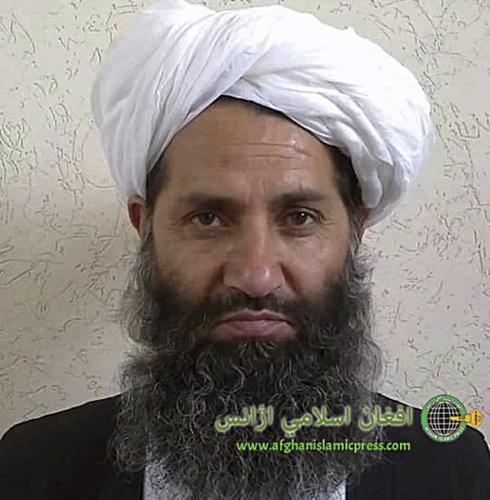
FILE - In this undated photo from an unknown location, released in 2016, the leader of the Afghanistan Taliban Mawlawi Hibatullah Akhundzada poses for a portrait. (Afghan Islamic Press via AP, File)
The Taliban are led by Mawlawi Haibatullah Akhundzada, a senior religious cleric from the Taliban's founding generation.
He was named as the Taliban's leader in 2016 after the group's previous leader Mullah Akhtar Mohammad Mansour was killed in a U.S. airstrike in Pakistan.
At the time, Thomas Ruttig of the Afghanistan Analysts' Network said the new Taliban leader might be able to "integrate the younger and more militant generation."
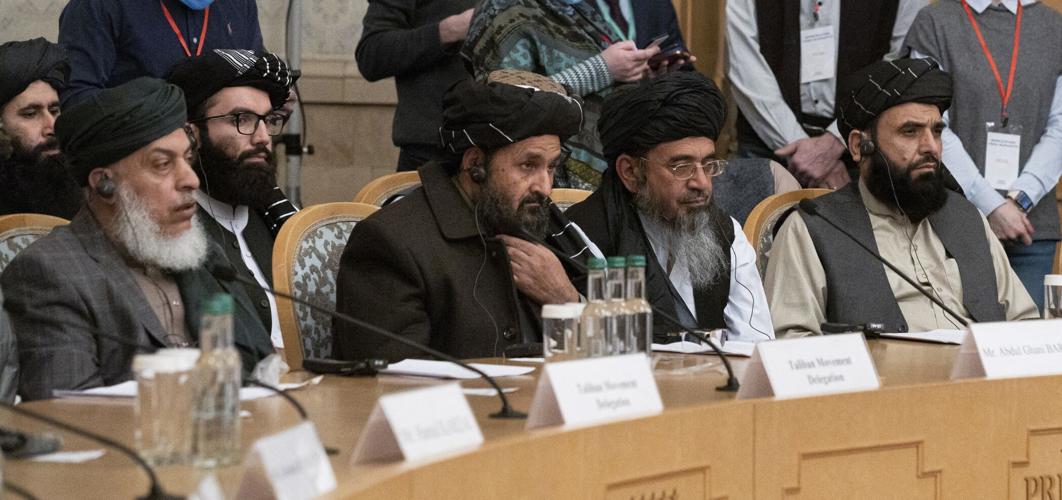
Another key player is Mullah Abdul Ghani Baradar, the Taliban co-founder, who was released in 2013 after being captured in 2010 in Karachi, Pakistan's largest city. Baradar heads the group's political committee, and recently met with Chinese Foreign Minister Wang Yi.
What did the Taliban agree to with Trump?
In 2017, the Taliban issued an open letter to the newly elected U.S. President Donald Trump, calling on him to withdraw U.S. forces from Afghanistan.
After years of negotiations, the Taliban and the Trump administration finally signed a peace deal in 2020. The U.S. agreed to withdraw troops and release some 5,000 Taliban prisoners, while the Taliban agreed to take steps to prevent any group or individual, including al Qaeda, from using Afghanistan to threaten the security of the U.S. or its allies.
But that didn't bring about peace.

Taliban co-founder Mullah Abdul Ghani Baradar, center, with other members of the Taliban delegation attend an international peace conference in Moscow, Russia, Thursday, March 18, 2021. (AP Photo/Alexander Zemlianichenko, Pool)
Violence in Afghanistan grew to its highest levels in two decades. The Taliban increased their control of wider swaths of the country — and by June of this year, contested or controlled an estimated 50% to 70% of Afghan territory outside of urban centers, according to a United Nations Security Council report.
The report warned that an emboldened Taliban posed a severe and expanding threat to the government of Afghanistan. The report argued that the Taliban leadership had no interest in the peace process and appeared to be focused on strengthening its military position to give it leverage in negotiations — or, if necessary, in using armed force.
"The Taliban's messaging remains uncompromising, and it shows no sign of reducing the level of violence in Afghanistan to facilitate peace negotiations with the Government of Afghanistan and other Afghan stakeholders," the report said.
What do the Taliban want?
The Taliban have tried to present themselves as different from the past — they have claimed to be committed to the peace process, an inclusive government, and willing to maintain some rights for women.
Taliban spokesman Sohail Shaheen said women would still be allowed to continue their education from primary to higher education — a break from the rules during the Taliban's past rule between 1996 and 2001. Shaheen also said diplomats, journalists and non-profits could continue operating in the country.
"That is our commitment, to provide a secure environment and they can carry out their activities for the people of Afghanistan," he said.
But many observers worry that a return to Taliban rule is a return to the Afghanistan of two decades ago, when women's rights were severely restricted. Antonio Guterres, the United Nations secretary-general, said in a tweet that hundreds of thousands were being forced to flee amid reports of serious human rights violations.
"International humanitarian law and human rights, especially the hard-won gains of women and girls, must be preserved," he said.
Amin Saikal, the author of "Modern Afghanistan: A History of Struggle and Survival," said the Taliban did not want Afghanistan to become a pariah state, and wanted to continue receiving international aid. But, Saikal said: "As far as their ideological commitment is concerned, they have not really changed."
Why were the Taliban so strong against the Afghan forces?
Over the past two decades, the U.S. spent more than a trillion dollars in Afghanistan. It trained Afghan soldiers and police and provided them with modern equipment.
As of February, the Afghan forces numbered 308,000 personnel, according to a United Nations Security Council report released in June — well above the estimated number of armed Taliban fighters, which ranged from 58,000 to 100,000.
Ultimately, though, the Afghan forces proved to be no match for the Taliban.

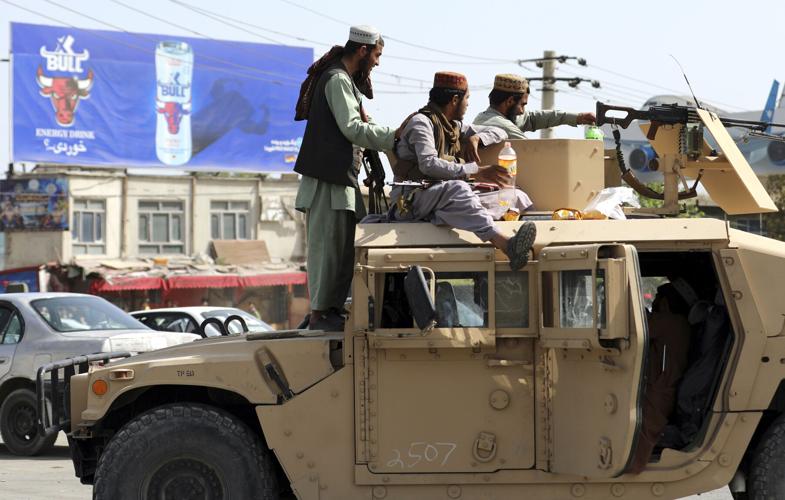
Taliban fighters stand guard in front of the Hamid Karzai International Airport, in Kabul, Afghanistan, Monday, Aug. 16, 2021. Thousands of people packed into the Afghan capital's airport on Monday, rushing the tarmac and pushing onto planes in desperate attempts to flee the country after the Taliban overthrew the Western-backed government. (AP Photo/Rahmat Gul)
Carter Malkasian, a former senior adviser to the chairman of the U.S. Joint Chiefs of Staff, who is also the author of "The American War in Afghanistan: A History," said the Afghan forces sometimes lacked coordination and suffered from poor morale. The more defeats they had, the worse their morale became, and the more emboldened the Taliban were.
"Afghan forces, for a long period of time, have had problems with morale and also their willingness to fight the Taliban," he said. "The Taliban can paint themselves as those who are resisting and fighting occupation, which is something that is kind of near and dear to what it means to be Afghan. Whereas that's a much harder thing for the government to claim, or the military forces fighting for the government."
Taliban spokesman Shaheen said they weren't surprised by their successful military offensive.
"Because we have roots among the people, because it was a popular uprising of the people, because we knew that we had been saying this for the last 20 years," he said. "But no one believed us. And now when they saw, and they were taken by surprise because before that they didn't believe."
Could the US have known that the Taliban would return?
Just last month, senior officials in the Biden administration believed it could take months before the civilian government in Kabul fell.
Now lawmakers are pressing the Biden administration for answers and demanding information on how U.S. intelligence could have so badly misjudged the situation on the ground.
Texas Rep. Michael McCaul, the top Republican on the House Foreign Affairs Committee, has called the situation an "unmitigated disaster of epic proportions," while Senate Minority Leader Mitch McConnell said "everyone saw this coming" except the President, who "publicly and confidently dismissed these threats just a few weeks ago."

American officials have expressed dismay at the now fallen U.S.-backed Afghan government's inability to protect key cities and regions from the Taliban, despite laying out a strategy for doing so during his communications with Biden and other senior U.S. leaders.
Defense Secretary Lloyd Austin said the "lack of resistance that the Taliban faced from Afghan forces has been extremely disconcerting."
"They had all the advantages, they had 20 years of training by our coalition forces, a modern air force, good equipment and weapons," he said, according to sources on the call where he made the comments. "But you can't buy will and you can't purchase leadership. And that's really what was missing in this situation."
___
Photos: Taliban sweep into Afghan capital after government collapses

Taliban fighters take control of Afghan presidential palace after the Afghan President Ashraf Ghani fled the country, in Kabul, Afghanistan, Sunday, Aug. 15, 2021. (AP Photo/Zabi Karimi)

Taliban fighters take control of Afghan presidential palace after the Afghan President Ashraf Ghani fled the country, in Kabul, Afghanistan, Sunday, Aug. 15, 2021. (AP Photo/Zabi Karimi)

Taliban fighters take control of Afghan presidential palace after the Afghan President Ashraf Ghani fled the country, in Kabul, Afghanistan, Sunday, Aug. 15, 2021. (AP Photo/Zabi Karimi)

Taliban fighters take control of Afghan presidential palace after the Afghan President Ashraf Ghani fled the country, in Kabul, Afghanistan, Sunday, Aug. 15, 2021. (AP Photo/Zabi Karimi)

Taliban fighters take control of Afghan presidential palace after the Afghan President Ashraf Ghani fled the country, in Kabul, Afghanistan, Sunday, Aug. 15, 2021. (AP Photo/Zabi Karimi)

Taliban fighters take control of Afghan presidential palace after the Afghan President Ashraf Ghani fled the country, in Kabul, Afghanistan, Sunday, Aug. 15, 2021. (AP Photo/Zabi Karimi)

Taliban fighters take control of Afghan presidential palace after the Afghan President Ashraf Ghani fled the country, in Kabul, Afghanistan, Sunday, Aug. 15, 2021. (AP Photo/Zabi Karimi)

Afghans sit on the wall as people wait for hours to withdraw money, in front of Kabul Bank, in Kabul, Afghanistan, Sunday, Aug. 15, 2021. Officials say Taliban fighters have entered Kabul and are seeking the unconditional surrender of the central government. (AP Photo/Rahmat Gul)

Stranded people arrive to cross the border into Afghanistan, at a border crossing in Chaman, Pakistan, Sunday, Aug. 15, 2021. Normally thousands of Afghans and Pakistanis cross daily and a steady stream of trucks passes through, taking goods to land-locked Afghanistan from the Arabian Sea port city of Karachi in Pakistan. (AP Photo/Jafar Khan)

Stranded people arrive to try to cross the border into Afghanistan, at a border crossing in Chaman, Pakistan, Sunday, Aug. 15, 2021. Normally thousands of Afghans and Pakistanis cross daily and a steady stream of trucks passes through, taking goods to land-locked Afghanistan from the Arabian Sea port city of Karachi in Pakistan. (AP Photo/Jafar Khan)

Taliban fighters pose for a photograph in the city of Kandahar, southwest Afghanistan, Sunday, Aug. 15, 2021. (AP Photo/Sidiqullah Khan)

A man sells Taliban flags in Herat province, west of Kabul, Afghanistan, on Saturday, Aug. 14, 2021. (AP Photo/Hamed Sarfarazi)

A U.S. Chinook helicopter flies over the U.S. Embassy in Kabul, Afghanistan, Sunday, Aug. 15, 2021. Helicopters are landing at the U.S. Embassy in Kabul as diplomatic vehicles leave the compound amid the Taliban advanced on the Afghan capital. (AP Photo/Rahmat Gul)

Smoke rises next to the U.S. Embassy in Kabul, Afghanistan, Sunday, Aug. 15, 2021. Taliban fighters entered the outskirts of the Afghan capital on Sunday, further tightening their grip on the country as panicked workers fled government offices and helicopters landed at the embassy. Wisps of smoke could be seen near the embassy's roof as diplomats urgently destroyed sensitive documents, according to two American military officials. (AP Photo/Rahmat Gul)

Afghans wait in long lines for hours to get visas in front of the Iranian embassy, in Kabul, Afghanistan, Sunday, Aug. 15, 2021. Officials say Taliban fighters have entered Kabul and are seeking the unconditional surrender of the central government. (AP Photo/Rahmat Gul)

Afghans wait in long lines for hours to withdraw money, in front of Kabul Bank, in Kabul, Afghanistan, Sunday, Aug. 15, 2021. Officials say Taliban fighters have entered Kabul and are seeking the unconditional surrender of the central government. (AP Photo/Rahmat Gul)

Smoke rises next to the U.S. Embassy in Kabul, Afghanistan, Sunday, Aug. 15, 2021. (AP Photo/Rahmat Gul)

Taliban fighters raise their flag at the Ghazni provincial governor's house, in Ghazni, southeastern, Afghanistan, Sunday, Aug. 15, 2021. (AP Photo/Gulabuddin Amiri)

Taliban fighters poses for a photograph while raising their flag Taliban fighters raise their flag at the Ghazni provincial governor's house, in Ghazni, southeastern, Afghanistan, Sunday, Aug. 15, 2021. (AP Photo/Gulabuddin Amiri)

The Taliban flag flies at the Ghazni provincial governor's house, in Ghazni, southeastern, Afghanistan, Sunday, Aug. 15, 2021. (AP Photo/Gulabuddin Amiri)

Taliban flags fly on the gate of Ghazni provincial governor's house, in Ghazni, southeastern, Afghanistan, Sunday, Aug. 15, 2021. (AP Photo/Gulabuddin Amiri)

The Taliban flag flies at the Ghazni provincial governor's house, in Ghazni, southeastern, Afghanistan, Sunday, Aug. 15, 2021. (AP Photo/Gulabuddin Amiri)

Taliban fighters raise their flag at the Ghazni provincial governor's house, in Ghazni, southeastern, Afghanistan, Sunday, Aug. 15, 2021. (AP Photo/Gulabuddin Amiri)

Taliban fighters raise their flag at the Ghazni provincial governor's house, in Ghazni, southeastern, Afghanistan, Sunday, Aug. 15, 2021. (AP Photo/Gulabuddin Amiri)

Taliban fighters take control of Afghan presidential palace after the Afghan President Ashraf Ghani fled the country, in Kabul, Afghanistan, Sunday, Aug. 15, 2021. (AP Photo/Zabi Karimi)

Lights are on at the U.S. Embassy buildings after nightfall, in Kabul, Afghanistan, Sunday, Aug. 15, 2021. (AP Photo/Rahmat Gul)

An Afghan national is mobbed by media person for byte as he arrives at Indira Gandhi International airport by Air India special flight from Kabul, in New Delhi, India, Sunday, Aug. 15, 2021. (AP Photo/Dinesh Joshi)
CNN's Kevin Liptak, Jason Hoffman, Kylie Atwood, Jennifer Hansler, Nicole Gaouette and Nic Robertson contributed reporting.