

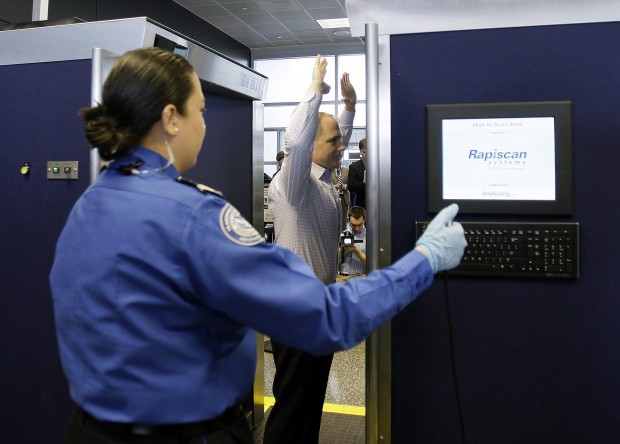
BOSTON - The Transportation Security Administration announced Friday that nine more U.S. airports will receive body-scanning technology, as the U.S. heightens its effort to detect explosives and contraband amid a threat highlighted by an attempted bombing on Christmas Day.
TSA Security Director Lee Kair said units will be fielded in the coming months at Fort Lauderdale, Fla.; San Jose, Calif.; Columbus, Ohio; San Diego; Charlotte, N.C.; Cincinnati; Los Angeles; Oakland, Calif.; and Kansas City.
They will join three machines going online Monday at Boston's Logan International Airport, and one being deployed next week at O'Hare International Airport in Chicago.
All are among 150 machines bought with money from the federal stimulus package signed by President Obama last year. They join 40 machines already in use at 19 airports nationwide.
People are also reading…
The new and existing machines will be in primary positions, meaning they will be the default screening equipment passengers face at checkpoints. The existing machines have been in secondary positions, being used only when a passenger failed a metal screening or posed some other risk factor.
Passengers retain the right to opt out of a body scanning for a more intense but traditional screening. The Associated Press timed a body scanning at 25 seconds, and Kair said he did not expect them to take any longer than a passenger would have to otherwise wait for the X-ray of carry-on bags.
Deployment of the machines was announced in the fall, before Nigerian Umar Farouk Abdulmutallab allegedly tried to blow up a Detroit-bound airliner on Christmas Day with explosives concealed in his underwear. That highlighted the need for additional security.
Other nations have signed on to use the scanners, including Nigeria and the Netherlands, where Abdulmutallab started his flight and then connected to the U.S.
Civil libertarians and even Pope Benedict XVI have complained that the new machines can violate a passenger's privacy. The American Civil Liberties Union has denounced the screening as a "virtual strip search."
One Logan passenger didn't share the concerns.
"There's always going to be issues. As long as they maintain proper control over the situation, I have no problem with it," said Michelle Carrier, 32, who was flying to Houston. "Freedom's important, but this is one of the prices you pay for safety."
The image from a machine displayed for reporters Friday showed the blurry outline of a female volunteer. None of her clothing was visible, nor were her genitals, but the broad contours of her chest and buttocks were. Her face also was blurred.
Overall, the image looked like the outline of a ghost. Samples are on display on the TSA's Web site (www.tsa.gov).


