

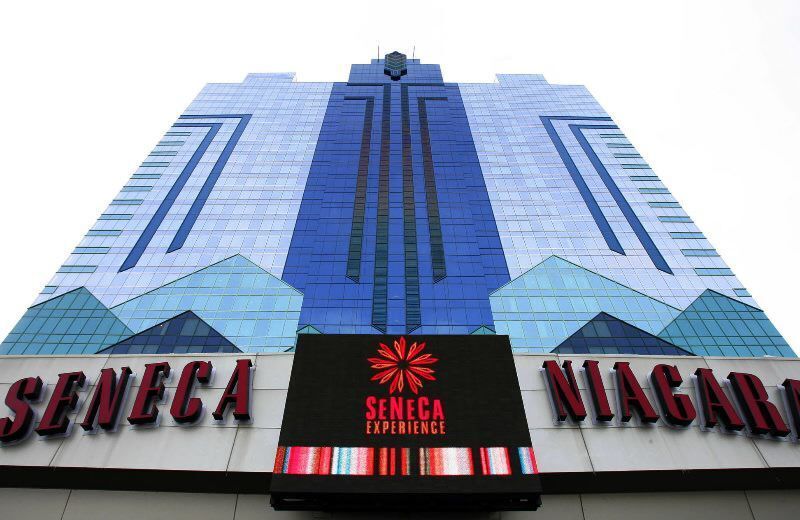
Snake eyes.
With a federal judge’s ruling last week, the Seneca Nation of Indians has lost three times in its effort to evade paying what it owes the state from the hundreds of millions of dollars it has raked in at three Western New York casinos. Its prospects of prevailing were always small and now they must be considered nil.
For the sake of its reputation, the well-being of the cities and counties that rely on casino revenue and the benefits of business as usual, the Senecas need to stop throwing the dice. It’s time to pay up and get on with things.
Indeed, it’s past time. Although the Senecas had a plausible case when they stopped making payments 2 1/2 years ago, they also lost a plausible decision when the dispute went to binding arbitration, the method of resolution that both sides had agreed to when they signed the compact allowing casino gambling in Western New York.
People are also reading…
That 2002 agreement was supposed to be a win-win for the Senecas and the state. To get around what was then a state constitutional ban on casino gambling in New York, land within Niagara Falls, Buffalo and Salamanca was transferred to the Senecas, where it became sovereign territory, legally able to host table games, roulette wheels, slot machines and more. In exchange, the Senecas agreed to send the state 25% of slot revenues. The state would then send a portion of that money the three cities and certain counties. It worked for a while.
But in 2009, the Senecas and the state came to an impasse after New York permitted the use of video gaming machines within the tribe’s exclusivity zone, including in Hamburg. That dispute took four years to settle.
Then, in early 2017, the Senecas again stopped sending money, citing the compact’s regrettable silence on the requirement for payments after 2016, when a seven-year renewal period began. It was true: New York’s carelessness in reviewing the document opened that loophole.
The case went to arbitration and early this year, the panel ruled 2-1 that the Senecas owed the state an amount that has since reached at least $255 million.
“To conclude otherwise and interpret ‘renew’ to mean that the Nation gets exclusivity without sharing revenue would render several provisions of the compact meaningless, ignore the purpose of the parties’ agreement, challenge common sense and produce a commercially unreasonable result,” according to the decision.
The ruling, which relied on federal and state law, was inarguable, but the Senecas argued it, anyway. In spring, it asked the Department of the Interior to review the decision. The department concluded that such a review could not be undertaken unless both the tribe and the Cuomo administration agreed to that path.
The tribe also filed an appeal with federal court and, on Friday, it lost again. District Court Judge William M. Skretny said the law requires federal courts to uphold binding arbitration decisions “so long as there is a ‘barely colorable justification for the outcome reached.’ ” That standard, he said, was “easily met here.”
Even then, the Senecas haven’t committed to paying up. They are, they said, reviewing the decision. They could appeal yet again, but even they must sense the waste of time and resources that would exact. What is more, their blindness is shredding any residual goodwill in areas that casino money was meant to benefit.
Seneca County is among those that are supposed to receive a share of casino revenues. With that money choked off, the county Board of Supervisors last month passed a resolution calling on Gov. Andrew M. Cuomo to use “any and all lawful means” to close the casinos until the Senecas pay up. The resolution also demands that the state continue providing all entitled counties with the revenue they should have received.
That may be unlikely to happen, but the Senecas need to know they are losing friends and support. It’s time to make peace and call this game off.
