

In the late 1970s, with a new movie in the works, Clayton Moore, the REAL Lone Ranger, was forbidden from wearing his traditional mask. His fans were outraged. Maybe there was some kind of justice when that new movie, with a Tucsonan in the role of the famous masked man, proved to be a total flop.
[photo moved to image asset]
AP photo
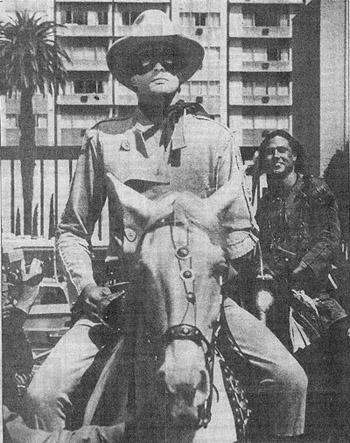
The new Lone Ranger and Tonto rode into Los Angeles in 1980.
In 1980, an ex-Tucsonan, Klinton Spilsbury, was selected to play the famous masked man. He was introduced, along with the new Tonto, Michael Horse in front of Mann’s Chinese Theater in Hollywood. Spilsbury, 25, had briefly attended the UA and his father, Max, was a former UA assistant football coach.
Much to the chagrin of the Lone Ranger’s longtime fans, the film’s producer, Jack Wrather, wanted to avoid any confusion with his new hero. So, he obtained a court order preventing Clayton Moore from wearing the famous black mask. Instead, Moore had to wear wrap around sunglasses during his many public appearances.
People are also reading…
But, trouble quickly showed up on the New Mexico set where “The Legend of the Lone Ranger” was filming. Spilsbury’s lack of acting experience was the first problem. A national columnist referred to his skills as not even mediocre and the handsome, young actor’s voice had to be dubbed by another actor.
[photo moved to image asset]
AP photo
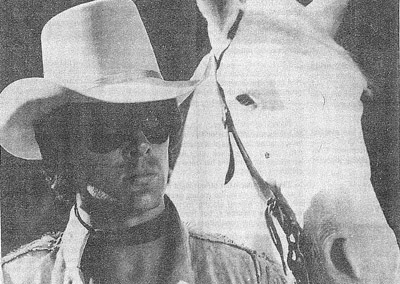
Klinton Spilsbury as the Lone Ranger.
Apparently, riding a horse had not been a requirement for the role either. It became increasingly clear that the new Lone Ranger could not ride a horse. Must have been hard to duplicate that mighty “Hi-yo Silver Aw-a-ay” scene.
But, those issues may not have been the worst for the image of the Lone Ranger. It was reported that Spilsbury drank too much in the local taverns. He had broken glasses, thrown drinks, slapped a waitress and fallen down a lot. If questioned on his bad behavior, he would proclaim “Hey, I’m the Lone Ranger!”
After it was completed, the “Legend of the Lone Ranger” was pulled from a planned Christmas distribution and shelved indefinitely. When it was finally released, it was expected to lose more than $25 million. In 1983, it made its television debut.
As for Moore, the publicity surrounding the movie and his de-masking only served to increase his popularity. By 1984, he was allowed to resume wearing the famous black mask. Moore died in 1999.
“Return with us now, to those thrilling days of yesteryear … ,”


