By Tim Hunter
Special to the Arizona Daily Star
Most weeks Tim Hunter advises Caliente readers about what to look for in the heavens.
This week he sets a milestone of his own by filing his 500th Sky Spy column. Hunter wrote his first one in February 2007, although his passion for astronomy dates to 1950, when his second-grade teacher showed him a book filled with pictures of the constellations and planets.
He moved to Tucson in 1975 after he finished his training as a radiologist at the University of Michigan Medical Center in Ann Arbor. In 1987, he and David Crawford founded the International Dark-Sky Association, a nonprofit corporation devoted to promoting quality outdoor lighting and combating the effects of city lights on astronomy.
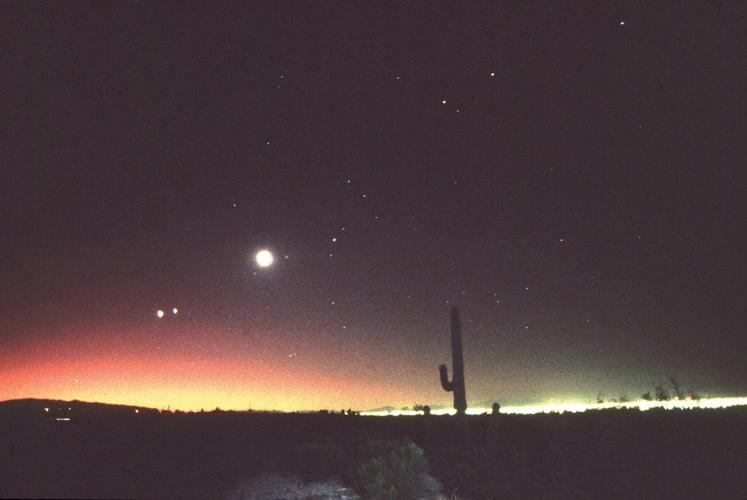
The sun sets Thursday, Aug. 25, at 6:56 p.m. Go out and enjoy the sunset and then watch the western sky along the horizon as twilight darkens. Mercury, Venus, and Jupiter will be close together just above the horizon with Mercury the closest to the horizon. Venus is the brightest planet and is to the right (north) and above Mercury. To the left (south) of Venus is bright Jupiter which is also higher than Mercury.
No matter how busy you are, your assignment is to look for these planets every night after sunset for the next five days. Venus and Jupiter will have a spectacular conjunction (close grouping) on Saturday, Aug. 27. What a great way to celebrate the weekend! That evening Venus and Jupiter will only be 0.2 of degree apart. This is about as close as they get, and it is a must-see event.
While Venus and Jupiter will look as if they are practically touching each other Saturday night, we know the importance of such a conjunction is its beauty rather than it having any astronomical importance. Venus and Jupiter will still be millions of miles from each other. Historically, good descriptions of close planetary conjunctions can be used to help accurately date events that have occurred around the time of a celebrated conjunction.
Contact Tim Hunter at skyspy@tucson.com
5 Questions with Tim Hunter
What got you interested in astronomy?
When I was in second grade I was shown a book with the constellations and pictures of planets. I became fascinated with astronomy. The first constellation I remember from that book is Cygnus the Swan which I couldn’t find in the sky until several years later. That book was printed around 1930 before the discovery of Pluto, and it listed Neptune as the most distant planet from the sun. Even then, I knew Pluto was the most distant planet from the sun. Even as a second grader, I realized the book was old and out of print. However, Pluto is no longer a planet these days! How times change.
What is your favorite astronomical event?
I like good meteor showers even more than total eclipses of the sun. When I was 12 or 13, the Perseids were particularly good, and I stayed up all night marveling in the bright meteors. I wish I had kept notes at the time.
If you could visit any planet, which would it be?
If I live to tell the tale, I would visit Venus. We have not seen the surface of Venus, because it is hidden in dense clouds, and the temperature on the surface is over 800 degrees F with a pressure 90 times that of the Earth, a very hellacious place. Due to these conditions, we have “seen” the surface with a few images taken by Soviet Venera probes that landed on Venus surviving only for a short time. We have extensive radar images of the surface of Venus, but they are hard to translate into what we would see if we walked on the surface of Venus and lived to tell about it.
What are you most excited about seeing in the next year?
The big event for next year is the total eclipse of the sun on Aug. 21. It will sweep across the continental U.S. going from the Pacific Ocean into Oregon and across the U.S. all the way to South Carolina and out into the Atlantic Ocean.
What is a must-have for someone getting into astronomy?
The old fashioned paper/plastic planisphere. It is cheap, easy to use, and is the best way to learn the constellations and bright stars.
Be the first to know
Get local news delivered to your inbox!







 The Mount Rushmore of Arizona Wildcats men's basketball players