Arizona offensive coordinator Seth Doege started his coaching journey a decade ago in 2016.
It wasn’t a glamorous offensive coordinator job at a Power 4 school and it wasn’t even a role to coach the position he played his entire life in quarterback, a position that allowed him to become one of the top passers in Texas Tech history.
Doege was a 27-year-old graduate assistant coach on head coach Mike Jinks’ staff at Bowling Green in Ohio, and Arizona’s offensive play-caller coached BGU’s wide receivers. Doege coached at Bowling Green for three seasons, then his coaching path steered him to USC, Ole Miss, Purdue, Marshall and Arizona over the next decade.
“Looking back on it now, I probably didn’t know what I was doing,” Doege said. “I thought I did.”
Jinks was a former running backs coach at Texas Tech after he was a longtime high school football head coach in Texas. Bowling Green’s staff under Jinks “was a bunch of Texas guys with a bunch of Texas Tech ties.”
People are also reading…
“We had a lot of fun, but we weren’t very good,” Doege said. “That was a problem. That first year, I enjoyed coaching wideouts because they were the best players on the field. It was a natural fit for me because playing quarterback and getting to know your receivers and taking them out and doing routes and talking to them in the summers when the coaches aren’t around, it felt natural to me and I learned a lot.”
The biggest lesson for Doege coaching wide receivers was “I learned how to manage the room.”
“That was my biggest welcome-to-college football (moment),” Doege said. “‘You want to coach the receivers? Well, there’s a bunch of alpha prima donnas in that room that expect the ball every play, so good luck managing that.’ It was fun and I had a great time.”

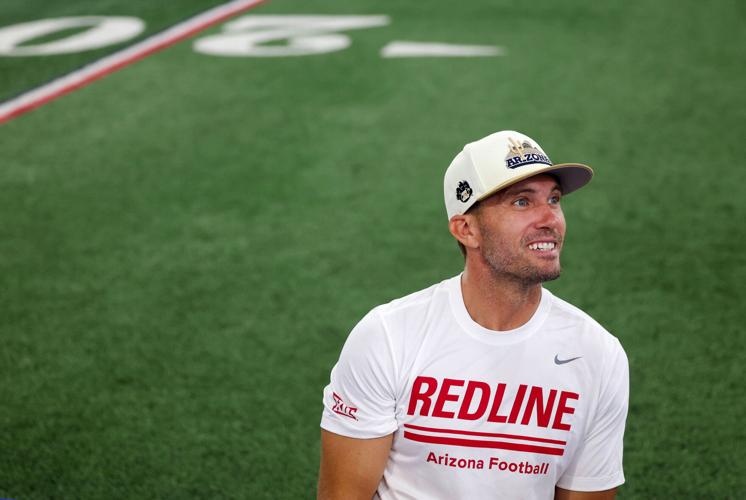
Arizona offensive coordinator Seth Doege speaks with members of the press on football media day at the Davis Sports Center, Aug. 4, 2026, in Tucson.
When it comes to managing Arizona’s wide receivers, as the Wildcats are getting into the swing of training camp, “I leave it up to (wide receivers coach Bobby Wade), because Bobby has the best feel for the room,” Doege said.
“He does a great job of inserting guys at specific times in practice,” Doege said.
Added Doege: “Bobby is probably the best I’ve ever been around at managing numbers and making sure everyone feels secure and getting the opportunity they deserve. We’ll continue to do that, continue to build that, mix and match and make sure they’re getting their fair opportunities.”
Doege, Wade and Arizona head coach Brent Brennan have mentioned in the past — going back to the spring — that Arizona could potentially rotate up to eight wide receivers this season, with Tre Spivey, Chris Hunter and Giovanni Richardson as the headliners — three wide receivers who have played a combined 1,751 offensive snaps and recorded 121 receptions, 1,559 yards and 15 touchdowns.
Spivey, Hunter and Richardson lead an Arizona receiver group that is losing its two most productive receivers from the Holiday Bowl squad in Kris Hutson and Javin Whatley.
“Everybody knows about Tre Spivey, Chris Hunter and Gio, but there are six guys right behind them that are really good football players and are all going to be pushing each other for reps,” Brennan said.
The candidates pushing the aforementioned trio include West Virginia transfer Rodney Gallagher III, USC transfer DJ Jordan, Colorado State transfer Jordan Ross, sophomore Isaiah Mizell, junior Brandon Phelps and freshmen R.J. Mosley and Caleb “Jet” Smith.
“Starting in the spring, I fell in love with Rodney,” Doege said. “When you’re in the transfer portal and recruiting guys, it’s easier than high school because you’re seeing them do it. If you look at Rod’s tape, he’s catching game-winning touchdowns in the Big 12. There’s a warrior component to Rodney that I really like.”
In three years at West Virginia, Gallagher had 64 receptions for 605 yards and three touchdowns. The former four-star recruit, who has garnered comparisons to former UA wide receiver and punt returner Luke Wysong, had the second-most receptions (28) for the Mountaineers in 2025 — his only season under former Arizona head coach Rich Rodriguez.
Doege has two rules when it comes to playing slot receiver: “If you want to play in the slot, you better have great feel for space and you better be tough; Rod is both of those.”
“The other thing about Rodney is when you put the ball in play and you put it in his hands, he’s tough to tackle because he’s really twitchy,” added Doege. “I’m excited about Rod. I think he’s going to bring a ton of value for us.”
Ross “is very explosive and very smooth” and Jordan “is about as explosive of a receiver as we have on our team,” Doege said. Jordan was a highly touted recruit as a Los Angeles-area native and Sierra Canyon High School product. After redshirting his freshman season at USC, Jordan had five catches for 38 yards in his second season in 2025.
Even though Ross was a three-star recruit out of Warren High School in Downey, California, he held offers from Auburn, Washington, Notre Dame and Arizona, but signed with Colorado State, which had a strong L.A. pipeline under former CSU head coach Jay Norvell.
Ross and Jordan “are still learning the scheme,” Doege said. Arizona’s offense is “way more complex than what people give us credit for,” added Arizona’s offensive coordinator.
Doege said Jordan and Ross are overcoming similar struggles as Spivey, whose inconsistencies with lining up correctly pre-snap and running wrong routes prevented him from receiving more playing time.

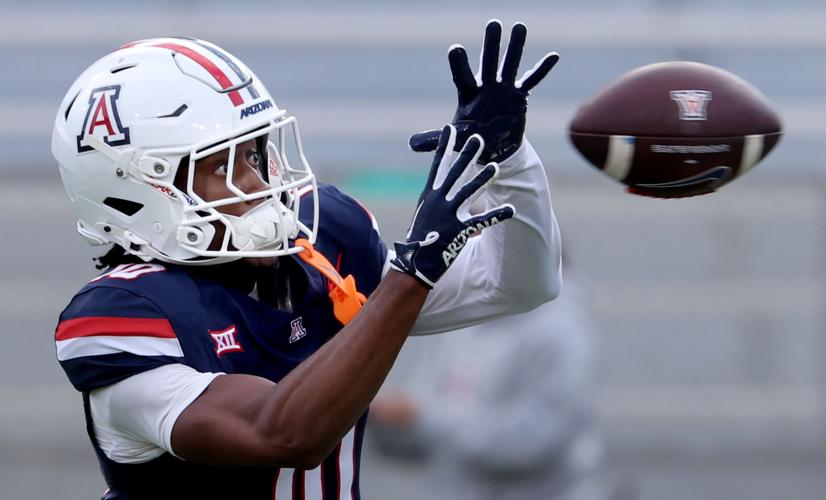
Receiver Jordan Ross eyes a pass on his route during the Spring Showcase in Tucson on April 25.
“DJ and Jordan are on the same train, trying to figure it out, trying to be consistent,” Doege said. “But both of them are really, really talented.”
‘Night-and-day’
Mizell, a 6-1, 165-pound Orlando native and Boone High School graduate, had arguably his best practice Thursday since becoming a Wildcat. Mizell, who has developed a reputation as being arguably the Wildcats’ fastest player, caught multiple passes from quarterback Noah Fifita and won a 50-50 ball against potential starting cornerback Dwight Bootle on a deep pass in a team period.
Mizell is “night-and-day (different) than where he was last year,” Doege said.
“Completely different player and, honestly, a completely different person, in a sense,” Doege added. “You gotta have some patience with young kids. His skillset was that he was really fast, but that was really it. He didn’t know how to play receiver. He didn’t have a great feel for it, but he knew how to run.”
Mizell played in three games last year and briefly became a part of the rotation halfway through the season when Hutson, Hunter “and some other guys were banged up,” Doege said.
“We were depending on a freshman who wasn’t really ready to truly play, and there were some busted routes and all of a sudden it looks like ‘What the hell are they running?’” Doege said.
Doege said “the greatest thing about Mizell is that not only has he developed as a receiver that we can depend on — now, he’s got some work to do still and he’s not a finished product — but I trust him.”
“I think that comes with maturity,” added Doege. “The way he approached the offseason, the way he approached winter conditioning, the way he approached summer, that’s what is paying off for him, his mentality and the way he’s been attacking. I’m excited about him.”

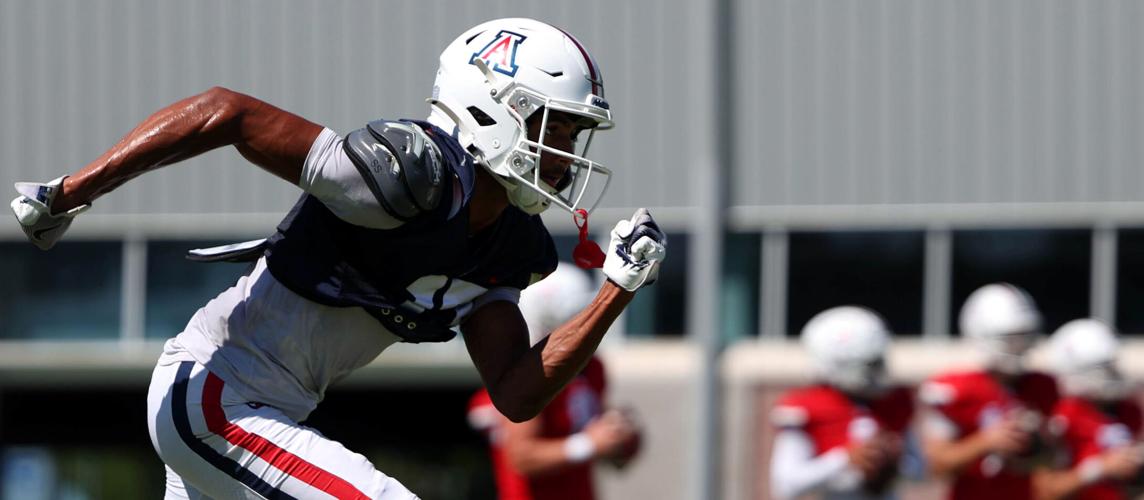
Arizona wide receiver Isaiah Mizell (17) takes off on his route during fall training camp at Dick Tomey practice field, Aug. 20, 2025.
Mizell and the 6-3, 201-pound Phelps, a Gilbert native who missed most of the spring with an injury, are returners who are pushing to be in the mix at receiver.
Earning their stripes
Arizona’s two receivers from its 2026 recruiting class in Mosley and Smith, “those two are both professionals,” said Fifita.
At the Lowell-Stevens Football Facility, Arizona has an “accountability board.” If you’re late to a team or position meeting, your name goes on the board. If you miss a team meal at Bear Down Kitchen, your name goes on the board. If you miss a UA class, your name goes on the board.
Mosley and Smith’s names have yet to show up on the board.
“Those guys have never been an issue,” Fifita said. “You talk about the way they work, they’re guys that put their head down and work. That’s how you want to be, especially as a freshman. You’re coming in to earn your stripes and that’s exactly what they did. They didn’t talk, they just came in and went about their business and got through their work. … Both of those guys are extremely special and they’re special people.”
Smith had one of the top plays on the first day of training camp, elevating over multiple defenders on a deep ball during a team period; second-year quarterback Luke Haugo threw the pass.
Smith has a chance to crack Arizona’s receiver rotation “because of the way he carries himself and the confidence and speed he plays with,” Fifita said.
The 5-8, 166-pound Smith is also one of the candidates at punt returner, a position that requires vision, elusiveness, fearlessness, speed and ball-tracking skills. Punt returner is a thankless job. When a punt returner does their job, nobody notices. But when there’s muffed punts, everyone notices. Smith “doesn’t shy away from that part,” said special teams coordinator Craig Naivar.

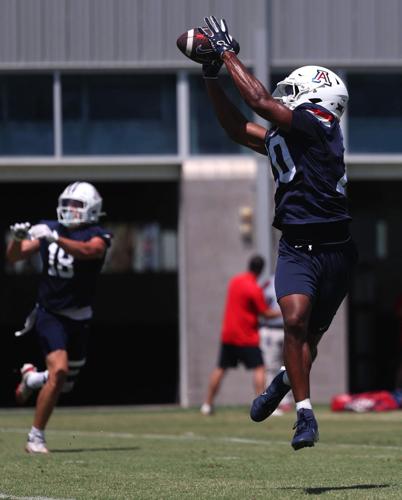
Arizona wide receiver Caleb Smith (20) catches a pass during fall football practice at Tomey Field, Aug. 6.
“He is very steady back there,” Naivar said of Smith. “He doesn’t panic. If the ball drifts on him, if he didn’t read it off the foot correctly, he doesn’t panic and make rapid adjustments that cause problems. He’s really smooth at catching the football and he believes. That’s a big piece of it, catching everything.”
It’s one thing to return punts on the practice field as a true freshman, but what about live action in front of 50,000-plus people? The Arizona coaches aren’t reluctant to put Smith at punt returner because of his confidence and consistency, plus, the Allen, Texas product played at Allen High School, a stadium that holds 18,000 people — the eighth-largest high school football stadium in the U.S.
The four-star Mosley, a 6-3, 199-pound Pittsburg, California product, was Arizona’s highest-rated signee for 2026 — the highest-rated receiver to sign with the Wildcats since Tetairoa McMillan in 2022, according to 247Sports.com’s ranking system.
Mosley “has a natural instinct for catching the ball and he’s a great route runner,” said Fifita, who also noted Mosley caught most of the 50-50 balls thrown his way during Arizona’s player-run practices this summer. After overcoming a hamstring injury in the spring, Mosley is a big-bodied receiver with potential.
To get on the field as freshmen, “for those young players, they have to demonstrate to know what to do,” Brennan said.
“They’re both very talented and that was the reason we were excited when they chose to come to the University of Arizona” Brennan said. “That will play out more and more as we get going. … Are they making the most out of the opportunities they get? I tell players that all the time, especially young players. The fastest way to get on the field is to know what to do. It’s amazing how many times they struggle with that or know what that is until someone else is playing in front of them, because they consistently know what to do and can perform at a high level.
“I think for those young players, it’s important that they know what to do and they can play with toughness and full speed.”
Contact Justin Spears, the Star's Arizona football beat reporter, at jspears@tucson.com. On X(Twitter): @JustinESports

Justin Spears
Sports Reporter


 Worried about Arizona football’s O-line? ‘Coach O’ will take care of it | Michael Lev