

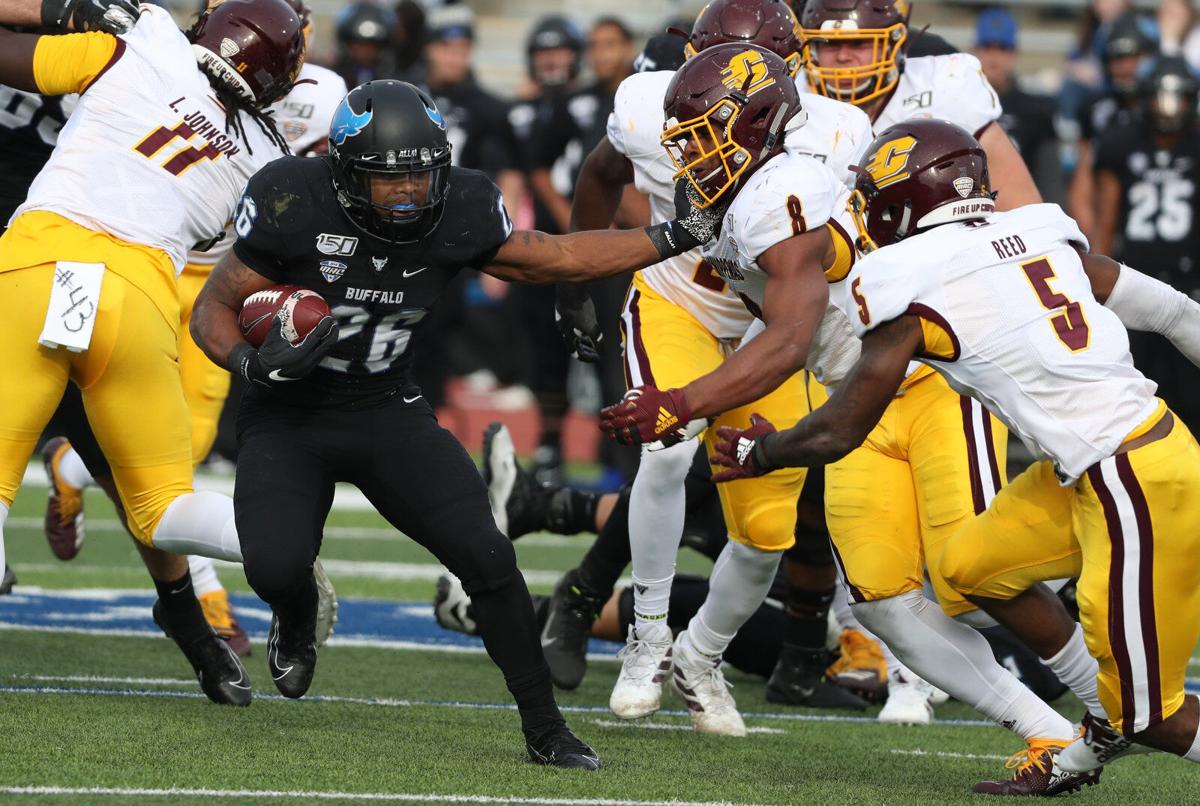
The return of the MAC wasn’t simply a knee-jerk reaction to everything else that was happening within the landscape of college football, officials say.
Instead, the Mid-American Conference had been keeping a close eye on the progression of the Covid-19 pandemic at national and regional levels, as well as advances in testing.
The MAC was calculating a return to play. But when the Big Ten announced Sept. 16 that it would start its football season Oct. 24, that accelerated the MAC’s move to play its season.
The MAC announced Friday that its season is scheduled to begin Nov. 4, and it will be a conference-only, six-game schedule in which teams will face five division opponents and one crossover opponent. The games are likely to be on weeknights, especially early in the season, to help the MAC fulfill the its obligations to ESPN.
People are also reading…
“We were behind the scenes, doing some modeling,” MAC commissioner Jon Steinbrecher told The News on Friday. “We’d laid out a fall football model and a spring football model, and we weren’t talking publicly about it. We’d been digging in on the testing for a little while, and clearly, the Big Ten announcement certainly seemed like the starting gun. That really brought a great deal of focus, and away we went.”
The evolution of testing
When the MAC announced Aug. 8 that it would not play fall sports, there was only one widely used and immediate testing procedure that detected Covid-19: the polymerase chain reaction (PCR) test, an invasive nasal swab that had a 72-hour turnaround for results.
Yet there have been advances in testing over the last seven weeks, and the MAC will utilize a Covid-19 rapid antigen test that produces results between 15 and 30 minutes. The MAC’s testing program begins Oct. 5 and requires four antigen tests per week for its athletes, coaches and football staff. All positive tests will need confirmation with a PCR test, and athletes who test positive will enter a cardiac screening protocol.
“The disease hasn’t changed,” UB athletic director Mark Alnutt said. “It’s still the same disease that we have to be cognizant of and we have to be able to live with during these times, but what has changed is the testing aspect of this.
“From August to now, the first thing is the testing, testing that is now made readily available and wasn’t available at that time, when we made that decision (to cancel). Also, the opportunity for timely results. A lot of our institutions were performing tests where there was a significant delay for when we would get the results, and that does nothing for us as we’re in a position where we’re having consistent contact. Now, when we have point-of-care antigen tests with a quick turnaround of 15 minutes, we’re able to diagnose it as soon as possible.”
Alnutt said a better understanding of Covid-19 itself, as well as better methods to mitigate the spread of the disease in the last seven weeks, factored into the conference’s decision to play football this fall.
Alnutt also said there is an enhanced protocol for return for athletes who test positive for Covid-19.
“It’s no longer, let’s reacclimate them to physical activity," he said. "It’s going to involve cardiac testing, making sure through an EEG process and other testing mechanisms we have, to make sure they are in a position to return. And with illnesses and other viruses such as mono and influenza going on, we have to be cognizant of what the particular long-term effects are (of Covid-19).”
Alnutt told The News in August that the UB athletic department anticipates $1 million in Covid-19-related costs, including an estimate of at least $650,000 for NCAA-mandated testing. UB initiated a yearlong fundraising campaign in September that aims to raise $1 million that would help defray Covid-19 expenses.
The MAC is also planning a partnership for testing, which is expected to be announced next week. The Mountain West announced this week that it will partner with Quest Diagnostics for its member schools to test athletes, coaches and football staff three times a week.
The value of voices and responsibility
But as testing developments progressed, and as other conferences picked up steam in their return-to-play pursuits, players grew anxious. After the Big Ten announced last week it was playing football, UB running back Jaret Patterson spearheaded a social media campaign in which he spoke on behalf of the Bulls and asked for the MAC to reconsider its decision to postpone football season to the spring.
“When I saw half the (Football Bowl Subdivision) playing, and the MAC is not playing, that just made me and (wide receiver Dominic Johnson) want to fight more, because we just want a chance to play,” Patterson said.
Late last week, Patterson was part of video conference with the MAC’s 12 coaches, two players from each team and Steinbrecher.
Steinbrecher discussed with each of the 36 individuals the importance of discipline, accountability and responsibility in order to maintain a season. By that point, at least 13 FBS games had been postponed because of Covid-19 issues, whether it was positive tests, contact tracing protocols or the possible exposure of players and staff to someone who was infected with Covid-19, a highly contagious disease with no vaccine. Five additional games have been postponed since.
“No one had to speak up to know that,” Steinbrecher said. “But it is reaffirmed every time you talk to the student-athletes about this.”
Steinbrecher said if there are Covid-19 related disruptions in the schedule, the MAC will manage those on a case-by-case basis.
“We don’t have the luxury of bye weeks but hopefully, we don’t lose games,” Steinbrecher said. “If we have to rearrange things, we will consider that. This is going to be a work in progress, as the season goes along.”
As the MAC prepares for its return, accountability will be key for the Bulls.
“The coaches have done a great job of explaining to us that one guy can mess it up for the whole team,” Johnson said. “A lot of the guys on the team do this as their job. When this is your job, you take pride in it and make things a priority. Right now, keeping the mask on, being smart, not going to social gatherings, doing what you have to do to play football games, if that’s staying in your room, doing your homework, eating when you’re supposed to eat, that’s what it’s going to have to be.
“When you view things as an extreme priority in order to do your job, we’re going to keep taking that lead on things. We know that information is going to put us in a great position to be successful this year.”
'The last week to 10 days have been intense'
Steinbrecher said that in the last two weeks, the MAC’s medical advisory panel had given positive feedback regarding regional trends in positive case rates and health conditions in regions within the conference, as well as testing advances.
According to the Johns Hopkins University coronavirus resource center’s tracking dashboard, Covid-19 positive rates have dropped since early August in three of the five states that have MAC member schools: New York (1% to 0.9%, through Friday), Illinois (4% to 3.6%) and Ohio (4.7% to 2.6%). Positivity rates have risen in Indiana (8.1% to 9%) and Michigan (2.2% to 2.7%).
UB also said it would adhere to state and local guidelines regarding the resumption of play, and its return would be subject to the approval of the New York State Department of Health.
“Would we be here without the Big Ten doing this? I don’t know if I’d have an answer for that,” Steinbrecher said. “We were going down some of those paths, but the last week to 10 days have been intense, in seeing if this would happen.
“You start digging into that more, and getting more positive feedback.”
UB hasn’t set an official start date for its preseason practices, but UB coach Lance Leipold is confident that his team will have ample time to prepare for an abbreviated season. The Bulls have been on campus since June for offseason, voluntary workouts, and already held walkthroughs inside of the NCAA’s countable hours guidelines.
“Monday is the 28th of September, and they say we’re going to play on Nov. 4, we would have started camp Aug. 7 and played Sept. 5, so we’re going to have plenty of time to prepare,” Leipold said. “This group has been working at it and I know they’ll be excited to go.”
Now, a new countdown begins for the return of MAC football, as well as a renewed attitude among the Bulls, who are favorites to win the MAC this season.
“This is what we’ve been doing our whole lives, as athletes,” Johnson said. “To have it taken away, at first, was very disheartening. To have this opportunity again, none of us are going to be taking it for granted.
“We’re ready.”


