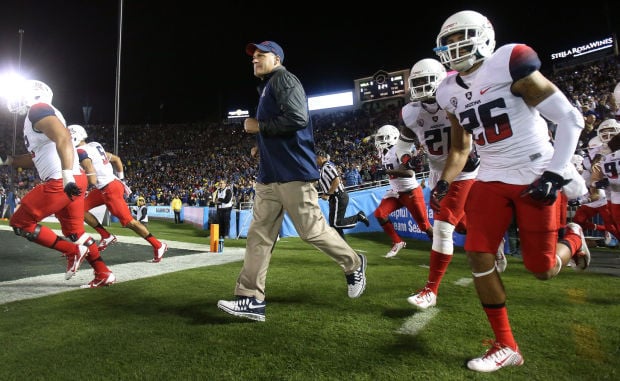
The intense attitude of Rich Rodriguez — even his wife of 25 years says “he is just so competitive” — has carried over to his Wildcats. In his third season, he’s led 10-3 Arizona to a berth in the Fiesta Bowl. That performance puts him at No. 1 on Hansen’s Top 100 list. See full list on pages B6-B7
Rich Rodriguez, the son of a coal miner, grew up in Grant Town, West Virginia, population 600. There is no red light on main street.
Rita Setliff, the daughter of an Army veteran, grew up 45 miles away in Jane Lew, West Virginia. Yes, that’s a town. Jane Lew. Population 400. There is no red light on main street, either.
Rodriguez was president of the junior class and the top all-around athlete in Grant Town. Setliff was a cheerleader who became an all-county tennis and basketball player.
This was the late ’70s. You can almost hear the music: Jack and Diane. Two American kids growing up in the Heartland.
People are also reading…
“I was reading the sports section because a boy I knew was No. 2 in the state in basketball scoring,” Rita Rodriguez remembers. “I looked to see who was No. 1. It was Rich. That’s the first time I heard of him.”
Rich moved from Grant Town to Morgantown to play football for the West Virginia Mountaineers. Rita moved from Jane Lew to Fairmont to play tennis for the Fairmont State Fighting Falcons.
They would not meet for another three years but they were getting closer. Morgantown and Fairmont are only 19 miles apart.
“A girl I knew liked Rich; it’s so funny, we always seemed to like the same guys,” Rita says now. “I thought he was cute, but I was dating someone else.”
Six months later, Rich and Rita met in the cafeteria where Mountaineer football players gathered. He broke the ice.
“Don’t you go to Fairmont?” he asked. “My brother Steve plays on the football team there.”
The attraction was mutual; Rita soon transferred to WVU. She made the cheerleading squad. On Saturday afternoons, she would stand on the sidelines and watch Rich Rodriguez — “he went by Richard or Rich then, never RichRod,” she recalls — make a name for himself as a hard-hitting defensive back.
On July 1, they celebrated their 25th wedding anniversary.
A month ago today, a few minutes before 5 p.m., Rich and Rita Rodriguez were standing 20 yards apart on the sideline at Arizona Stadium. The Wildcats were leading ASU 42-35 as the final seconds of the Territorial Cup ticked off the clock.
He turned, removed his headset, and rather than raise his arms for joy and join a pileup of happy Wildcats at midfield, Rich Rodriguez turned to look for his wife.
They embraced.
A little ditty about Jack and Diane; Two American kids doin’ the best they can.
It was the best moment of Tucson sports in 2014, one of many reasons RichRod is No. 1 on the Star’s list of Top 100 sports figures of the year.
Rich and Rita Rodriguez began their journey in Morgantown, moved to New Orleans, then to South Carolina, back to Morgantown, then to Michigan and finally to Tucson. They’ve won big, lost big, celebrated one another’s 50th birthday and raised two children.
They’ve been accompanied by some serious serendipity.
“My dad, Horace, didn’t want me to go to Morgantown, to the ‘big’ university,” Rita says with a laugh. “He was afraid I couldn’t handle myself in the big world.”
One thing about the Rodriguezes: they’ve never been afraid of the big world. They moved to Arizona in November 2011 without ever setting foot in Tucson.
He did not ask for time to rebuild. He simply built. Even while introducing a new quarterback every season, Arizona won. And won. And continues to win.
While Rich was learning the business at small-school Glenville State, Rita worked for the phone company, driving more than an hour each way to Morgantown. About the only thing that remained constant was the drive to be successful.
“I wanted to coach on the biggest stage possible,” RichRod says in the book “Three and Out.”
Rita recognized his fire within, his hard edge, soon after they met in the Morgantown cafeteria 30 years ago.
“You’ve got to remember, I played on the varsity tennis team at Fairmont,” she says. “So one year we were playing tennis, which he hasn’t played a lot, and I was beating him.
“He was very upset. He tried to break the racket, but it was a wooden racket and it wouldn’t break. He would say ‘I’m not going to get beat by a girl.’ He is just so competitive. It’s no less today than it was then. Maybe it’s more.”
Rodriguez became Arizona’s first Pac-12 Coach of the Year since 1992, and only its second since the school joined the league in 1978. He did it with a team generally picked to finish fourth in the South Division, one quarterbacked by a freshman, one that had just two players — linebacker Scooby Wright and center Steven Gurrola — chosen to the all-conference first- and second-teams.
“It was kind of improbable,” he says.
Kind of?
Before the Wildcats beat Utah 42-10 last month, a game in which the Utes were a six-point favorite, the Pac-12 Networks staff of analysts, Rick Neuheisel, Curtis Conway and Nick Aliotti, unanimously predicted that Utah would win.
To indicate their picks, all three held up placards with a red U on them. It was symbolic of Arizona’s football season. For three months, many of the analysts displayed logos of the UA’s opponents.
“The one thing our guys have done,” RichRod says, “is compete from the first whistle to the last whistle.”
That “Sixty Minutes of Arizona” mantra became the UA’s identity.
It improbably won late-game comebacks against Oregon, Cal and Washington, and held off late rallies by UTSA, Nevada and Arizona State.
In the end, the boy from Grant Town and the girl from Jane Lew embraced on the sideline, capturing the moment in an epic snapshot.
One frame, frozen in time, told the story of Tucson sports, 2014.