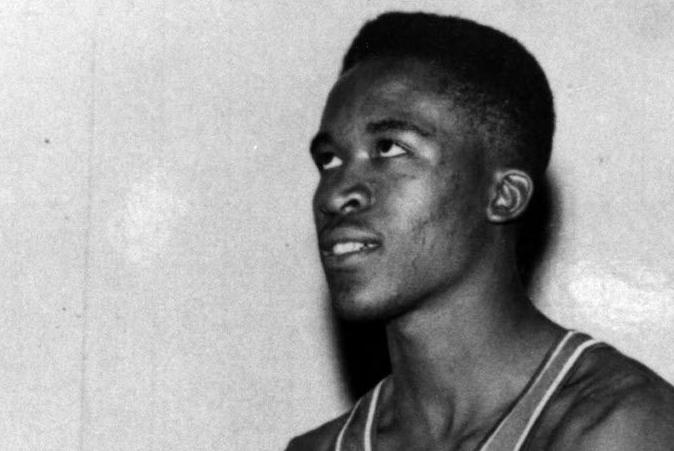
Dec. 8, 1951: Hadie Redd becomes the first African-American to play basketball at Arizona
The racial tension in Tucson in the early 1950s was such that the 1950 Tucson Open Golf Tournament changed its name to the Tucson Open Invitational Tournament to keep Joe Louis, the world champion boxer, from playing at the then-private El Rio Country Club.
The UA’s basketball team, which had competed in the 1951 NCAA Tournament for the first time, had never suited up or recruited an African-American player.
But when the Class 3A state championship was held at Bear Down Gym in March 1951, UA coach Fred Enke watched undefeated Miami High School beat the all-black Phoenix Carver High team.
With great interest, Enke followed Carver’s 6-foot-2-inch senior forward Hadie Redd. He knew Redd was skilled enough to play for the Wildcats, a program coming off 24-6 and 26-5 seasons, with an 81-game home winning streak.
People are also reading…
Enke thought Redd could be a star. Before Carver left Bear Down Gym that day, Enke introduced himself to Redd and offered a scholarship.
“I said, ‘You don’t have any Negroes,’” Redd told me in 1992. “And Coach Enke asked if I would be willing to be the first? I was so excited that I forgot about losing that state championship game.”
Nine months later, playing at Madison Square Garden against Canisius, Hadie Redd, the son of a Phoenix maintenance man, scored 20 points for Arizona.
After that it got much more difficult.
The star freshman became academically ineligible and left school in March of 1952. He returned to Phoenix, got a job, and gave the money to help pay for his mother’s medical needs. He was tempted to join and Army and forget basketball, but former Tucson High all-state running back Hayzel Daniels, then a judge in Phoenix, an African-American with exceptional influence in the African-American community, encouraged Redd to return to school.
And then it really got difficult.
In the 1953-54 season, Arizona’s road games in the Border Conference — especially in Texas — became a montage of racial ugliness.
At West Texas State, a fan displayed a sign that said “Go Home Blackbird.”
“They thought I was a demon,” Redd said in that ’92 interview, returning to Tucson to be inducted into the UA’s Sports Hall of Fame.
To its credit, the UA threatened to sever relations with Texas Tech, among other Border Conference schools, unless its “ban against Negroes” was lifted.
Redd was allowed to play all Border Conference games in his final two UA seasons, but he did not accompany his team in Texas hotels or restaurants. He stayed with local African-American families.
The same thing happened in 1955, when he became the starting first baseman on Arizona’s baseball team. Progress was painfully slow.
At the conclusion of the ’55 baseball season, Redd joined the Army. He was married and would have two children. He did not return to Tucson until 1988, when he was a featured guest at the All-Black Alumni Basketball Game at McKale Center.
By then, Hadie Redd had established an identity that went far beyond his ballplaying days at Arizona.
He joined the San Francisco Police Department at an entry level. He was soon promoted to the community relations department, then the District Attorney’s Office. In 1971 he was named chief investigator for the SFPD.
His work and reputation was such that on Sept. 11, 1992, the son born to laborers in Tyler, Texas, in 1933 was honored in San Francisco on “Hadie Redd Day,” as proclaimed by Mayor Frank L. Jordan.
“There were times I felt I wanted to leave and go some other place,” Redd said in ’92, “but there was too much at stake to quit.”
Redd scored 784 points in his Arizona basketball career, but it comes off more like 8,000. That’s how much he meant to the school. He was the UA’s equivalent of Jackie Robinson, breaking barriers in what was sometimes a painfully prejudicial city, even in the late ’50s.
“I meet with quite a few young men in Northern California, and I tell them about my college days,” he said. “They find it very difficult to believe. Why? Because we had it entirely different then. Today’s young man just hasn’t experienced it. They appreciate what you talk about and are grateful for hearing about any progress that has been made, but it’s difficult for them to understand. They just don’t have firsthand knowledge of it.”
Where is he now? Redd died of a stroke in 2011.
How he did it: After he retired, Redd was a volunteer in a San Francisco-based group, Black Men in Action, an organization to help young black men understand and deal with the evils of racism.