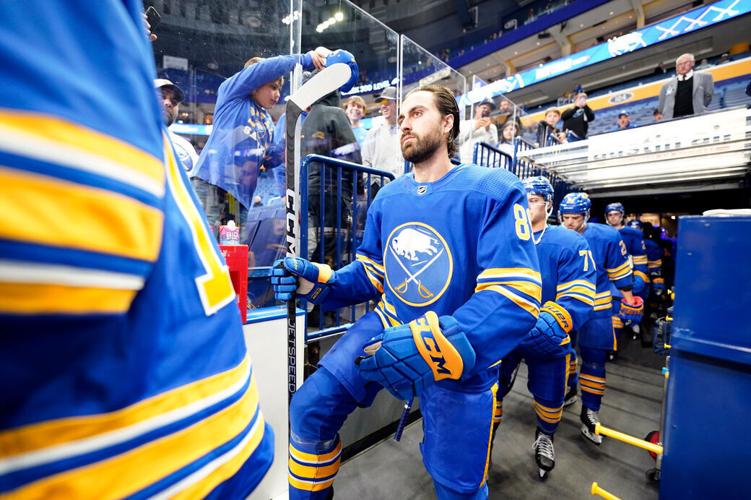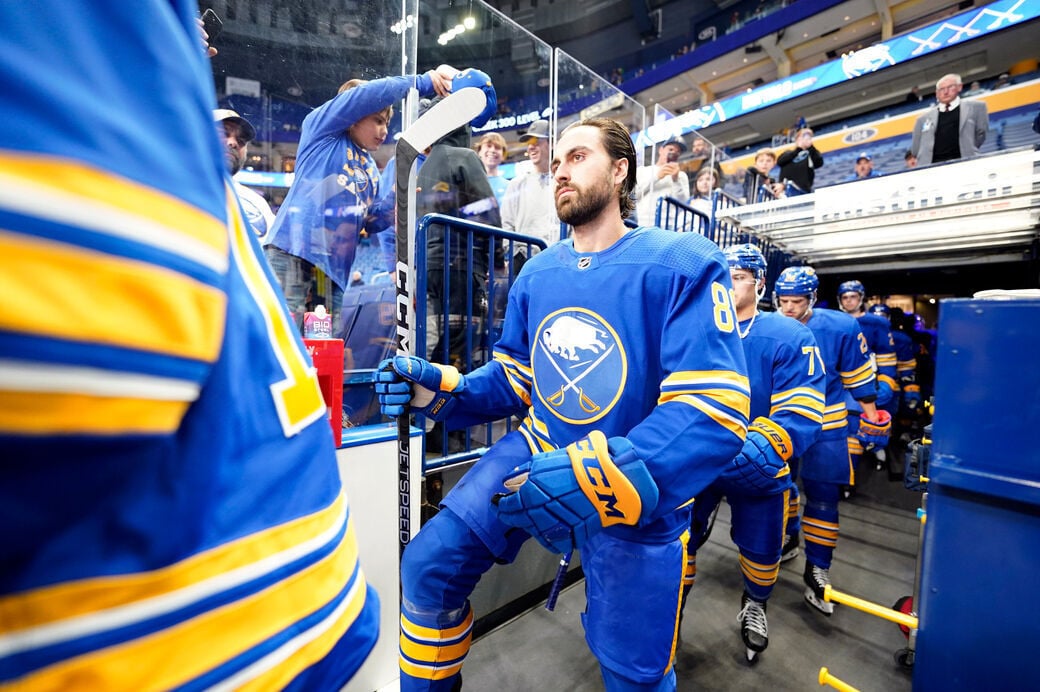
Having just received the news last November that his son, Alex, had been traded in-season for the first time of his NHL career, Carl Tuch prepared himself for the incoming phone call.
Alex had reached the Stanley Cup Final as a Vegas Golden Knights rookie. He was less than two seasons into a seven-year, $33.25 million contract. He was an established part of the club’s core. And he had developed significant and unforgettable bonds with teammates, staff members and the entire Las Vegas community.
Carl expectation: He would have to console (trades happen) and uplift (this is a new opportunity) Alex, even though his move to the rebuilding Buffalo Sabres was a move close to his hometown of Baldwinsville and a significant increase in ice time.
“At first, you feel bad because he had a lot of change coming and a lot of uncertainty coming,” Carl said. "You’re worried about him and how he’s going to take it.”
People are also reading…
The phone buzzed and Carl answered.
“Almost seconds later, he said, ‘Dad, can you believe I’m going to Buffalo!?’” Carl said. “He was elated. That made me feel so much better. He wasn’t upset. He was excited. He was happy. It was a dream. For a parent, it was, ‘Thank you, what a relief.’”
A relief because Alex’s dream met reality – he was returning to the team he grew up rooting for and from a hockey standpoint, the Sabres provided a chance to show off his entire skating, passing, shooting and leading toolbox.
“He would always talk about how, growing up, he wanted to play for the Sabres,” said Vegas defenseman Shea Theodore, a former teammate who remains a close friend.
Tuch, 26, has capitalized on the trade, which also sent Peyton Krebs and draft-pick compensation to the Sabres in exchange for disgruntled center Jack Eichel. Entering Tuesday night’s match at Montreal, Tuch is tied for second on the team in goals (nine), is third in points (16) and his career-high average ice time of 18:34 leads all Sabres forwards.
The Sabres, though, aren’t winning. The shine of their 7-3 start has been extinguished amidst an eight-game losing streak that has sent them plummeting down the league standings. But maybe Wednesday’s return home to play St. Louis will provide the needed spark. When Tuch attended his first Sabres game as a young kid, he posed for a picture in the upper deck with a red Sabres jersey. When the team announced plans for a goathead throwback jersey earlier this year, Tuch celebrated on social media.
The Sabres will re-debut their goathead black jersey against the Blues.

Alex Tuch, age 6, with his dad, Carl, at a Sabres game. Alex is wearing the goathead jersey of the time, and will get to wear one again Wednesday night.
“I’m going to be shaking, honestly,” he said during an extended interview with The Buffalo News last month. “I idolized the guys who put that jersey on each and every single night and being able to come here and put the Sabres jersey on means the world to me, but to put the goathead on, I didn’t think anything would make me more anxious and excited, but they found a way. They figured it out – put a goathead on the jersey.
“I’ll be flying (Wednesday night).”
Talk about a full hockey circle of life event. His favorite team wearing his favorite jersey … and he’s on the ice. The journey started in Syracuse and moved on to Ann Arbor, Mich.; Boston; Des Moines, Iowa; Las Vegas; and now Buffalo.
Ann Arbor to Boston
Tuch’s road to the NHL began in the Syracuse area, where he was big enough size-wise and good enough skill-wise to play “up” in age groups. At ages 3-4, he played with kids ages 5-7. When he was 5-6, he played on a team with kids 6-8. As a 15-year-old, he started playing Junior B hockey for the Syracuse Stars in a league that included players as old as 19.
“I was a good skater and I wasn’t a small kid so it was easier for me to play with older kids,” Tuch said. “I enjoyed the challenge. There was never a time when I said, ‘Oh, I can’t do this.’ That was never in my mind.”
Carl and Sharon Tuch built a rink in their backyard for Alex and younger brother Luke (a second-round pick by Montreal who currently plays at Boston University). Younger sister, Leah, played high school field hockey and now attends Oswego State, studying to be a special education teacher.
Carl’s job at ABB Hitachi required travel and Sharon drove Alex to most practices. During game weekends, Carl would serve as a team manager, sometimes assistant coach.
“By the time he was 5 or 6, he was better than me,” Carl said. “We surrounded him with good coaches so I didn’t have to teach him hockey. My role was more of a life-lessons role and being a parent, not a hockey coach.”
The Tuchs think Alex was 6 when he attended his first Sabres game and wore the red jersey, the in-person thrill matching the smile on his face in the picture.
“Kid in a candy store; saucer eyes,” Carl said. “He was having a good time and he was there with his team so that was fun, too. What happened after that, he was so busy because that was the start of travel hockey and weekends were games and during the week was practice so he didn’t get a lot of chances to go to Sabres games. Those were unbelievable memories when he did get to go.”
Tuch’s hockey career in Syracuse progressed, setting up his first major decision: Pursue playing in USA Hockey’s National Development Team Program, which would set him up to play in college, or go to the Ontario Hockey League, which would make him ineligible to play for a U.S. college.
Tuch traveled to Ann Arbor for a 40-player camp and program officials met afterward with he and his father.
“We want to offer you a spot here; we have to know in a week,” they told the Tuchs.
The Tuchs weighed their options. Alex visited the Ottawa 67’s and Kitchener Rangers in the OHL and also talked with several other teams. Before the OHL Draft, in which he was projected as a first-round pick, Alex decided to join the USA Hockey program beginning with his 11th grade year.
“I wanted to represent my country,” he said. “I loved it. It was awesome.”
But not right away.
“Terrible (first couple of months),” he said. “I was immature, naïve, sheltered – all of the above. Loved my home. Loved being at home. Wasn’t really used to being away. I had a tough time.”
Tuch adapted, though, on and off the ice. He was on a team full of stars collected from around the country; his first team included Eichel, Detroit Red Wings captain Dylan Larkin and established NHL players J.T. Compher (Colorado) and Connor Clifton (Boston). He received hard-but-instructive coaching from Danton Cole. And he made an impression on his future Sabres coach, Don Granato.
In the USA Hockey program, Granato led the odd-birth year team so he didn’t coach Tuch’s 1996 birth-year team.
“I can remember watching him play one of his first games and thinking, ‘Wow, I wish I was coaching this kid,’” Granato told The News after a recent practice. “I remember that like it was yesterday. He was big then and he had great feel for the game and for time and space around him and a lot of power in his game, even at that age.”
Tuch managed only 10 points (four goals) in 38 games for the USNTDP in 2012-13, but increased his production to 32 points (13 goals) in 26 games for the Under-18 team the following season.
“The USA program, he had a really tough coach (Cole) and that made him better; he had to overcome adversity,” Carl Tuch said. “Nothing has ever been handed to him.”
Tuch was drafted 18th overall by the Minnesota Wild in 2014 and played two years at Boston College.
Shortly after committing to play for USA Hockey at age 16, Tuch had his sights set on playing for one of college hockey’s premier programs. His first scholarship offer was from RPI, whose coach, Seth Appert, now leads the Sabres’ AHL team in Rochester.
Tuch visited RPI, Cornell, Colgate, Michigan and Boston College, ultimately signing with Boston College and coach Jerry York.
“I fell in love with BC,” he said. “First and foremost, Jerry helped turn boys into men away from hockey. He really focused on each individual and making sure you were the best person possible. He ran a tight ship; it was disciplined. You were held accountable. You were pushed on and off the ice. Where he helped me was to play more of a pro style. There was a lot of structure, but at the same time, you had the freedom to play and he allowed me to discover different areas of my game.”
Tuch totaled 62 points (32 goals) in 77 games in two seasons, including the 2016 Beanpot overtime winner. He is “chipping away” on his degree (major in communications and minor in marketing) and is 9-10 classes away. Last month, he was taking a principles of economics class online.
Tuch signed with the Wild in April 2016.
Thriving in Vegas
Tuch played only six games for the Wild, spending his first pro season with the top minor-league affiliate in Des Moines and posting 37 points (18 goals) in 57 games.
“His game grew the most in Iowa,” Carl Tuch said.
The first time Alex was traded was ahead of the Golden Knights’ deal-a-palooza in the June 2017 expansion draft. The Wild didn’t want Vegas to select Matt Dumba, Marco Scandella or Eric Staal so they traded Tuch to the Golden Knights for a conditional draft pick and the understanding from General Manager George McPhee that he would not select the aforementioned trio and instead add Erik Haula.
Vegas had a glut of contracts to start its initial season so Tuch and Theodore were sent to the minor-league Chicago Wolves. Tuch scored four goals in three games and was called up to Vegas when several forwards were injured. Theodore soon followed and they lived in the same house for two seasons in suburban Summerlin.
“We always had a good time and some good laughs,” Theodore said when the Golden Knights were in Buffalo earlier this month. “He’s very laid-back, very easygoing.”
Tuch played 78 games (15 goals among his 37 points) for Vegas in 2017-18.
“Everybody individually had a lot of success, everybody was having fun at the ink and away from the rink, we loved the lifestyle and the fans treated us way better than we could have ever imagined,” he said. “We were winning, too, on top of that.”
Vegas beat Los Angeles, San Jose and Winnipeg in the playoffs and won Game 1 of the Final against Washington before losing four straight. Tuch had 10 points in 20 postseason games.
“We all had that chip on our shoulder,” he said. “Every time we played, we would usually have a guy who played on that team so we would be like, ‘We want to win this game for that guy.’ We started rolling in the playoffs.”
Tuch signed a contract extension before his second season with Vegas and his production increased to 20 goals. The following season, Pete DeBoer replaced Gerard Gallant as coach midseason.
“If it was baseball, they would talk about ‘Tuchy’ as a five-tool guy – he’s got size, speed, he can shoot, he can make plays and he has great hands,” said DeBoer, now the Dallas Stars’ coach, in a phone interview. “He’s got everything you want in a player and I think like all power forwards, it takes a little longer for them to develop and come into their own. He was just scratching the surface of the player he was going to become.
“We just tried add more layers to his game. We added some penalty-killing duties and we played him at center. We just felt like if we could make him versatile enough to play in any situation, he would be a better player and we would be a better team.”
During the bubble playoffs in Edmonton (fall of 2020), Tuch scored eight goals in 20 games and DeBoer said, “I would argue he was the best player in the bubble on any team for a few of those weeks. He was that dominant.”
Tuch’s final game in a Vegas uniform was a conference final loss to Montreal. He underwent shoulder surgery and was traded to the Sabres while rehabbing the injury.
“Going to Buffalo was the perfect opportunity for him to become what he should be and that’s a first-line player and I told him that when he got traded,” DeBoer said.
’Huge impact’ on Sabres
Tuch wants to be with the Sabres, wants to be a part of their resurgence, wants to be a top-six (or even top-three) forward, wants the responsibility of playing a big role in every game. Emphasize, the wants to be here, though. He is aware of the players who have asked out during the organization’s playoff drought and seeks to be part of the solution.
“Huge impact in that regard,” Granato said. “His energy for the organization, his feel for the history of the organization – you can feel that. You could feel he was a guy who came here with that knowledge. It was a real boost for our guys because here were a bunch of young guys that are gaining respect for the city they play in and Alex walks in and he’s lived it. He was that little kid in the stands.”
Said defenseman Jacob Bryson: “Donny (Granato) and (GM) Kevyn (Adams) talk about how they want guys who want to be here, and he’s a prime example.”
That he plays a prominent role helps. Tuch’s enthusiasm for being with the Sabres might not carry as much weight if he were in and out of the lineup due to performance. When he gets his 6-foot-4, 219-pound frame in full flight, he whizzes by his teammates and coaches who are watching from the bench, the teammates glad he’s not their problem to stop, and the coaches impressed with how he is out-of-control fast.
“If he collided with somebody, yes, it would be a runaway train, but there is a grace to it when he gets going that is pretty special,” Granato said.
Pretty special will be Wednesday night. A unique touch in the Sabres’ locker room is listing the hometown above each player’s stall. Next to “89 Tuch,” is “Syracuse, U.S.A.” Every time Tuch reaches to hang up his skates, he sees it. That will hold a particularly special meaning when he puts on his throwback jersey to play for his home-region team.
“It’s crazy,” he said. “You always get to remember your roots when you walk in. Just two, 2½ hours down ‘The I-90’ (was home). Always dreamed about it, but never really thought it would happen.”