

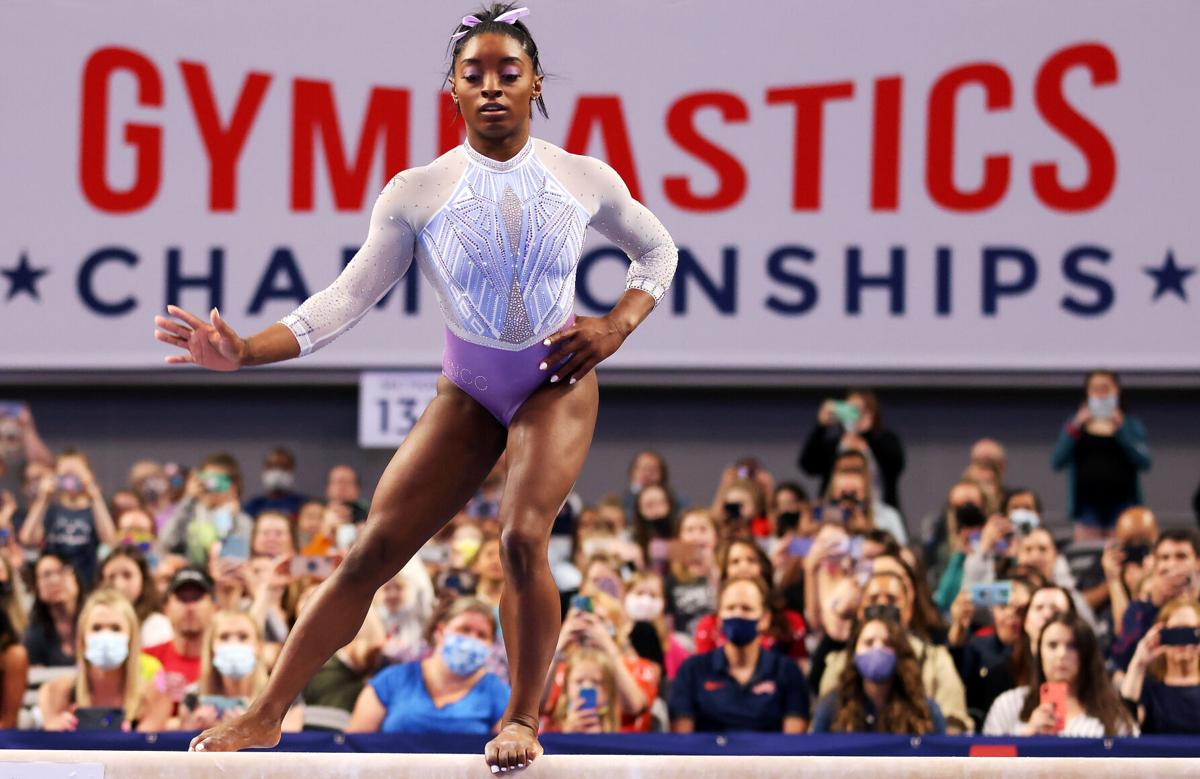
The sequined outline of a goat, sketched on the right shoulder of Simone Biles' leotard, sparkled under the lights at Dickies Arena as she waited to perform her floor exercise routine Friday night. Biles is acknowledged to be the GOAT of women's gymnastics — Greatest of All Time — and she came to the U.S. championships this weekend all but a lock to win her seventh U.S. all-around title.
But even the greatest sometimes have a misstep or two.
She had flown high and far on her two vaults, moved nimbly between the uneven bars, and delivered a balance beam routine of staggering difficulty. But her tumbling and twisting is so powerful that the white lines on the springy floor couldn't contain her, and she stepped out of bounds three times during her floor exercise routine. She lost half a point from her score on the first day of the two-day women's competition but she's still the GOAT by any measure.
People are also reading…
If anything, the missteps made Biles seem more human — and they gave her room to put on a real show at the U.S. Olympic trials later this month in St. Louis before she shines on the big stage at the Tokyo Games. Even though on Friday she replaced the history-making Yurchenko double pike vault she did last month with an "easier" Cheng (and did a second vault, called an Amanar, with a hop on the landing), she easily had the top score on Friday. Her total of 59.550 points put her well ahead of a gritty Sunisa Lee and Jordan Chiles, who trains with Biles in Spring, Texas.
Biles had the top score on beam (14.350) and floor exercise (14.650). Lee, of St. Paul, Minn., had the top uneven bars score (15.300) and was second with 57.350 points. Chiles has 56.900 points. The women's event will conclude on Sunday.
The U.S. championships will determine which women qualify to compete at the trials, with the top eight all-arounders automatically earning berths and the rest being selected by a committee. For Lee, who has battled injuries, a strong performance on Friday was especially meaningful because it was the first time her father, John, had seen her compete in person in three years. He was paralyzed in an accident in 2019.
"It was amazing having him here," she said "Before the competition, he told me to forget about everything and just do what I do best."
That, she did. "It felt really good to be back out there because I feel people kind of counted me out a little bit because I was only doing bars and beam for a little bit," she said of having to limit her competition because of a foot injury. "But I think by trials I can be back to 100 percent."
Chiles steadied herself after an early wobble on the balance beam but kept calm and earned 13.95 points. It's her third straight strong meet and she's squarely among the favorites here and at the Olympic trials. "This meet is really, really important. It's the competition right before trials and I just wanted to show I can stay consistent the whole time," she said. "I'm really happy that I was able to do that today."
Rio team gold medalist Laurie Hernandez, who has been attempting a comeback, was withdrawn from the competition on the advice of medical personnel after performing her balance beam routine. It's still possible that she will compete on Sunday.
The men's competition will end on Saturday and is likely to feature the crowning of a new all-around U.S. champion. Six-time all-around winner Sam Mikulak of Newport Beach, Calif., and Corona del Mar High fell prey to nerves, fatigue, and a lack of competitive experience the past year and was in seventh place with 82.45 points after Thursday's opening session, 3.8 points behind leader and two-time NCAA all-around champion Brody Malone of Stanford. Yul Moldauer, the 2017 U.S. men's all-around champion, was tied for second with Brandon Briones of Stanford with 83.60 points each.
"I really didn't come in here having any high expectations. I just wanted to come in and focus on my gymnastics because that's the one thing I can control, and just hitting routines," said Malone, whose total of 86.25 points included tying for the best vault with a score of 14.70.
Mikulak's high bar score was the best of the session and assured him an invitation to the Olympic trials. But he fell off the parallel bars and struggled during his floor exercise routine. "By no means did I feel like my good, confident, gymnastics self. I'm going to think a lot going and seeing what I can adapt, what I can change, kind of some quick tweaks to give me that confidence back," said Mikulak, who intends to retire from the sport after the Olympics.
Mikulak said he planned to consult with his sports psychologist before the finale to get "some new, positive vibes," and that he was considering adjusting his diet to improve his energy. "One thing I guess I've got going right now," he said, "the bar is set real low and I should be able to improve a lot from this day going into Saturday."
Here's a look at every Olympic gold medal design since 2000
Sydney 2000

American athlete Marion Jones holds up her 5 Olympic medals for track and field events in central Sydney, Australia, in this Oct. 1, 2000 photo. The IOC formally stripped Marion Jones of her five Olympic medals Wednesday Dec. 12, 2007, wiping her name from the record books following her admission that she was a drug cheat. (AP Photo/Adam Butler)
Salt Lake City 2002

Sarah Hughes of the United States displays her women's figure skating gold medal, during a press conference at the 2002 Winter Olympic Games in Salt Lake City, Friday Feb. 22, 2002.(AP Photo/Darron Cummings)
Athens 2004

Silver medalist Andreas Dittmer of Germany, gold medalist David Cal of Spain and bronze medalist Attila Vajda of Hungary (left to right) display their medals on the podium after in the Men's C1 1000 meter final, during the canoe flatwater event at the 2004 Olympic Games in Schinias near Athens, Greece, Friday, Aug. 27, 2004. (AP Photo/Mark J. Terrill)
Turin 2006

From left, the bronze, gold and silver medals of the Turin 2006 Winter Olympic games are seen in Turin, Italy, Tuesday, Jan. 10, 2006. The design of the medals is inspired by the shapes of historical Italian coins and rings, and the hole at the center of the medals represents the open space of a piazza, an Italian square. (AP Photo/Alberto Ramella)
Beijing 2008

Official medals of Beijing 2008 Olympic and Paralympic Games display during a delivery ceremony of the medals to Executive Vice President of BOCOG Jiang Xiaoyu in Beijing Thursday, July 3, 2008. (AP Photo/Oded Balilty)
Vancouver 2010

USA's gold medalist Shaun White reacts during the men's halfpipe medal ceremony at the Vancouver 2010 Olympics in Vancouver, British Columbia, Thursday, Feb. 18, 2010. (AP Photo/Jae C. Hong)
London 2012

The Olympic medals are seen on the hands of Chairman of London 2012 Olympic Games, Sebastian Coe, right, and Olympic gold medalist Kelly Holmes as the medals are unveiled during the London 2012 Olympic one year to go ceremony at Trafalgar Square in London, Wednesday, July 27, 2011. (AP Photo/Sang Tan)
Sochi 2014

Gold, left, silver, center, and bronze medals are displayed for journalists during a presentation of Sochi 2014 Olympic medals at the SportAccord International Convention in St. Petersburg, Russia, Thursday, May 30, 2013. (AP Photo/Dmitry Lovetsky)
Rio 2016

FILE - In this Aug. 12, 2016, file photo, five-time Olympic champion Katie Ledecky shows off her gold medal from the women's 800-meter freestyle swimming competition at the 2016 Summer Olympics in Rio de Janeiro, Brazil. (AP Photo/Michael Sohn, File)
Pyeongchang 2018

FILE - In this Sep.21, 2017 photo, South Korean athletes pose with the silver, gold and bronze medals, from left, for the Pyeongchang 2018 Winter Olympics during an unveiling ceremony in Seoul, South Korea. (AP Photo/Lee Jin-man)
Tokyo 2020 (now 2021)

The medals feature an unusual design quirk. They will be made using old cell phones and other electronics.


