LOS ANGELES – Expanding the World Cup doesn't only mean more games.
It means more rest, too.
After having a full week between the opener against Paraguay and the second game against Australia, the U.S. men's national team has another six days before the group-stage finale against Turkey. Compare that with previous World Cups, when there were typically four days between group-stage games, and there's anywhere from three to six days between games in the knockout rounds.
At the 2022 World Cup, for example, the U.S. men's national team played every four days.
"I absolutely love it," Tyler Adams said. "Your body feels it, obviously, a little bit more coming in from the end of a season and into a World Cup where there's so much emotion, so much adrenaline, all these things. So yeah, it's nice having (more time off)."
People are also reading…

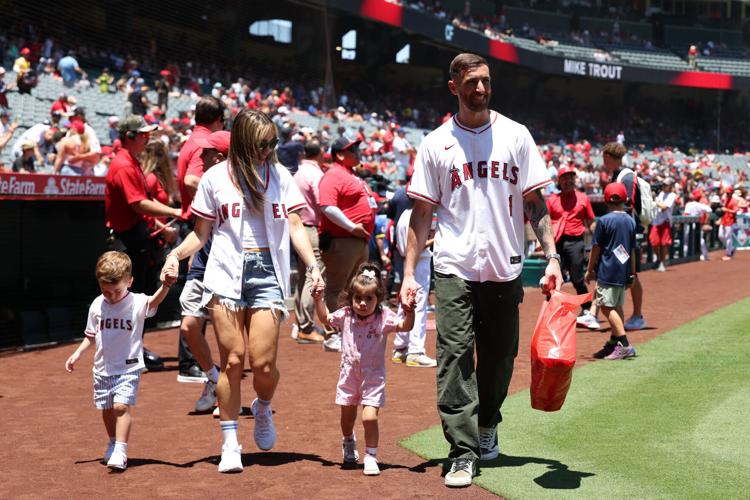
Matt Turner and his family attend a June 14 game between the Los Angeles Angels and the Tampa Bay Rays at Angel Stadium in Anaheim, Calif.
When there are only four days between games, the days go quick. The first is typically an off or recovery day. There's traveling to the site of the next match, which usually occurs two days before the game. (Though in Qatar, with all of the games in and around Doha, travel could be done day of game.) And oh, yeah, training, meetings and film review have to be fit in somewhere in between.
That doesn't leave much time to catch your breath, let alone do anything else.
At this World Cup, nothing has to be rushed.
The first day after the USMNT plays is usually focused on recovery. Massages, stretching, ice baths, things like that. The next is a complete off day, giving the players time to spend with their families, sightsee or relax. Then it's back to training, and there are still three or four full days to get work done.
It's similar to the club schedule where, outside of cup competitions, there is typically one game a week.
"You're able to actually game plan games whereas in Qatar, you weren't really able to do that. You're able to game-plan training, you don't have to go really full into it," said Brenden Aaronson, who is playing in his second World Cup. "I think that's the biggest part of it. And I think that's going to help us throughout this time."
The USMNT doesn't have to log a lot of miles in the group stage, playing two of its games at SoFi Stadium, about an hour's drive from its base camp in Irvine, California, and the third in Seattle. Compare that with, say, England, which has its base camp in Kansas City and group-stage games in Dallas, Boston and New York.
"For teams that have to travel a lot and play in three different places, I think it's a good thing that they have enough time to be able to recover and take care of their body and take care of their injured," Weston McKennie said.

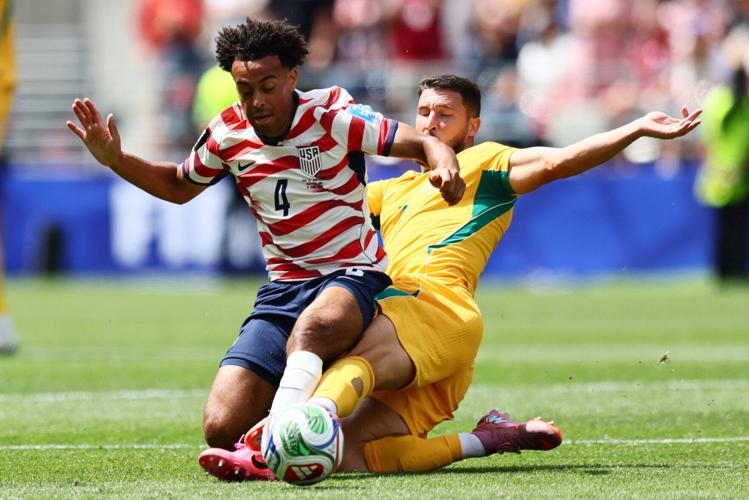
Tyler Adams of the U.S., left, and Australia's Mathew Leckie play in Friday's Group D World Cup match in Seattle.
Giving injured players that extra time to recover might be the biggest benefit of this expanded tournament. At least, it's going to be for the USMNT.
Christian Pulisic didn't play in the game against Australia after injuring his left calf in the first half against Paraguay. But coach Mauricio Pochettino said he expects Pulisic will be ready for the group-stage finale against Turkey.
The Turkey game is 13 days after the USMNT played Paraguay. In that same time frame in Qatar, the USMNT had finished the group stage and played its round-of-16 game against the Netherlands.
"I've enjoyed the fact that we've had time to de-stress from the game. We've got more time in between games for people who might pick up niggles and stuff to actually get ready for the next game. So I do think there's benefits to that," Antonee Robinson said.
So what are players doing with all this newfound free time? Teams from other countries are taking advantage of the chance to sightsee. Harry Kane and England teammates Djed Spence and Dan Burn went to a Kansas City Royals game with manager Thomas Tuchel. Norway's Erling Haaland checked out Katz's Deli in New York.
The USMNT is staying at a beachside resort, so sun and sand is always an option. Similar to in Qatar, U.S. Soccer has set up a lounge at the team hotel where players can watch games, play video games or hang out.
But for many of the USMNT players, the days off are a chance to spend time with their families. For players who are in Europe for the majority of the year, that's no small thing.
"Off day, I don't want to spend time with any of (my teammates)," Adams cracked.
"I don't get to see my brothers, my mom or my dad often," Adams continued. "So that was super important to just be able to hang out with them and put the game to the side for a day."
No team likes to press pause when it's winning at the World Cup. But the trade-offs of these extra days off make it worth it.