Rafael Nadal is just like any other star athlete seeking validation and a measure of dominance in their chosen sport.
It can be both a gift and a curse, and that idiom certainly rings true for the 22-time Grand Slam champion.
But Nadal, playing in his familiar garb of pirate pants and a sleeveless shirt, is hardly like any other athlete, especially a tennis player. The sound of that left-handed serve (Nadal actually is right-handed) and forehand, with a grunt, is just part of the charm. The openness with which he displays his emotions is a thing of beauty.
In "Rafa," the new Netflix documentary which premiered Friday (produced by Skydance Sports), Nadal gives us an in-depth look at what it takes to become an icon and the sacrifices required to reach a level most mortals could only hope to achieve.

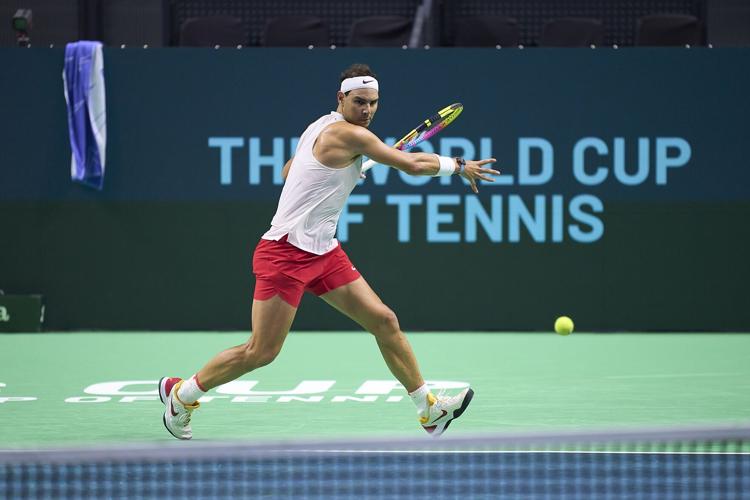
Rafael Nadal of Team Spain during Spain's training session prior to the Davis Cup match on Nov. 18, 2024 in Malaga, Spain.
Throughout the four-part, nearly four-hour film, director Zachary Heinzerling (“Cutie and the Boxer,” “Stolen Youth: Inside the Cult at Sarah Lawrence,” "McCartney 3,2,1") doesn’t take shortcuts or insult viewers. The documentary shows the good, the bad and the ugly side of Nadal as he puts his body through the wringer, especially as he winds down his career in 2024, seeking one more shot at glory even though he knows his body won’t cooperate. The four parts serve as a testament to the toughest battles of Nadal’s career: early-career injuries, rivalries with Roger Federer and Novak Djokovic, and further injuries that ultimately forced him to retire at age 38.
People are also reading…
Heinzerling said the film took a year of filming and another year of editing and that he had the pleasure of having Nadal's personal home movies at his disposal.
"There were no explicit restrictions, which is surprising," Heinzerling said to USA Today Sports. "He has not been able to articulate who he is through his words. There is a real integrity and honor in that. You have to watch him struggle through the pain. But once he decided to do it, he was all in."
Behind-the-scenes looks at the inner workings of an athlete in their craft are nothing new, especially for a documentary of this length or scope, but this is no infomercial for one of the sport’s greatest players.
The yes-men you see with most athletes are nowhere to be found here, as Nadal’s team demands excellence and isn’t afraid to tell him the truth or make fun of him, especially when he has to urinate before a match or when he is an admitted lover of Alpro strawberry yogurt and Oreo cookies. The audience will appreciate the sometimes introverted Nadal opening up about subjects that would never have been revealed without his cooperation (the film can be viewed in English and Spanish, with English subtitles).
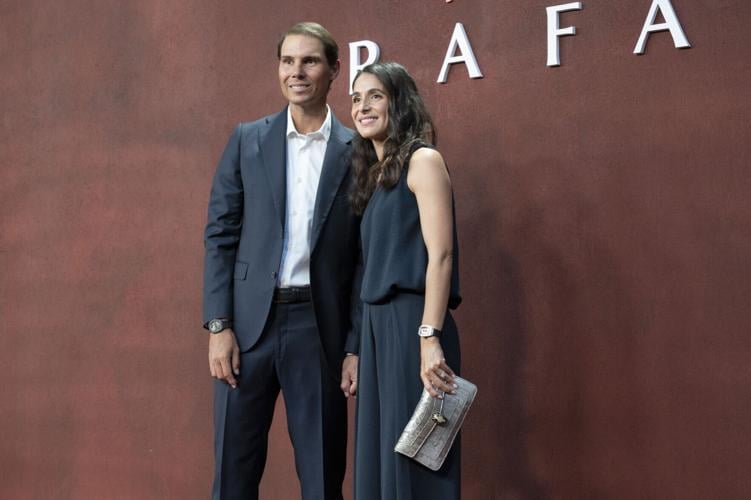
No doubt a standout in the film is Nadal's wife, Maria Francisca Perello, with whom he has two sons. From the story of how they met as youngsters to helping him navigate a new normal in life after tennis, Perello serves as the emotional rock whenever needed.

Rafa Nadal and María Francisca Perelló attend the global premiere of "RAFA" the Rafa Nadal documentary at BETI JAI in Madrid, May 20.
When discussing the numerous injuries he played through — and despite many people, including doctors, telling him to stop playing — the drive to win and stubbornness take over with undeniable force. Nadal reveals in the film that he has Mueller–Weiss syndrome, a rare, degenerative foot condition that should have ended his career long before he racked up 14 victories at Roland Garros.
Nadal also says that during his heyday in the 2010s, he became reliant on anti-inflammatories to keep him functioning on and off the court. The consequence: He now has small holes in his intestines.
“If I hadn’t explored all that, I probably would have 10 fewer Grand Slams,” Nadal says matter-of-factly. “I’m not saying one or two, I’m saying 10 or 12. This is the reality.”
The film opens with Episode 1, “No Tomorrow,” which traces Nadal’s journey from first picking up a racket at age 3 to his first Grand Slam title at the 2005 French Open, when he began his journey to becoming “the king of clay,” just two days after his 19th birthday. Heinzerling smartly weaves the narrative through interviews with his family and home movies.
How Nadal accomplished all that he did, including spending almost 18 years (912 weeks) ranked in the top 10 and being the only player to be ranked No. 1 in three different decades, is honestly beyond comprehension.
If there is a theme in the film, it’s the moment Nadal’s uncle, Toni, shows up. Even Nadal acknowledges the role his Uncle Toni played in his success. One thing Heinzerling does in detailing their relationship, especially in Episode 2, “The Rainmaker,” is to avoid playing the moral police. The audience will decide whether the methods Toni Nadal used to help his nephew become one of the greatest athletes of his generation were above board. Athletes and their relationships with family members or their entourage can be complicated enough; even here, when the love is apparent, it makes for a fascinating yet uncomfortable watch.
Things came to a head in 2017, when Carlos Moyà was brought in to help form a coaching duo, and Toni decided to leave the team of his own volition (he told the press before actually telling the team).
“I felt a bit shocked. He was my uncle, and the influence he had on me was greater than anyone else I’ve ever had. I was afraid to think about how I would react without Toni," Nadal says in the film. "I lived the final years of my career with a sense of freedom and less tension than when Toni was around.”
Nadal’s quirks are also on display, with him brushing his hair away, lining up water bottles, and pulling up his shorts.
But it’s Nadal’s contemporaries, namely Federer and Djokovic, who give the needed on-court analysis of his game and what made him such a great.
“Rafa likes rhythm, I don’t need it,” Federer, who had a 16-24 career record against Nadal, says when describing the fierce rivalry.
Heinzerling says the key to Nadal's success, and one of the themes of the film, is how he handles his circumstances.
"It’s something we have seen in tennis before. But tennis is a psychologically demanding sport. You can’t hide behind any teammates," Heinzerling said. "Rafa is the people’s champion. That kind of humility is motivation. The race was also against himself, not others. He just has a different mentality than the rest of us."
Hardcore tennis fans will no doubt shed a tear and sometimes look away at the pain Nadal endures during his career. Ultimately, the film can be bogged down by slow pacing at times, but it does an adequate job of presenting Nadal not purely as a sympathetic figure, but as a man dealing with the emotional and physical toll on his three-decade road to glory.