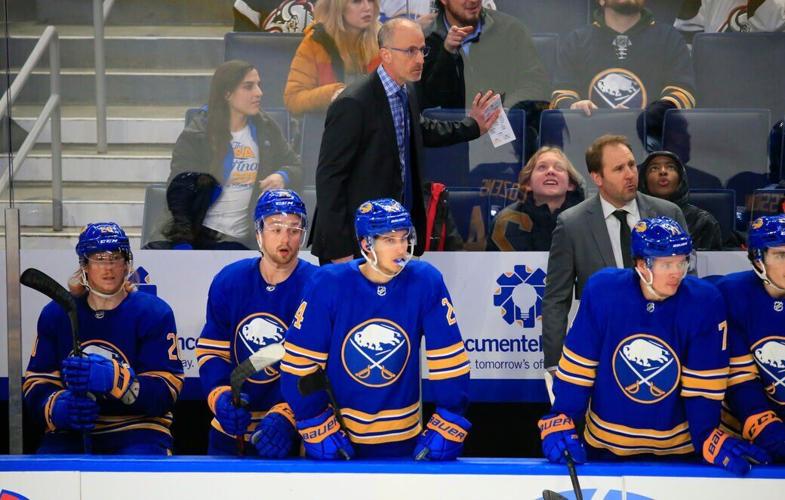
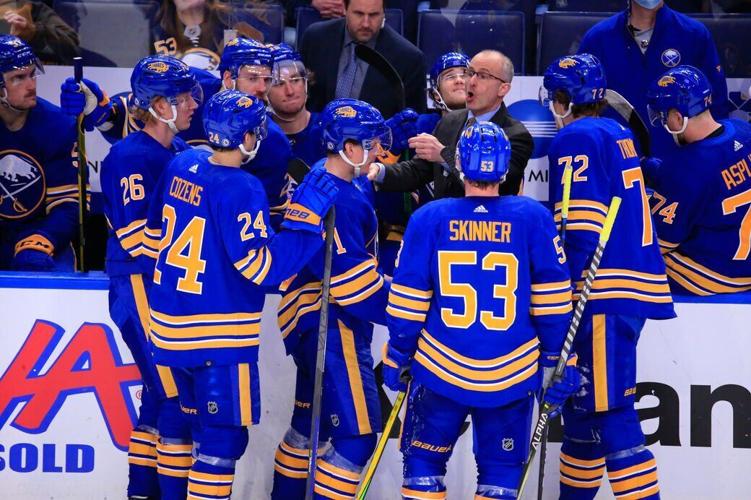
When the 16,505 fans filed to the exits following a memorable sendoff for broadcasting legend Rick Jeanneret, Don Granato stood in front of his players in their dressing room and reflected on an 82-game whirlwind that brightened the outlook for the Buffalo Sabres.
“You guys are all – right here, in my heart, I’ll never forget this group of guys on this team,” he said in response to the come-from-behind overtime win to cap his first full season as the Sabres’ coach. “And what happened out there tonight was no accident.”
For once, Granato could bask in what the group built together. He admittedly didn’t take time to think about all that his players accomplished during a season that inspired hope for a fan base that’s endured 11 years without the Sabres reaching the Stanley Cup Playoffs.
People are also reading…
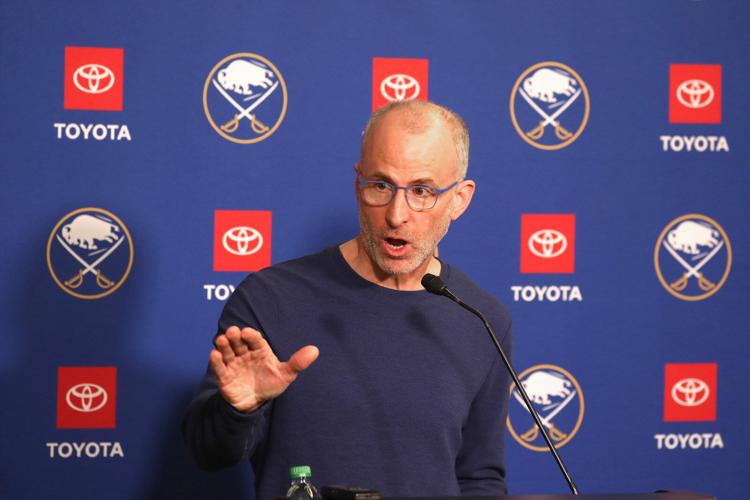
He was too hyper-focused on what’s next. The job doesn’t allow for anything else. But the pride poured out of Granato during his end-of-season press conference, as the 54-year-old hockey lifer listed all that his players achieved over the past seven months. This, after all, was his first NHL head coaching job and it arrived 28 years after his playing career ended. He experienced triumph and tumult in between, including multiple championships and a battle with Hodgkin's lymphoma.
There was Tage Thompson’s breakout 38-goal season following a move to center, Rasmus Dahlin’s emergence as a legitimate top defenseman in the NHL, Jeff Skinner finding his scoring touch again, Kyle Okposo reaching the 20-goal mark, Victor Olofsson persevering through an injury to lift Buffalo during its impressive finish to the season, Casey Mittelstadt scoring the winning goal in the finale following a difficult injury, Craig Anderson’s 300th career win and Henri Jokiharju emerging as a leader when Owen Power arrived.
Seemingly every Sabres player on the roster, no matter their experience, improved under Granato and his staff. And coupled with what occurred off the ice, a bond that Dahlin referred to as a brotherhood, the franchise finally has a foundation in place that’s necessary for winning.
“When I reflect back, that’s what I look at,” said Granato. “Like, the rewards these guys got is phenomenal for me. … Those are special for me, personally. … We felt like we just kept moving up and up and up. And I feel like, OK, the exciting thing for me is – we’ve gotten to this level – is the next level. Figuring it out and then targeting it and moving on it. The offseason for me, the excitement is I can move onto the next thing, and we can move on to the next thing.”
Against the grain
Dahlin made a mistake that’s common for a young defenseman on a team that’s not ready to contend. At only 21 years old and burdened by the pressure of being drafted first overall by Buffalo in 2018, Dahlin committed a turnover on a power play that led to Seattle’s Brandon Tanev scoring a shorthanded goal on Nov. 29.
It was the most recent error for Dahlin during a difficult start to the season. Previous coaches were firm in their response and gave answers to the media that only fueled criticism from the outside.
Granato passionately backed Dahlin publicly. There was no decrease in playing time or scolding. Unshackle yourself from external expectations and forget about your desire to please coaches, Granato told his emerging star defenseman. Dahlin responded with a breakthrough season in which he was selected to the NHL All-Star Game and became the first Sabres defenseman since Garry Galley in 1995-96 to reach the 50-point mark.
On and off the ice, Dahlin emerged as a leader and became an alternate captain.
“He makes sure that you are confident,” Dahlin explained. “He pushes you. He wants every guy to succeed in there. You really feel that he has your back. I remember I did some mistake against Seattle or something. He stood up for me. … We want to succeed, and we want to win for him. It’s a mix of everything.”
There were many nights this season when Dahlin texted Granato following a game asking what he could do to improve. The message wasn’t to play loose or feel free to make mistakes. Instead, Granato and his coaching staff didn’t want his players to fear that a turnover or bad play would lead to a decrease in ice time.
They repaid that trust by working diligently. Dahlin, for example, went on the ice 30 minutes before practice multiple mornings throughout November to defend one-on-ones from his off-hand side after he was beat in that situation in a previous game. He finished the season with career highs in goals (13), points (53) and average ice time per game (24:01) while defending the opponent’s top line most nights.
“We’re young,” Dahlin said. “We have to do all the mistakes to realize, ‘Oh, I can’t do this in certain situations.’ Experience is everything, I feel. What they are doing right now is special, for sure. It’s not only me in the locker room that has growth this year.”
There was always going to be a steep learning curve for Thompson. He was asked to play center in the NHL for the first time. But he made the move knowing that Granato believed in his ability to succeed there. The coach’s approach was ideal for Thompson. He started the 2020-21 season on Buffalo’s top line alongside Jack Eichel and Taylor Hall following an outstanding training camp, only to lose that spot two games later. He was scratched for 18 of the team’s first 33 games last season.
Under Granato, there was no longer a concern that one mistake or bad game – both are inevitable for even the world’s best – could lead to a benching. He finished two goals shy from becoming only the fourth center in franchise history to reach the 40-goal mark. The exclusive club is Gilbert Perreault, Pat LaFontaine and Pierre Turgeon. And Thompson totaled a career-best 68 points while centering the top line.
Granato benefitted from not having an edict or pressure to win immediately, unlike his predecessor Ralph Krueger. Granato became interim coach when the Sabres lost their 12th consecutive game in March 2021. But he also had what few coaches in the league do, an intimate knowledge of developing young players and scouting talent.
He gained both through his time at the USA Hockey National Team Development Program and as a pro scout with NHL teams. Through his career experiences, Granato adopted an uncommon approach that resonated with the Sabres' players.
“When Donny came in, like he talks about playing fearless,” said Okposo. “And that's something that not a lot of people in the NHL talk about. You think about basic psychology, it seems like a pretty good way to do it. Like everybody's going to make mistakes in this business. And you guys are very quick to point out mistakes, of course. But everybody's going to make mistakes, and if you're able to get past that, then you're allowed to grow naturally as players.”
Behind the scenes
Alex Tuch cringed when he saw Granato writing, “Woo,” in black dry-erase marker on a whiteboard during a pregame meeting last month.
“Play for the woo,” Granato said with a grin.
The witty phrase was a play off Tuch’s postgame victory celebration. A heart-and-soul player for the Sabres, he hugged his goalie following wins and when leaving the ice, belted out, “Woo!”
“I was not expecting that,” Tuch joked. “When he started writing 'Woo' up on the board, I was like, where's he going with this kinda thing? As soon as it happened, I was like 'Oh my god, this is embarrassing.' That’s the type of locker room we have, though. It's pretty loose, it's fun. It’s great to be a part of.”
The positive vibes weren’t created overnight. A behind-the-scenes culture like the Sabres’ can only be built through time, persevering adversity and leadership. Okposo and Zemgus Girgensons were at the forefront of the change.
Young players were free to express their personalities and opinions. Conversations included everyone in the dressing room and weren’t limited to a select few. It was spearheaded by the players, but for it to work, it also must be accepted by the coach.
The season was filled with moments that demonstrated that bond and loose atmosphere, from Okposo’s son, Odin, reading the lineup card before a game to the Sabres wearing 1970s-style basketball uniforms from the Will Ferrell comedy, “Semi-Pro,” when walking off the bus at the Heritage Classic.
Looseness can be mistakenly perceived as a weakness when preparing for competition. But there’s a balance to what the Sabres created. Practices are no longer the same drills run ad nauseum that lead to players going through the motions. Now, they're packed with fiercely competitive situations that encourage effort in one-on-one battles and a desire to win. There was a lightheartedness to those sessions throughout the season. But there was also anger when one side lost to the other.
“I think it’s easy to kind of just say, ‘Guys, go play loose,’ but if you go too far on that side, you lose accountability in a way,” said Skinner, who had 33 goals this season. “You can’t just go all the way to that side of playing too loose. I think he does a good job of keeping that balance because you want young guys to have confidence to make plays. A lot of our young guys are highly skilled, so you want them to have room to be creative. But at the same time, you have to play hard. …
“I think that’s probably one of his biggest strengths as a coach is being able to communicate to his players that sort of line, where the line is, what he expects from us. That is a good feeling as a player.”
'That next step'
Granato was hired as an assistant coach with the Sabres in the summer of 2019 when he decided to attend the team’s alumni golf outing. Late to arrive to the event, he stepped quietly into a room filled with men who scored goals, blocked shots and stopped pucks for the franchise since its inception in 1970.
Rob Ray, president of the alumni association, noticed a stranger was in their midst and walked to the back of the room to see if Granato was lost. Granato will have no issue being recognized at future alumni events. Or anywhere else in Buffalo.
The Sabres went 16-9-3 over the season’s final two months, a 102-point pace. There were seven victories over playoff teams, as well as a galvanizing triumph over Eichel and the Vegas Golden Knights in KeyBank Center.
The late-season success occurred after a series of calamitous events, including last-second losses, the Eichel saga that played out publicly until his trade to Vegas, a Covid-19 outbreak, false positive tests hours before puck drop in Arizona, an injury list that at one point included 11 players and the team used six different goalies.
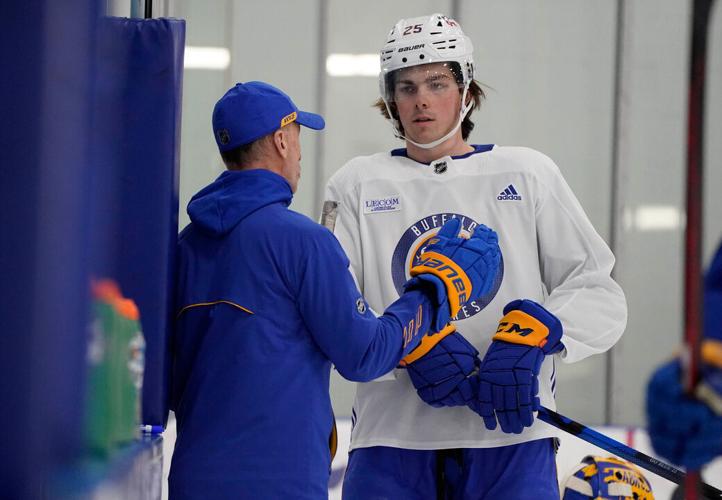
Granato remained focused on helping each player on the roster improve through individual instruction, whether it be one-on-one video sessions or through the work of his assistant coaches.
The rapid development of the Sabres and their young core will heighten expectations next season. Most of the roster will be back for training camp in the fall. There’s a foundation for a formidable top six on defense – led by Dahlin, Power, Jokiharju and Mattias Samuelsson – and a burgeoning forward group that will benefit from the invaluable experience gained by Dylan Cozens and Peyton Krebs, among others.
Granato, like his players, doesn’t want to wait to end the playoff drought. But he and all involved recognize that it’s going to take time and patience, like the Sabres showed fans this season. And as he finally reflected on all they accomplished together, Granato couldn’t help but look ahead.
“I will say that, yeah, I’ve had a long journey coaching, but I’ve had confidence I’d be in the NHL at some point,” Granato said, referring to a career that’s included head coaching gigs in the USHL, ECHL and AHL. “I just wanted to be good when I got to the NHL. I wanted to be better when I got to the NHL, so the timing of taking over this team was perfect for me. It was right. It felt right.
“And then being in Buffalo itself and there’s some things that personally in my life that just fit this. This feels like the right spot to be at the right time. So, happy and excited for all of that. Grateful for all of that. But for me, it’s always that next step. What's the next one?"