On the topic of the Mount Rushmore for Arizona baseball players, I would tell you this:
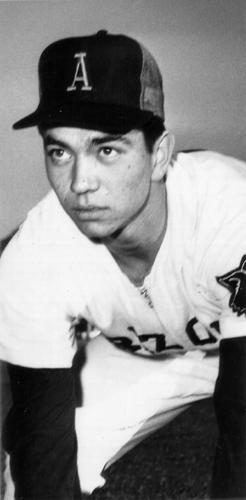
USC baseball coach Rod Dedeaux, who had won national championships in 1961 and 1963, contacted Arizona freshman shortstop Eddie Leon in the spring of 1963 and offered him a full scholarship to transfer to USC. Who wouldn't bite at that?

Eddie Leon at the UA, March 1965. Arizona Daily Star file photo
Arizona was a legitimate Top 25 baseball program in 1964, but the Wildcats had lured Leon from Tucson High School with an academic scholarship — he was a 4.0 student and president of the THS senior class — rather than offer him a full athletic scholarship, which was considerably more than an academic scholarship. UCLA soon called and offered the same deal.
Once UA coach Frank Sancet was informed of the poachers at UCLA and USC, he changed Leon's scholarship to a full ride just in time for his first varsity season, 1965. Few could have predicted what came next: Leon became the No. 9 overall draft pick in the summer of 1965, selected by the Minnesota Twins. Leon declined. He remained at his hometown school through 1967. Twice a first-round draft pick, he became the most coveted shortstop in college baseball.
People are also reading…
Leon led the nation with 75 RBIs in 1966 (he also led in triples with 10). He was a two-time first-team All-American who led Arizona to the 1965 College World Series and left Arizona considered the top baseball player in school history, which was quite a statement given the All-Americans and MLB baseball careers of previous Wildcats such as Hank Leiber, Donnie Lee, Carl Thomas, Dan Schneider and on and on.
What made Leon's story even better is that he was so smart that he skipped two grades in elementary school, meaning that he was usually two years younger than his teammates. But he knew what he was doing; he earned a UA degree in engineering and then signed with the Cleveland Indians after graduation. He went on to play nine MLB seasons, five as a starting shortstop.
Inducted into the inaugural UA Sports Hall of Fame Class of '76, Leon is a no-brainer as part of any Mount Rushmore of UA baseball players. As part of the Daily Star's eight-week summer series of Wildcat Mount Rushmore players/coaches, Leon is my first choice as baseball's Mount Rushmore figure.
The others: 1980 NCAA player of the year Terry Francona, 1976 All-American catcher and national champion Ron Hassey and Hank Leiber, the school's first true baseball star who went on to be a three-time All-Star outfielder for the New York Giants.

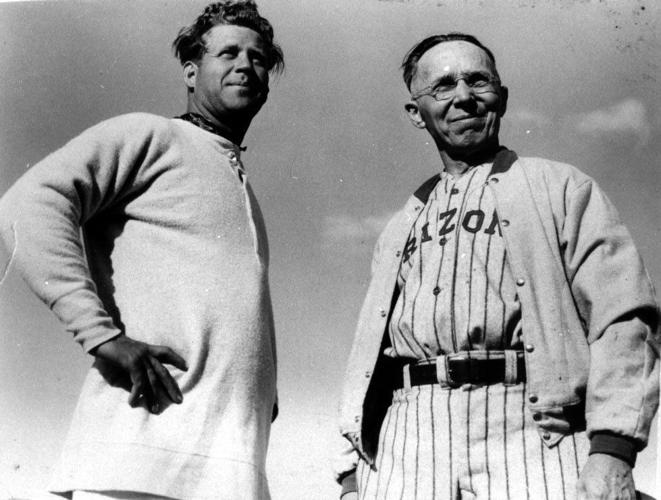
James Fred "Pop" McKale and Hank Leiber, left, was a baseball star for McKale in the 1930s and played in two World Series with the New York Giants, making the All-Star game twice with the Cubs.
Leiber? He played football, basketball and baseball for Arizona from 1929-31, a pitcher-outfielder from Phoenix who helped establish the UA as a brand school in college baseball.
Leiber was so good that when the Chicago Cubs and New York Giants played spring training exhibition games in Tucson, they scouted Leiber and offered him contracts. With two years of eligibility remaining, Leiber accepted the Giants' offer and thus became the first "early entry" athlete at Arizona, jumping from the UA campus to pro baseball.
Leiber did more than just play two years at Arizona. After hitting 101 big league home runs, he returned to Tucson, finished his degree, and became co-owner and manager of the minor-league Tucson Cowboys. A decade later, Leiber became a charter member of the Tucson Conquistadores, helping to operate the PGA Tour in Tucson for decades.
He was even an assistant coach under Pop McKale. While holding out in a contract squabble with the Giants in 1935, Leiber returned to Tucson and helped McKale coach the Wildcats during a month-long contract holdout.
Hassey was a middle-of-the-order bat on Jerry Kindall’s teams of 1974-76 that went, in order, 58-6, 43-13 and 56-17, the magical year Arizona won the 1976 national championship. Hassey drove in 86 runs that season, a school record that stood until 2025. To make it more impressive, Hassey made the switch from third base to catcher for his final two Arizona seasons. He left school with 235 RBIs, an Arizona record.
Hassey went on to play 14 MLB seasons, playing in three World Series to become one of the most high-profile Wildcats in baseball history.
As for Francona, his 1980 season — he hit .401 for the UA national champs — he became perhaps the most well-known UA baseball player ever. Kindall had an insider advantage in the recruiting of Francona, whose father, Tito, had played with and against Kindall in the big leagues, and spent several spring training sessions playing for the Cleveland Indians at Hi Corbett Field.
The irony of selecting a Mount Rushmore of UA baseball with Leiber, Leon, Hassey and Francona is that the two most nationally recognized ex-Wildcats, six-time All-Star outfielder Kenny Lofton and Hall of Fame relief pitcher Trevor Hoffman, didn't get much consideration. Lofton was a UA basketball player from 1986-90 who only played in two UA baseball games. Hoffman played third base and shortstop at Arizona before switching to pitching early in his pro career.
Final thought on Leiber. I had the chance to meet him in the 1980s at the Tucson Country Club. Two ex-UA football stars of the 1940s from Tucson High, Tom and John Black, arranged the meeting by telling me, "Hank is probably the best baseball player in UA history." They had watched him play while growing up near the UA campus.
Leiber was a vault of historic information that day. He talked at length about McKale, about batting against Bob Feller and getting to play golf with Arnold Palmer when the PGA Tour was played at El Rio Golf Course in the 1950s.
"People forgot about me a long time ago," Leiber said. "But even though I'm from Phoenix, I've always considered myself a Wildcat first."


 Greg Hansen's picks for Mount Rushmore of Arizona softball | Greg Hansen's notebook