In the summer of 1999, I got a call from Tom Sanders, associate athletic director at Arizona, who was working to enhance the school's sports history. He had made 1950s football running back Art Luppino his lead project.
"If you get time today, come over to my office, I've got something you won't want to miss," said Sanders.
What is it, I asked?
"Actual game film of Art Luppino against New Mexico State in 1954."

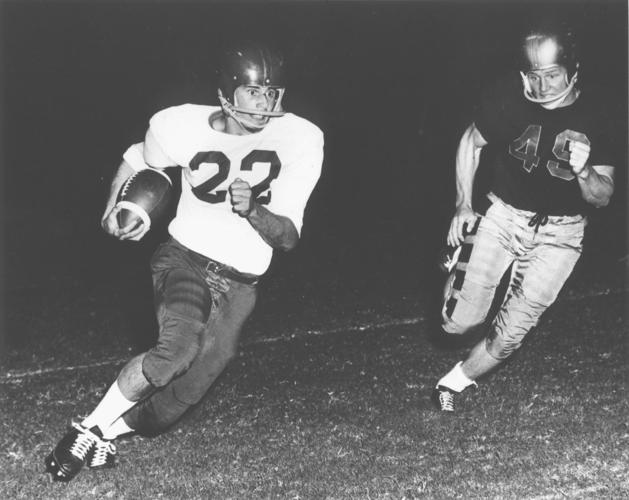
Arizona's Art Luppino (22) led the NCAA in rushing in back-to-back seasons of 1,359 and 1,313 yards, then unprecedented in college football.
Sanders had been trying to acquire as much historical data on Luppino, the famed "Cactus Comet," for a year or two. Now he had the mother lode.
"Art came to my office yesterday with the old film of that game and we watched it together," Sanders said, his voice full of excitement. "You won't believe it."
People are also reading…
Later that day, I sat in Sanders' office and watched the most legendary performance in UA football history. Luppino, a sophomore tailback, rushed six times for 228 yards. Yes, 228 yards, an average of 38 yards per carry. He also returned a kickoff 88 yards for a touchdown and returned a punt 43 yards for a touchdown. He also played safety the entire game.

Luppino
No wonder Parade magazine sent a writer and photographer to Tucson to do a cover story on the young man with movie star looks from San Diego. His nickname, Cactus Comet, and his story were irresistible, even to a media giant like Parade magazine.
By the time Sanders was through authenticating Luppino's feats — he led the NCAA in rushing in 1954 and 1955, with 1.359 and 1,313 yards, respectively — the UA administration agreed to display Luppino's jersey No. 22 at Arizona Stadium for posterity.
When the Daily Star announced plans for an eight-part Sunday series on the Mount Rushmores of UA sports, the first person that popped into my mind was Luppino, who, I am fortunate to report, has always signed his email exchanges with me with two simple words: "The Comet."
In my opinion, he fills the first spot on the Mount Rushmore of UA football. Now 92 and living in Kerrville, Texas, Luppino is joined by College Football Hall of Famers Ricky Hunley, Chuck Cecil and Tedy Bruschi, four players who most define UA football history. Here's some background information:
– Hunley, from Petersburg, Virginia, chose to attend Arizona over Notre Dame in 1980. He was as good as advertised. He made a still-standing school record 566 tackles in four seasons and was the lead figure in Arizona's rise as a Pac-10 power, ranked No. 3 in the 1983 preseason AP poll, and certainly the backbone in ending ASU's domination of the Territorial Cup, knocking the Sun Devils out of the 1982 Rose Bowl and beginning The Streak, a 10-year undefeated period against ASU.
My enduring memory of Hunley, a sideline-to-sideline linebacker, was in an October 1981 victory over Stanford and senior QB John Elway. As Stanford drove to the UA 11-yard line in the final two minutes, seemingly ready to overturn a 17-13 deficit and beat the Wildcats in Tucson, Hunley himself stopped the great Elway on four consecutive plays: twice putting intense pressure on him, forcing incomplete passes, once breaking up a pass at the goal line, and then deflecting Elway's final pass in the end zone.
Hunley had 12 tackles in that game. A year later, he was a consensus All-American. A decade later, he was inducted into the College Football Hall of Fame.
– Cecil: On a hot August afternoon in 1984, following the UA's afternoon practice during two-a-day camp, I asked defensive coordinator Moe Ankney if anyone stood out during the workout.
"I'd say No. 6," said Ankney. "He's a heat-seeking missile."
I had never heard of No. 6, redshirt freshman Chuck Cecil, a former walk-on. By the time Arizona played at Stanford late in the 1987 season, Cecil was a consensus All-American safety, who, a year earlier, had authored the most famous play in UA football history, a 106-yard interception return to beat Rose Bowl-bound ASU at Arizona Stadium.
My lasting memory of Cecil was in Palo Alto in ’87. He intercepted four passes, giving him a Pac-10 record 21. His fourth interception came late in the fourth quarter, stopping a Stanford rally. Following the game, I walked into the UA locker room and saw school president Henry Koffler embracing No. 6. "He put on quite a show," said Koffler. Indeed. Twelve years later, Cecil was inducted into the College Football Hall of Fame.
– Bruschi: Sitting in the lunchroom at Camp Cochise in August 1991, Dick Tomey invited me and several other reporters for a Q&A session following the morning's workout. Someone asked if anyone caught Tomey's eye.
"Our freshman defensive lineman, Tedy Bruschi," Tomey said. "He's got a motor. He doesn't stop. He puts pressure on everyone. He's going to play right away."
Four years later, Bruschi had made 55 sacks, tying the all-time NCAA record. He had been on the cover of Sports Illustrated, became a consensus All-American and had been the unofficial captain of Desert Swarm, Arizona's famous defenses of 1992-95. He went on to start for three Super Bowl championship teams for the New England Patriots.
My favorite Bruschi play came in his final UA game, a crazy 31-28 victory at ASU. With two minutes to go, trailing 28-21, Bruschi sacked the ASU quarterback, forcing a fumble that teammate Joe Salave'a scooped up and ran for a touchdown, tying the game. Arizona won on a last-second field goal two minutes later. What a way to close a historic career.
Luppino, Hunley, Cecil, Bruschi. That's a Mount Rushmore that can match most in college football.



 The Mount Rushmore of Arizona Wildcats football players