

GENOA, Italy — Genoa, if you ignore the debate among scholars, is the birthplace of Christopher Columbus. But after visiting the famed historic port, you might wonder why the explorer ever left.
Tricked out in all the wealth of the Middle Ages and Renaissance, it must have been stunning. Even a half-millennium after its heyday, the Italian port cuts an impressive figure.
Though Genoa can't elbow past Rome, Venice and Florence among Italy's must-see cities, it is a fabulous spot. The prices are reasonable, it's less crowded with tourists, museums abound, and it offers fabulous cuisine, with an emphasis on seafood and the local specialty, pesto.
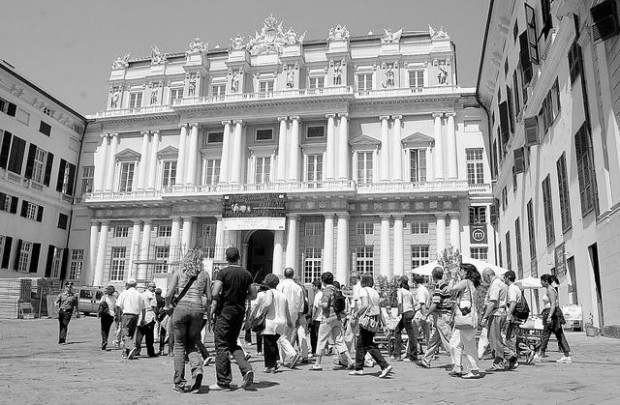
A stroll through the medieval center peels away the centuries. The labyrinth of narrow streets lives in nearly perpetual shadow as 500-year-old buildings lean in until they almost meet. No street follows a straight line for long, and it's a challenge to keep a sense of direction.
People are also reading…
Genoa was an important trade center by the third century B.C. Its sailors have plied the world's trade routes since the Phoenicians and Greeks. Genoa offered a jumping-off spot for the Crusaders. And it was a major player in European politics from the 13th through the 16th centuries. Its merchants dumped their profits into stunning palaces lining the renamed Via Garibaldi. Back then, it was called the Via Aurea, or Golden Street, an appropriate name. Many of the 16th-century palaces are now museums. And others have courtyards open to the public.
But the waterfront is what really makes Genoa work. A large portion is renovated with a boardwalk, slips for yachts, a galleon (which was actually built for Roman Polanski's 1986 movie "Pirates"), restaurants, touristy shops, a fabulous aquarium and the Galata Museo del Mare (Sea Museum).
If you're a boat-in-a-bottle kind of guy or a Patrick O'Brian fan, this place beats shore leave on the Barbary Coast with a pocket full of doubloons and a bottle of rum. It covers ships and sailors from the earliest vessels up to today.
It has a completely reconstructed 17th-century Genovese galley, accompanied by a detailed profile of the men who powered these fast-moving ships with banks of oars. There is also a multimedia re-creation of sea travel in the early part of the last century, with films contrasting the crowded Atlantic crossing of America-bound migrants in steerage with the parties and dancing of flappers above.
The museum's glassed-in rooftop gives a panoramic view of the still-working port and the city climbing up a mountainside. It's also a great spot to watch the sun set over the Ligurian Sea.
The Acquario di Genova nearby bills itself as the biggest aquarium in Europe. It has the requisite sharks, penguins and dolphins, but it also has a really neat exhibit of skates and rays, where you can actually touch their soft bodies. Another section highlights the contributions of world-traveling naturalists, including Charles Darwin. A tank of coral from the Red Sea is packed with colorful and outlandish-looking fish. This stop is certain to entertain children as well as adults.
As the traditional birthplace of Columbus, Genoa could be excused for overdoing the promotion of the explorer. But Columbus' fame (and notoriety for some) doesn't seem to have taken over here. Sure, for the equivalent of about $4 you can squeeze into the tiny house where he reportedly lived as a child to see a disappointing display of what it might have looked like then. But Genoa isn't overrun with businesses, streets, squares and the lot named after him. You're likely to see the names Garibaldi and Doria more often. Giuseppe Garibaldi's military exploits in the mid-1800s were pivotal in Italy's unification. And Adm. Andrea Doria built Genoa's naval and political power in the early 1500s.
The town of Nervi makes a lovely side trip from Genoa. It's where the rich went to get away from it all in the 19th century. At less than 10 miles from Genoa, it's a short train ride. The seaside promenade (Passeggiata Anita Garibaldi) deserves its fame. It follows the low cliffs along the sea's edge, hitting the occasional small beach. In season, the Parco Villa Grimaldi is said to display 2,000 varieties of roses.
As a determined (some might say stubborn) hiker, I insisted that we keep walking the coast in search of a perfect restaurant, which we found in the town of Bogliasco. At Il Melograno, the seafood menu changes with the day's catch. Our seafood sampler plate overflowed with delicate anchovies, scampi, oysters and a white fish I couldn't translate, followed by lobster ravioli and a whole grilled fish. Everything was so fresh. A very friendly regular, Silvio, coached us through the menu and spent the afternoon chatting with us over a decanter of Spumante, a refreshing Italian sparkling wine.
Though Genoa likely won't overtake its more famous peers among Italian destinations, it deserves a visit in an extended Italian vacation or on one of the subsequent trips after Italy has won your heart.
On the Web:
• Genoa tourism information, tinyurl.com/22uxkg
• Galata Museo del Mare (Sea Museum), www.galatamuseodelmare.it/
• The aquarium Acquario di Genova, www.acquario.ge.it/


