

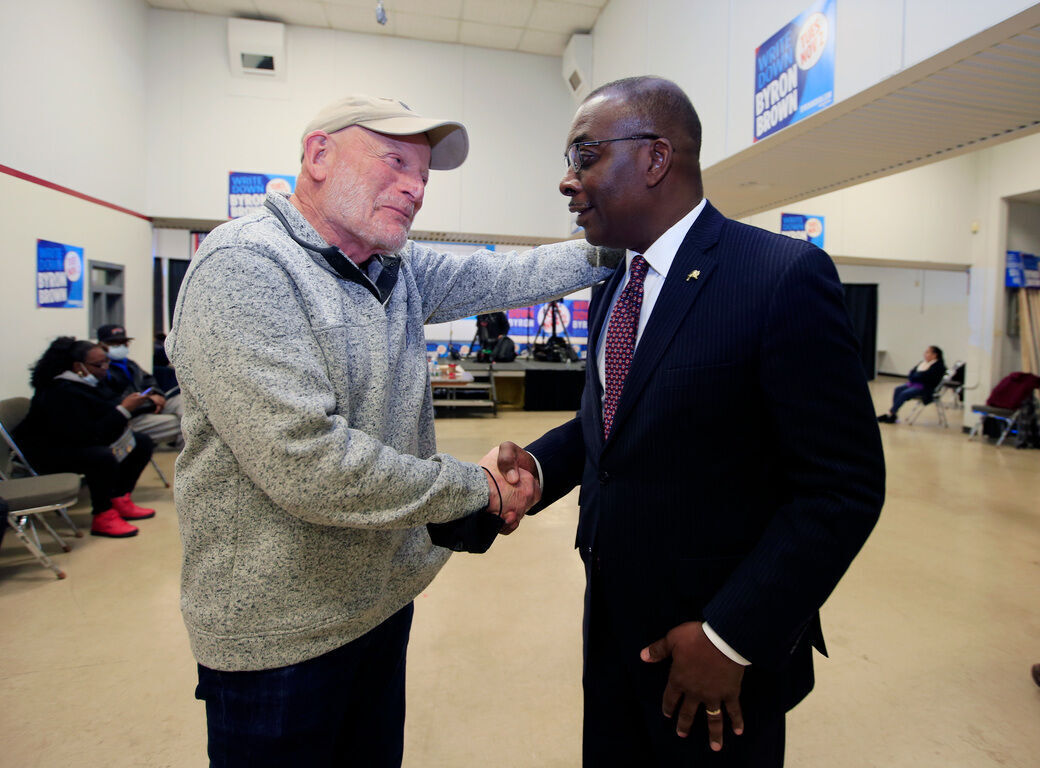
Buffalo's mayor's race turned out to be the tight race that wasn't – a blowout favoring write-in Mayor Byron W. Brown.
And it left a clear series of winners and losers, starting with the mayor himself.
Winners
Byron Brown: The low-key mayor of a changing city seemed to be old news when the dynamic democratic socialist India B. Walton beat him in the June Democratic primary. But Brown quickly reinvented himself as a write-in candidate and waged a harshly negative campaign that will leave some bruises – but that also will leave him as Buffalo's longest-serving mayor. And what a time to be mayor: The city is growing, and sitting on more than $300 million in stimulus funds that Brown could use to rebuild the city's aging infrastructure.
Christopher P. Scanlon: The mayor's friends and even his reluctant allies agree: No one person had more to do with the write-in rout than Scanlon, the South District Council member. Scanlon went to work to re-elect the mayor as soon as Brown decided to wage a write-in campaign, and went so far as to establish a Brown headquarters where volunteers turned out the vote in Buffalo's most culturally conservative neighborhoods. The result? Brown bested Walton by more than 5 to 1 in South Buffalo – meaning other pols now know that Scanlon is someone you want on your side.
People are also reading…
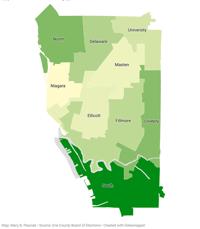
The South District, where many city employees live, saw 84% of voters write in a candidate's name.
Developers: Real estate developers like Douglas Jemal and Carl P. Paladino clung to the Brown campaign, hoping the development-friendly administration could be saved. And it was. Walton tried to portray the developers as selfishly trying to protect their own interests (which they were), but the majority of the city's voters didn't seem to care. Maybe it's because plenty of voters remember the city before Canalside, before the Medical Campus, and back when the buildings Paladino turned into housing were empty shells.
Kathy Hochul and Letitia James: The leading Democratic candidates for governor next year stayed strangely silent on the Buffalo mayoral race – and now that move looks wise rather than cowardly. Now they both enter next year's governor's race without being associated with a Walton loss.
Losers
India Walton: Walton is a gifted campaigner, a great orator who speaks from her heart about forging a Buffalo that's good for all of its residents. Yet like many on the far left (and far right), she seemed to put a premium more on the rightness repetition of her point of view than the notion that she had to go out and earn votes. Her campaign events and even her ads seemed to preach to the choir – which, as it turned out, wasn't all that big. Voters not in that choir looked at Walton as an inexperienced candidate with a complicated past, and went to the polls to write in a different candidate.

India Walton received just over half of the votes cast in the Niagara, Ellicott and Masten districts in Buffalo's mayoral race.
Buffalo's progressive activists: Plenty of people on the city's West Side – many of them young and relatively well-off and far to the left of traditional Buffalo Democrats – embraced the Walton campaign as an inspiration. These people, some associated with nonprofit organizations that aim to reduce poverty in one of the nation's poorest cities, have the best of intentions. But they tend to spend too much time talking to each other – and too much time blaming the media and Brown for the Walton campaign's missteps.
The Working Families Party: New York's preeminent leftist movement infused the Walton campaign with talent and money – and ended up tied to the mast of a sinking ship. So now the party is back where it was before the Walton campaign: It's an outfit that can try to influence statewide and upstate races, but one with a limited political appeal north of New York City.
Jeremy Zellner and Jay Jacobs: Zellner, the Erie County Democratic chairman, had no choice but to embrace Walton after she won the primary – but that embrace leaves him in a tough spot now that Brown is riding high again. But things are far worse for Jacobs, the state Democratic chair, whose clumsy comparison of Walton to the far-right David Duke lingers as a defining memory that could eventually cost Jacobs his job.


