None of the Founding Fathers hailed from here, but plenty of people with strong ties to Southern Arizona have made their mark on American history.
Among them are an astronaut, a judge, a renegade, a politician, a teacher, a gunslinger, a scientist and a Tucson torch singer.
Some of them are household names. Others toiled in relative obscurity, but still left powerful legacies.
Here are 10 of our region’s biggest history makers from the past 250 years:
Frank Borman
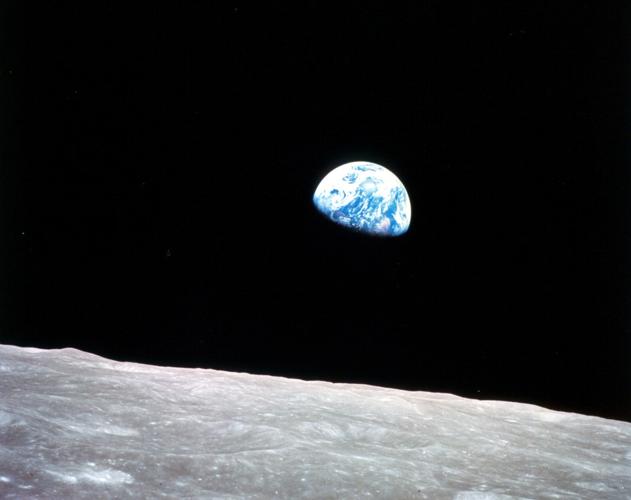
A Tucson High Badger was in command of the spacecraft when Apollo 8 captured historic photos of the Earth rising from behind the moon in 1968.
Frank Borman described the lunar surface as "a vast, lonely, forbidding expanse of nothing" and offered blessings to “all of you on the good Earth” during the crew’s famous Christmas Eve broadcast from deep space, which helped bring a hopeful end to one of the most tumultuous years of the 20th century.
People are also reading…
Borman was born in Indiana but grew up in the Old Pueblo, where he led Tucson High to its third straight undefeated state championship in football before graduating in 1946.

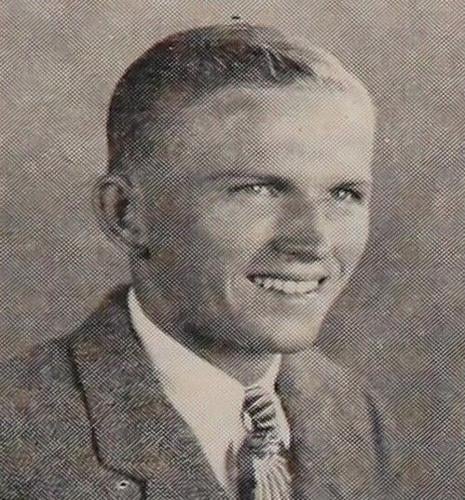
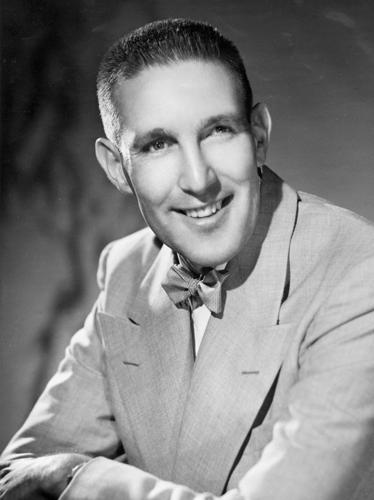
Apollo astronaut Frank Borman in his yearbook photo from 1946, the year he graduated from Tucson High School.
He attended West Point, served in the Air Force and became an aeronautical engineer and test pilot before joining NASA in 1962. His first trip to space was a grueling, 14-day mission orbiting Earth with Jim Lovell in the cramped Gemini 7 spacecraft.
After the first Apollo crew was killed in a launch pad fire in 1967, NASA tapped Borman to serve on the accident investigation board and head up the team that reengineered the capsule so the moon-landing mission could continue.
With Apollo 8, Borman, Lovell and Bill Anders became the first humans to leave Earth orbit and travel to the moon, where they completed 10 orbits in 20 hours and set the stage for the first moon landing seven months later. They were also the first humans to see the far side of the moon, view the entire disc of the Earth at once and witness an earthrise above the lunar surface.

The Apollo 8 astronauts, led by Commander Frank Borman of Tucson, were the first humans to see the entire Earth as a globe suspended in space, at Christmas time in 1968.
The trio returned home on Dec. 27, 1968, to medals and ticker-tape parades. The K-8 school at Davis-Monthan Air Force Base was named in Borman’s honor when it opened in 1977.
The Badger quarterback turned famous astronaut never flew in space again. He retired from NASA and the Air Force as a colonel in 1970 and went on to run Eastern Airlines.
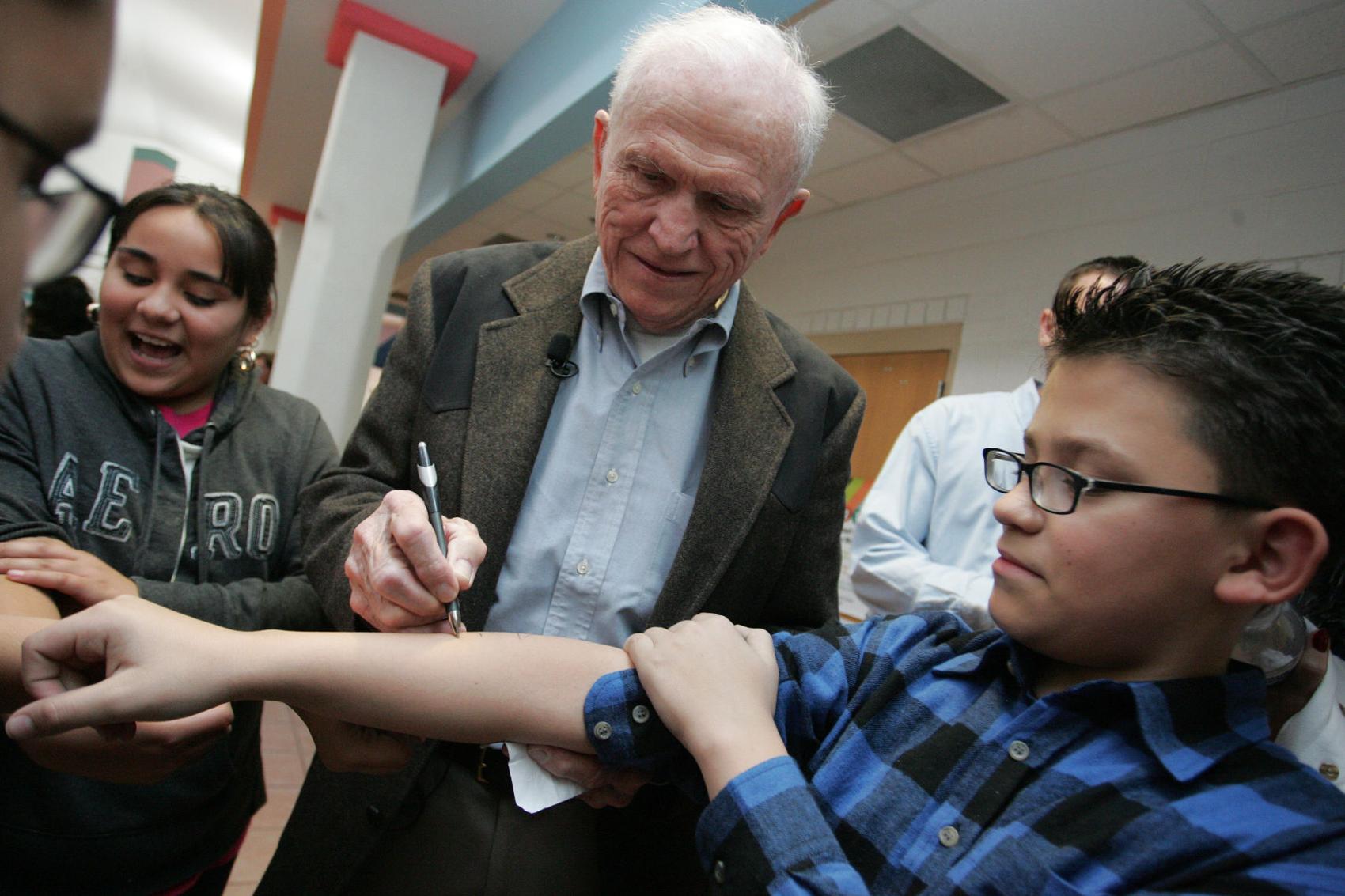
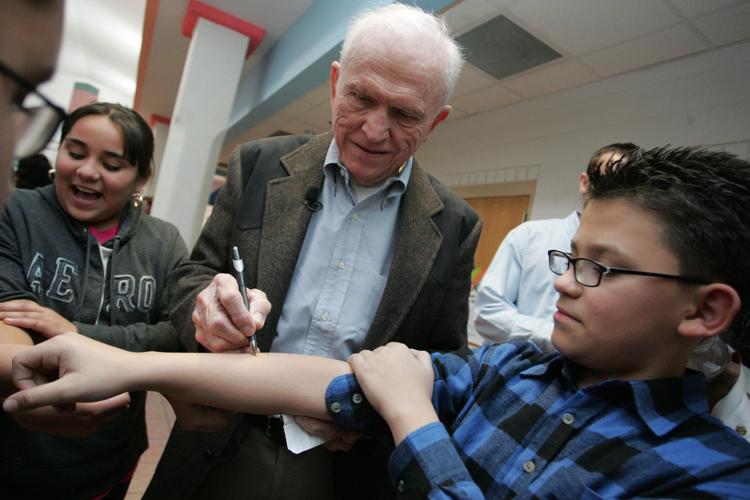
Retired NASA astronaut Frank Borman signs a fifth-grader’s arm Feb. 17, 2010 in Tucson after speaking with students from Mission Manor Elementary School about his trips to space. Col. Borman served as commander of the Gemini 7 and Apollo 8 missions in the 1960s.
Frank Borman died in 2023 at age 95. He remains one of just 28 humans to have flown to the moon and back, including the four members of the Artemis II crew who accomplished the feat in April.
A.E. Douglass
The University of Arizona is famous throughout the science world for its contributions to the fields of astronomy and tree-ring research. One man played a central role in bringing both of those disciplines to the desert more than a century ago.
Vermont-born Andrew Ellicott Douglass was sent west to Arizona in 1894 by a wealthy Boston man of letters named Percival Lowell to scout locations for a new research telescope. Together they founded the Lowell observatory, where Douglass worked until he was summarily fired in 1901 for daring to question Lowell’s stubborn — and incorrect — belief in the existence of engineered canals on Mars and possibly Venus.
Five years later, Douglass was hired as an assistant professor at the U of A, allowing him to return to astronomy and expand on work he began in Flagstaff analyzing the growth rings in wood to determine its age.

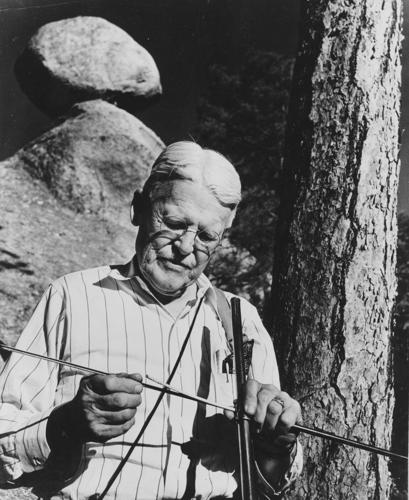
Science pioneer A.E. Douglass examines a tree core sample on Mount Lemmon in 1946.
Douglass would go on to establish the Steward Observatory in 1918 and formalize the new science of dendrochronology in 1937 with the creation of the Laboratory of Tree-Ring Research at the U of A.

A.E. Douglass
Building on the techniques Douglass pioneered, tree-ring research is used around the globe today to determine the age of archaeological sites and reconstruct ancient climatological conditions, shedding light not only on the distant past but improving our understanding of what is happening to our planet today.
As Douglass himself put it during his dedication address for Steward Observatory in 1923: “Scientific research is business foresight on a large scale. It is knowledge obtained before it is needed.”
A.E. Douglass died in Tucson on March 20, 1962, at the age of 94. He now has craters named in his honor on the surface of Mars and the Moon.
Wyatt Earp
For a guy so well known for his exploits in Arizona, Wyatt Earp certainly didn’t spend much time here.

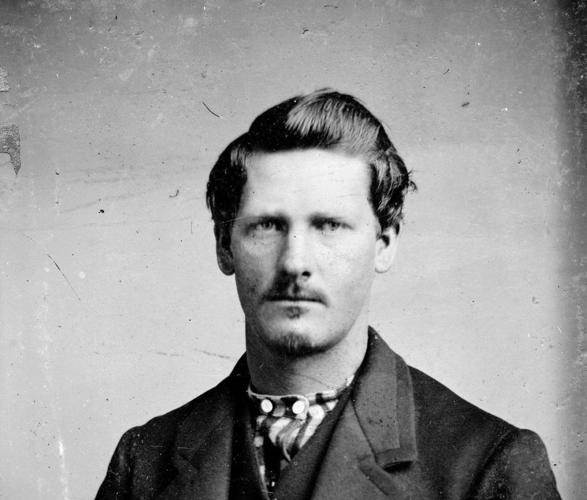
Wyatt Earp, shown in 1869.
The legendary lawman only lived in Tombstone for just over two years, and that includes the fateful 30 seconds or so he spent blasting away behind the O.K. Corral during the shootout that would define his life.

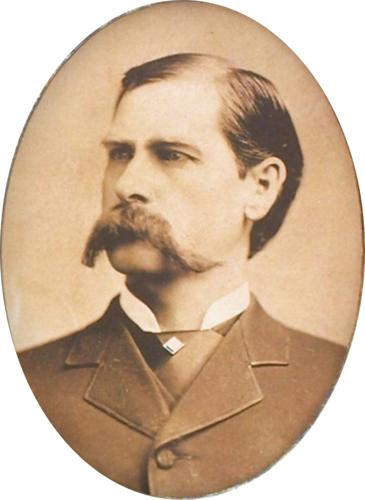
Wyatt Earp aged around 39, circa 1887.
It wasn’t until after his death in 1929 that his status as a mythical Wild West figure really took off, starting with a wildly flattering biography that became a bestseller in 1931. Since then, Earp has been depicted as a fearless Western hero in dozens of movies and TV shows. Historical plaques and statues now mark his movements across the West, and thieves have stolen the headstone from his grave near San Francisco no less than three times.
While Earp was alive, though, his reputation was complicated at best, littered with seamy associates, crooked card games, jumped claims and fixed prizefights. “He seemed to be followed by controversy his whole life,” said Chris Bradley, associate editor of the Arizona Historical Society’s quarterly Journal of Arizona History.
Why Earp has emerged as one of the most celebrated figures of the territorial period seems to be a mystery as perfect and impenetrable as Kurt Russell’s movie mustache in 1993’s “Tombstone.”
“Depending on which of his contemporaries you believed, Earp was either a hero or a thug,” writes historian Thomas Sheridan in his book “Arizona: A History.” “The truth was probably somewhere in between. Earp was a product of his times, drifting from one violent town to another in search of good cards and the backing of powerful men.”
Geronimo
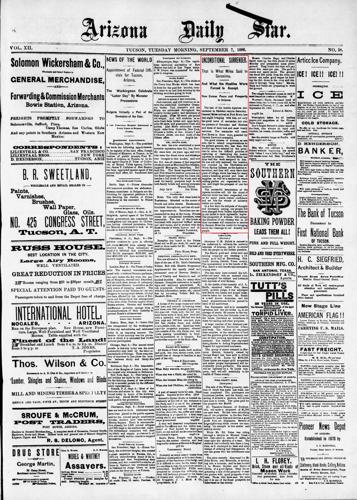
When Geronimo surrendered for the final time on Sept. 4, 1886, people in Tucson held a parade and a banquet for the Army troops involved in his capture.

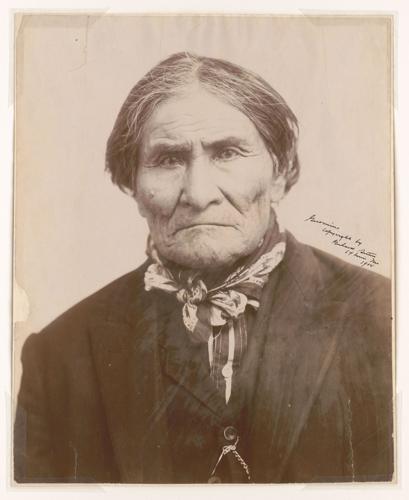
Geronimo, Apache leader
The treaty struck that day in a canyon near the Arizona-New Mexico border, about 45 miles northeast of Douglas, effectively ended two centuries of conflict between the raiding Apaches and the Indian tribes, Spaniards, Mexicans and Americans in the region.

Sept. 7, 1886: Geronimo surrenders
The Apache people would be forced off of their ancestral lands and onto reservations as far away as Florida and Alabama. Their most famous warrior would spend the rest of his life as a prisoner of war and a national curiosity, trotted out under guard to appear at major exhibitions and ride on horseback in President Theodore Roosevelt’s 1905 inaugural parade.
Geronimo was born in eastern Arizona in 1829 and raised as part of the Bedonkohe band of Apaches near the headwaters of the Gila River in New Mexico, according to the autobiography he dictated in his later years while in exile at Fort Sill, Oklahoma.

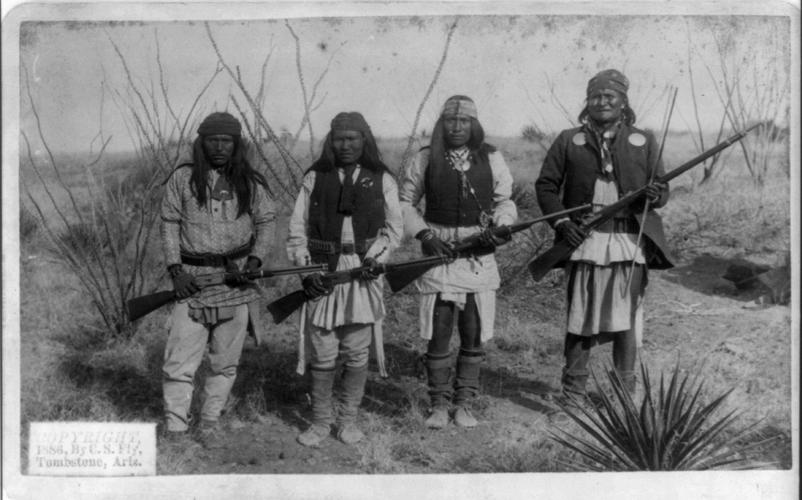
Geronimo, right, and fellow Apache warriors, photographed by Tombstone photographer C.S. Fly in 1886.
His reputation as a wartime leader was forged in blood, after his mother, his wife and their three young children were massacred by Mexican troops, touching off a brutal cycle of raids and revenge killings.
Through the ensuing decades, a growing number of U.S. troops were sent to the Southwest to secure the expanding settlements and cross-country supply routes there. But each time the Apache renegades agreed to settle peacefully on reservation land, said Geronimo in his 1906 autobiography, poor treatment and broken promises by the government would lead them to escape once again.
After his final surrender, Geronimo became a symbol of defiance and defeat, used in service of a simplified narrative about the so-called “taming of the West.” And though he dabbled in the customs of his captors, from the Ferris wheel to Christianity, he never stopped longing for the headwaters of the Gila.
“It is my land, my home, my fathers’ land, to which I now ask to be allowed to return. I want to spend my last days there, and be buried among those mountains,” he told his biographer for the final chapter of “Geronimo’s Story of His Life.” “If this could be I might die in peace, feeling that my people, placed in their native homes, would increase in numbers, rather than diminish as at present, and that our name would not become extinct.”
His people have endured, but Geronimo never got his wish. He died in Oklahoma in 1909 and was buried at Fort Sill, among the graves of other Apache prisoners of war.
Sandra Day O’Connor
Long before she made history as a Supreme Court justice, Sandra Day O’Connor rode horses, branded cattle and drove tractors as a cowgirl at a ranch straddling the Arizona-New Mexico border.
The Day family’s spread covered 250 square miles south of the Gila River near tiny Duncan, Arizona, where O’Connor grew up in a remote, four-room adobe ranch house with no running water or electricity for much of her childhood.
The Lazy B Ranch wasn’t an easy place to raise livestock or a family, but O’Connor loved it so much she begged her parents to let her come home after they sent her to live with her grandmother and attend an all-girls school in her native El Paso, Texas.
As O’Conner described it in the 2002 memoir she co-authored with her brother, H. Alan Day: “It was no country for sissies, then or now. … It’s possible to survive and even make a living in that formidable terrain. The Day family did it for years, but it was never easy.”
The experience helped shape the jurist she became, as did the rejection she experienced early in her career.
Though she graduated near the top of her class from Stanford Law in 1952, she struggled to find a firm in Los Angeles or San Francisco willing to hire a woman for anything other than clerical work. Instead, she talked her way into a role as an unpaid lawyer for the San Mateo county attorney and worked her way up from there.

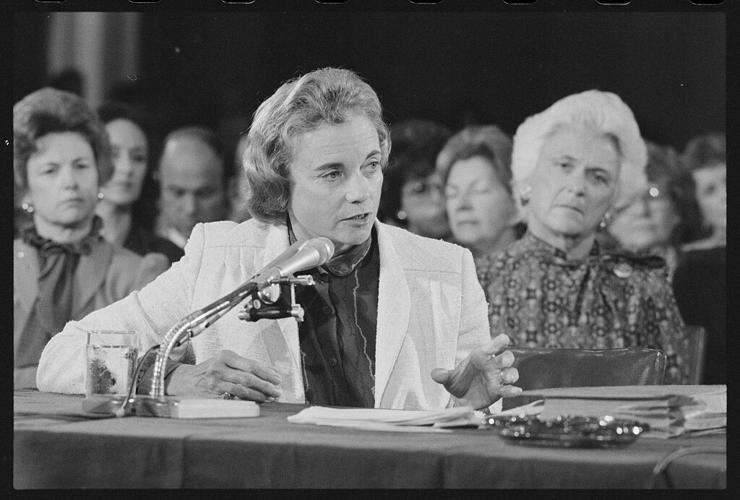
Sandra Day O'Connor speaking at her 1981 confirmation hearing for the U.S. Supreme Court.
She and her husband, John O’Connor, eventually settled in the Phoenix area, where she started a law firm, raised three sons and served as Arizona’s assistant attorney general, a Republican state senator and as the nation’s first female state majority leader.
She became a judge in 1974, first in Maricopa County Superior Court and then the Arizona Court of Appeals. That’s where she was working in 1981, when President Ronald Reagan nominated her — and the Senate confirmed her 99-0 — to become the first woman on the U.S. Supreme Court.
Over the next 24 years, the moderately conservative justice cast the swing vote in numerous important and controversial decisions, though she apparently disliked that term. According to one of her former law clerks, the word swing sounded to her like something frivolous and not well thought through.
O’Connor retired from the Supreme Court in early 2006 to spend time with her husband, who was diagnosed with Alzheimer’s disease in 1989 and died in 2009. She withdrew from public life nine years later, after announcing her own dementia diagnosis.

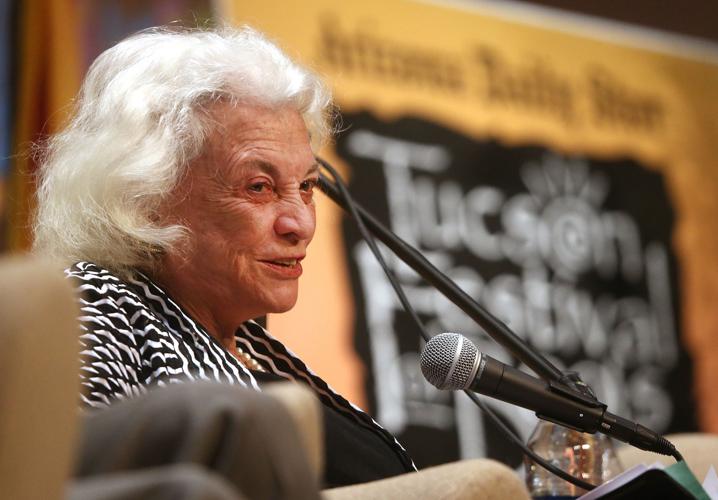
Retired Supreme Court Justice Sandra Day O'Connor speaks at the Tucson Festival of Books on March 15, 2014.
Upon her death in Phoenix on Dec. 1, 2023, the 93-year-old cowgirl justice from southeastern Arizona lay in repose in the Great Hall of the Supreme Court before being honored with a funeral service at the Washington National Cathedral.
Then Sandra Day O’Connor returned to where she came from. Her ashes were buried alongside her husband and her parents at the top of Round Mountain on the Lazy B Ranch.
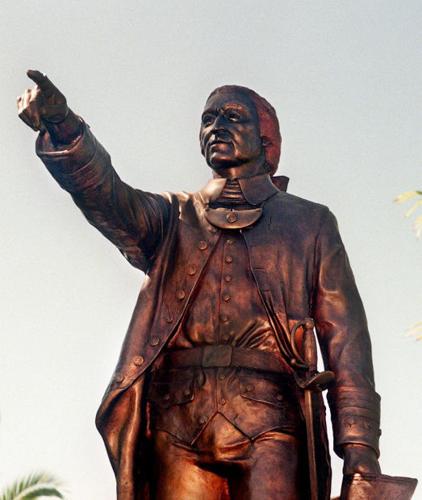
Hugo O’Conor
American independence was barely an idea and far from guaranteed when Hugo O’Conor died in 1779, but he helped shape the new nation nonetheless.
Without him, after all, the U.S. wouldn’t have one of its major — and dare we say finest — cities.
It was O’Conor who chose the future site of Tucson on Aug. 20, 1775, when he issued a proclamation designating a patch of land overlooking the Santa Cruz River as the newest fortress on New Spain’s northern frontier.
The Presidio San Agustín del Tucson was established the following year by Spanish troops who marched north from Tubac to begin fortifying their new home, first with earthen berms and crude wooden palisades, then adobe walls 10 feet tall and 2 feet thick.

Spanish authorities assigned Col. Hugo O'Conor to create a line of defense along the colonial frontier. The Tucson presidio was one of those posts. His statue stands today in front of the Manning House in downtown Tucson.
O’Conor didn’t get to stick around to see his proclamation fulfilled. In 1777, the crown promoted him and sent him south to serve as governor of the Yucatan. That’s where he was two years later when he fell ill and died roughly 4,800 miles from the green isle of his birth.
The redheaded Irishman was born Hugh O’Conor in Dublin in 1734. He risked execution in 1751 to flee Ireland and join the Spanish army — one of many young Irish Catholic “Wild Geese,” who crossed the sea to escape England’s oppressive Protestant rule over the island.
While in service to the King of Spain, O’Conor saw combat in Portugal during the Seven Years' War, trained militias in Cuba, secretly investigated corruption for the viceroy of New Spain and fought Indians as the Spanish governor of Texas.
Among the Apaches, against whom O’Conor launched numerous massive and brutal campaigns, he came to be known as "The Red Captain."
He is said to have ridden more than 10,000 miles on horseback during his travels.
And though his time here was brief, his impact on what is now Southern Arizona was indelible. With a stroke of his quill, an Old Pueblo was born.
Lute Olson
He turned the University of Arizona into a national powerhouse and singlehandedly boosted sales of both season tickets and backyard basketball hoops in the Tucson area.

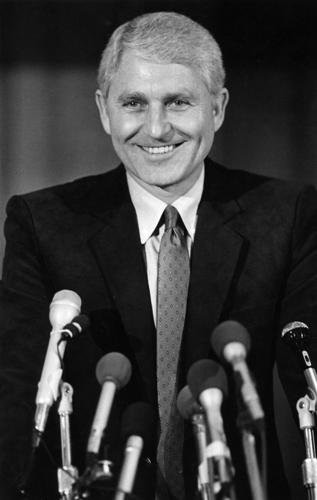
Lute Olson is introduced as the Arizona Wildcats’ new men’s basketball coach at a press conference in Tucson in 1983.
During his 24 years as head coach, Lute Olson took the Wildcats to places they had only dreamed of before: Four trips to the Final Four and, finally, a national title.
In the process, he won 76% of the games he coached and sent dozens of his players to the NBA, where several won championships and at least one — shout the name with us, Arizona fans! — has become a hall-of-fame coach in his own right.
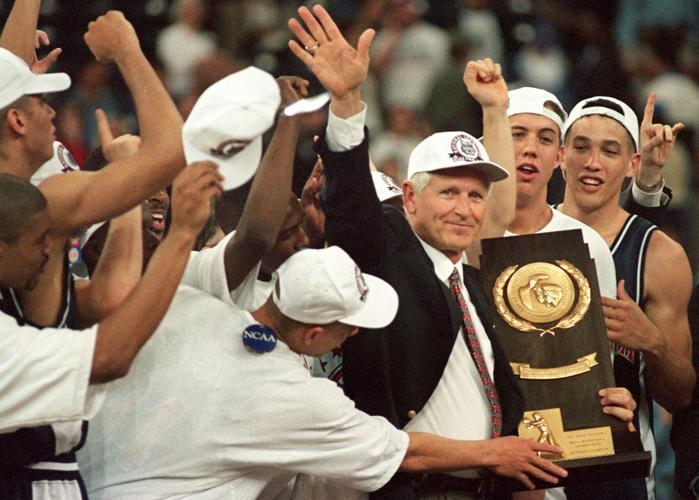
And somehow, Lute managed to accomplish all while looking like he had just stepped from the pages of a menswear catalog. Famously, the only time anyone can remember the man’s snow-white hair out of place is when Arizona forward Bennett Davison playfully ruffled it after the Wildcats won it all in 1997.

After knocking off a record three No. 1 seeds, it was hats off to Lute Olson and the Wildcats' basketball team, winners of the NCAA Tournament in 1997.
Olson, who died in 2020 at age 85, was inducted into the Naismith Basketball Hall of Fame in 2002, six years before he was forced to retire from coaching for health reasons. He remains one of just 18 coaches in college basketball history to lead multiple schools to the Final Four.
Not bad for a farm kid from tiny Mayville, North Dakota.
Former Arizona softball coach Mike Candrea spent years working alongside Olson at the athletic offices inside McKale Center, and he learned a lot about how to recruit, inspire and dress for success from the ever-dapper Lute.
"He wanted people to feel like the basketball program was an extension of the community, and he built it that way," said Candrea, a legend in his own right with career stats and records even Olson can’t touch. "Tucson became a basketball town. Today, it still is.”
Linda Ronstadt
Before there was Madonna or Taylor or Celine, there was Linda.
Some might even say that without Tucson native Linda Ronstadt, Madonna, Taylor Swift and Celine Dion might have had a harder go at superstardom in a male-dominated pop/rock world.
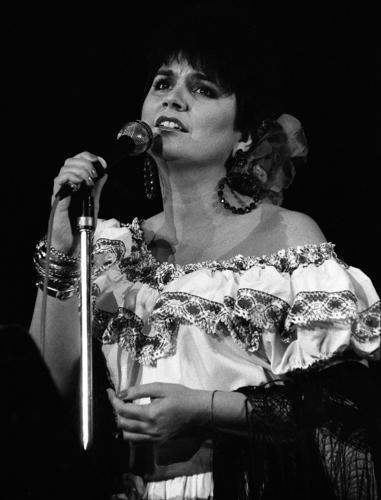
Ronstadt blazed trails in country, rock, pop and mariachi, racking up more than 100 million record sales and taking home 11 Grammys across seven genre categories. She recorded 24 studio albums and released 15 compilation records, picking up 21 Top 40 hits in pop, country and rock in a career that was born in her family's Tucson home.
14 photos of Linda Ronstadt through the years
Linda Ronstadt through the years
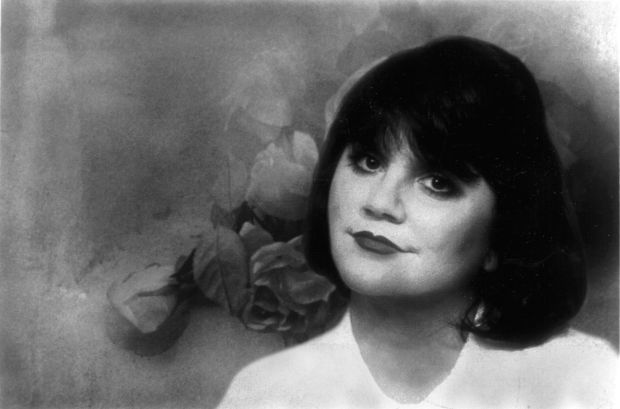
Handout photo of Linda Ronstadt in 1999.
Linda Ronstadt

Linda Ronstadt, Kenny Edwards and Bobby Kimmel, also known as the Stone Poneys, performed at Minus One Coffeehouse on Nov. 24, 1966.
Linda Ronstadt through the years

Linda Ronstadt, one of the Hall of Fame's first five inductees, brought mariachi music to the masses with two popular LPs. Linda Ronstadt
Linda Ronstadt through the years

Linda Ronstadt at Tucson's Symphany Cotillion Ball in 1977.
Linda Ronstadt through the years
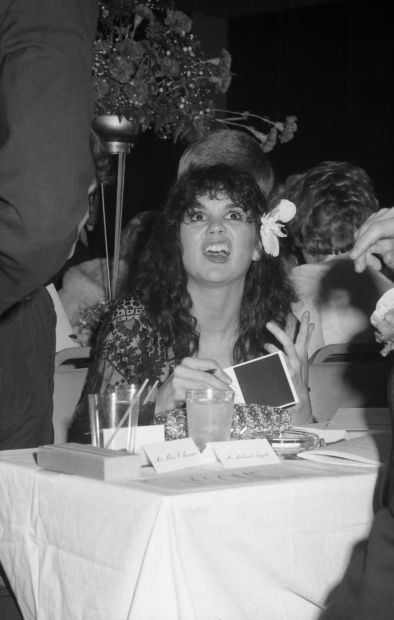
Linda Ronstadt signs autographs at Tucson's Symphany Cotillion Ball in 1977.
Linda Ronstadt through the years

Linda Ronstadt signs autographs at Tucson's Symphany Cotillion Ball in 1977.
Linda Ronstadt through the years
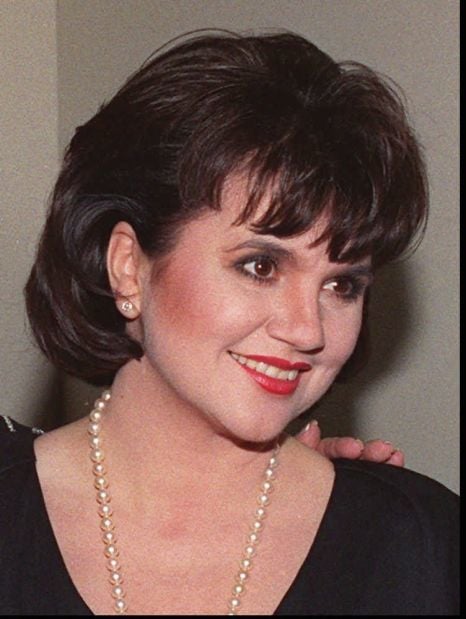
Linda Ronstadt, shown in this 1991 file photo, is singing the praises of teaching young children foreign languages. Ronstadt, whose album "Canciones de Mi Padre" ("Songs of My Father") won a Grammy in 1987, told state education officials in Phoenix Monday, Sept. 30, 1996, that if children aren't exposed to foreign languages early, they may not learn them at all.
Linda Ronstadt through the years
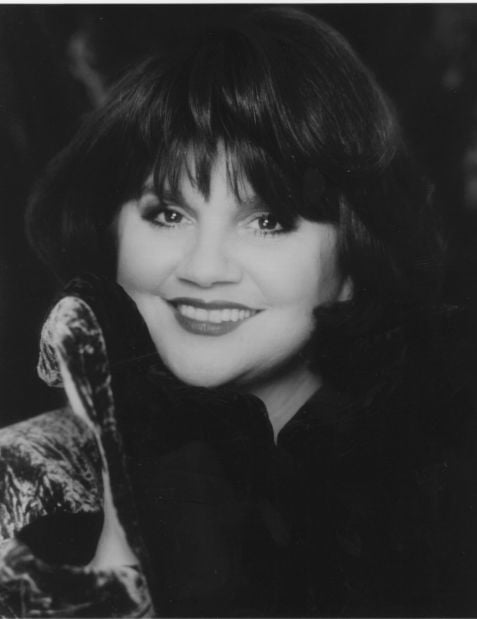
Linda Ronstadt in 1998.
Linda Ronstadt through the years

Linda Ronstadt circa 1983.
Linda Ronstadt through the years

Linda Ronstadt with Nelson Riddle
Linda Ronstadt through the years

Linda Ronstadt's tour programs from 1983 and 1984 at the University of Arizona's Esquire Apartments photographed Tuesday, April 19, 2011. Ronstadt has donated her collection of artifacts from her time with Nelson Riddle to the UA School of Music.
Linda Ronstadt through the years

Linda Ronstadt's What's New album on top of the hand-copied orchestra parts for "What's New" by Ronstadt arranged by Nelson Riddle at the University of Arizona's Esquire Apartments photographed Tuesday, April 19, 2011. Ronstadt has donated her collection of artifacts from her time with Nelson Riddle to the UA School of Music.
Linda Ronstadt through the years

Linda Ronstadt, right, and Sam Bush sing together at the Berger Performing Arts Center in Tucson on June 12, 2002. Most of the crowd was there to hear Linda Ronstadt sing, but by the end of the evening, Sam Bush's mandolin playing and harmonizing with Ronstadt converted many into enthusiastic fans.
Linda Ronstadt

Linda Ronstadt and Mariachi Vargas deliver inspiring celebration of old Mexico in sold-out concert.
Linda Ronstadt through the years

A likeness of Tucson native singer Linda Ronstadt was created by 86-year-old June Aguayo, who works out of her home. Aguayo is a regular staple at cultural events like Tucson Meet Yourself and has painted notable Tucsonans such as Raul Grijalva and Lalo Guerrero.
The third of Gilbert and Ruth Mary Ronstadt's four children, she grew up in a musical household. At family gatherings, she was one of the voices in a chorus of Ronstadt family members — aunts and uncles, brothers, sisters and cousins — who sang while her father played the guitar.
“That’s what we always did. We would have a big party and my dad and his guitar, and cousins and uncles singing, aunts and uncles,” she recalled in a 2023 Star interview. “They weren’t singing professionally; they were singing like talented amateurs and they were expressing their emotions.”
She landed in Los Angeles months after she graduated from Catalina High School in 1964 and played the L.A. club circuit for a few years with her band the Stone Poneys, before going solo in 1968.

Linda Ronstadt at the Mariachi Espectacular concert to close the Tucson International Mariachi Festival on May 9, 1986.
Ronstadt laid the groundwork for female artists who followed by refusing to be pigeonholed into a single genre. She spent her first several albums leaning into the country music she heard growing up in Tucson, fused with rock and folk, before pivoting to pop and then rock in the late-1970s. The 1980s found her rewriting her narrative again with a trio of pop standards albums arranged by the legendary Nelson Riddle.
Then in 1987, against the advice of her record label, Ronstadt recorded the Spanish-language mariachi record “Canciones de mi Padre” (Songs of my Father).
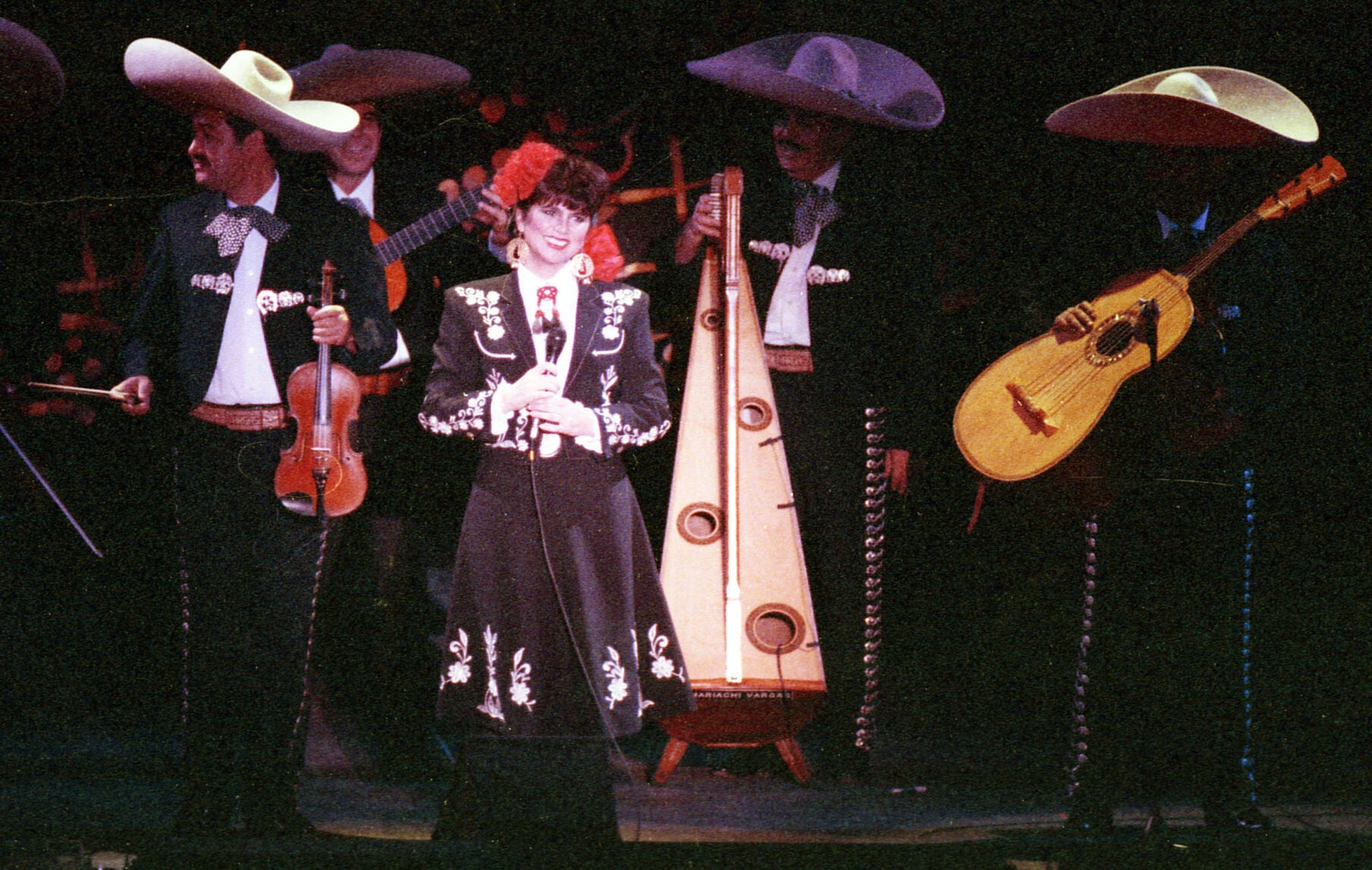
Linda Ronstadt with Mariachi Vargas at Tucson's Centennial Hall on Feb. 11, 1988.
“I didn’t think about whether it would be commercial or not; it was just songs I liked,” she said on the eve of the album’s re-issue in 2023. “It was self-indulgence.”
The record sold 10 million copies worldwide and stood for years as the biggest selling non-English-language album in U.S. history.
Mo Udall
He has been described as “the most important national leader ever to come out of Tucson,” but long-time Congressman Morris K. Udall was actually born and raised in the tiny town of St. Johns in eastern Arizona.
He came from a large Mormon family that produced a small army of prominent attorneys, judges and elected leaders. His brother, Stewart, served in the House and as Interior secretary. His son, Mark, represented Colorado as a congressman and a senator. His nephew, Tom, represented New Mexico in the Senate, then served as a U.S. ambassador.

1952 photo of Morris K. "Mo" Udall.
Udall lost an eye at age 6 but eventually grew to a “Lincolnesque” height of 6-foot-5, earning him a starring role on the University of Arizona basketball team and a season in the pros with the Denver Nuggets while he attended law school.

Morris Udall relaxes and reflects at a quiet time during his 1980 congressional campaign.
His first elected job was as Pima County attorney in 1952. His last was as a member of the U.S. House of Representatives, where he served for 30 years starting in 1961.
During that time, the Democrat fought to protect wilderness and the environment, while delivering crucial infrastructure to his arid home state in the form of the Central Arizona Project canal from the Colorado River.
Though higher office eluded him — he ran unsuccessfully for House speaker, majority leader and, in 1976, the Democratic nomination for president — he was admired on both sides of the aisle for his hard work, productivity, easy manner and sharp wit. He was known to end contentious debates with something he called “The Politicians Prayer”: "Dear Lord, make my words gentle and tender, lest someday I have to eat them."
Parkinson’s disease forced Udall to retire from Congress in 1991. He died in 1998, within months of another Arizona giant, his friend and political polar opposite Barry Goldwater.
A city park and the main post office in Tucson are now named in Udall’s honor, as is a spit of land on the island of Guam that is considered to be the westernmost point in the United States. The nation’s easternmost point, in the U.S. Virgin Islands, is also called Point Udall, though it was named for Mo’s brother, Stewart, in 1969.
María Urquides
The “mother of bilingual education” was born in an adobe house in the Old Pueblo’s oldest barrio in 1908 to parents who were also born in Tucson.

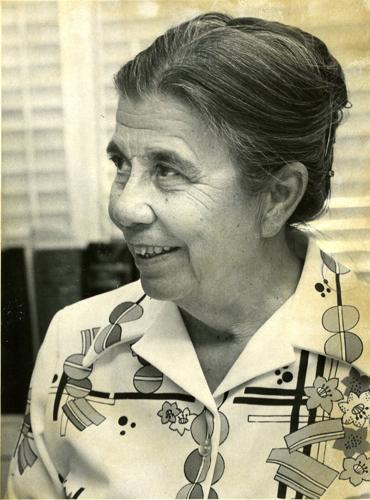
Maria Urquides, known as the mother of bilingual education.
Her father never went to school and her mother never made it past the third grade, so María Urquides became the first in her family to graduate from college on her way to a storied career in the classroom that helped set national education policy and attract attention from the White House.
Urquides began teaching in 1928 at Davis Elementary, a large and segregated primary school where the student body was largely Mexican-American and children got into trouble for not speaking English.
As she would tell an Arizona Daily Star columnist more than five decades later: "If I ever go to hell, it will be because of the kids I punished for speaking Spanish."
But much of her 45-year teaching career was actually dedicated to ending such practices.
After Davis, Urquides worked at Sam Hughes Elementary and as a founding teacher and counselor at Pueblo High School, where she helped establish one of Tucson’s first bilingual education programs. Presidents from Harry S. Truman to Ronald Reagan would recognize her pioneering work with appreciations and appointments to national conferences and commissions.
Arguably Urquides’ biggest impact came in the 1960s, when she teamed with fellow teachers on an influential national study that outlined problems facing Spanish-speaking students and highlighted successful bilingual programs across the Southwest. The report, titled "The Invisible Minority," led to the passage of the federal Bilingual Education Act in 1967.
A tribute to Urquides in the Star after her death in 1994 described her as “a one-woman almanac of achievement,” with lifetime honors from the YWCA and the National Association for Bilingual Education and induction into the Hispanic Hall of Fame and the Arizona Women's Hall of Fame.

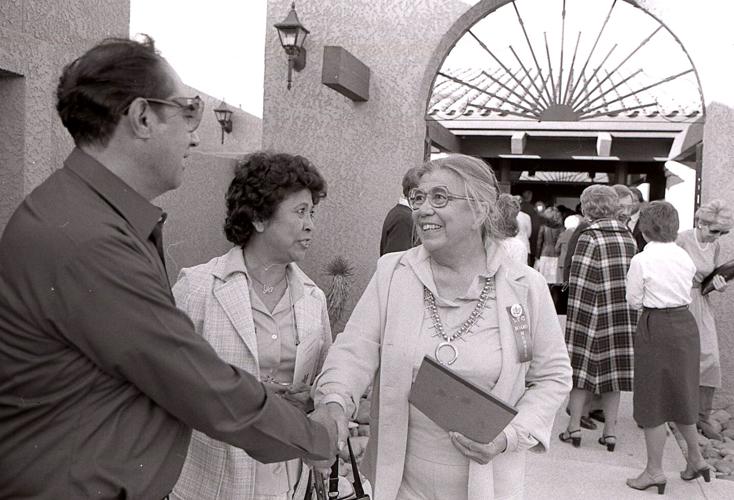
María Urquides, right, in 1983.
In 1976, two years after she retired from teaching, Tucson Unified School District dedicated the Urquides Adaptive Education School in her name. It continues to operate on Ajo Way near Mission Road as Lynn-Urquides Elementary School.
Star reporter Cathalena E. Burch contributed the Linda Ronstadt profile to this story.
Contact reporter Henry Brean at hbrean@tucson.com. On Twitter: @RefriedBrean

Henry Brean
Reporter