PATERSON, N.J. — Midway through Ramadan, Muslims across the United States are striving to maintain the holy month's traditional mix of prayers and festive spirit under a cloud of worrisome events.
The federal government's immigration crackdown has affected many of their communities. Virulent anti-Muslim rhetoric is surging. And now the Middle East — where many have loved ones — is buffeted by the Iran war.
In Paterson, New Jersey — home to one of the country's highest per capita Muslim populations — 18-year-old Haneen Alatiyat regrets that fear and uncertainty are keeping many community members from gathering to embrace Ramadan's communal traditions.

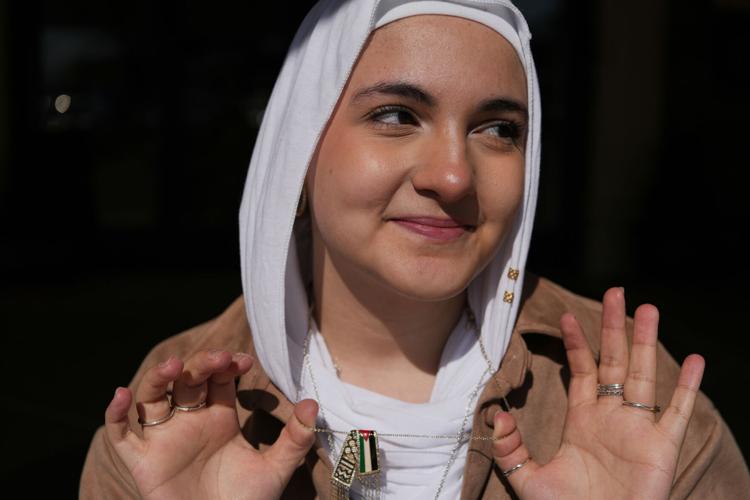
Haneen Alatiyat, a member of the Islamic Center of Passaic County in Paterson, N.J., poses for a portrait Feb. 27 at the mosque's entrance during Ramadan.
"The meaning of the holiday is to be together with the people you love," said Alatiyat, who is half Palestinian, half Jordanian.
"Unfortunately, because of the ICE raids that are happening, people don't want to do that," she added, speaking outside the Islamic Center of Passaic County in Paterson about Immigration and Customs Enforcement actions happening under President Donald Trump. It's the mosque where she worships every year with family during Ramadan.
People are also reading…
Paterson's Palestinian community — one of the largest outside the Middle East — had been grieving loved ones and trying to help the survivors of the Israel-Hamas war in Gaza even before the latest anxiety-fueling developments.
"This Ramadan has already been heavy for many families in our community with the immigration crackdowns," said Rania Mustafa, executive director of the Palestinian American Community Center in Clifton, New Jersey.
"Now, as the war on Iran started, many people here are experiencing another layer of fear and grief," she added.

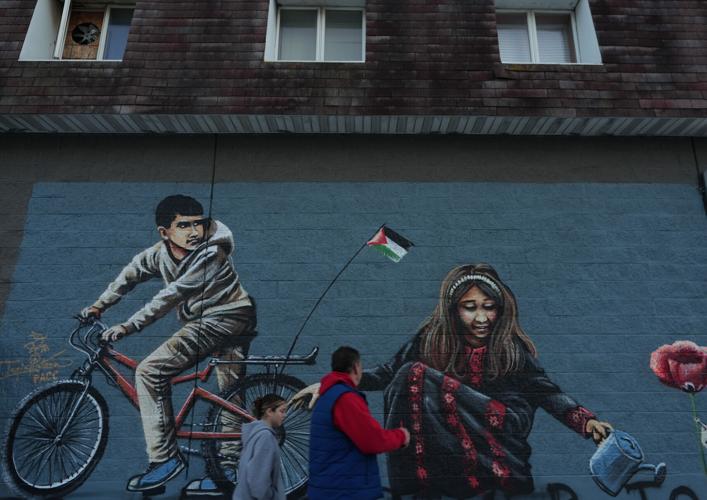
Passersby walk in front of a mural in "Palestine Way," a section of Main Street in the South Paterson neighborhood of Paterson, N.J., during Ramadan on Feb. 27.
Impact of Minnesota crackdown
In Minnesota, where many are reeling from the recent large-scale immigration crackdown, Ramadan came amid a powerful mix of emotions, according to Imam Yusuf Abdulle. He is the executive director of the Islamic Association of North America.
Many feel "blessed that we are alive and well," said Abdulle. "Also, we feel like we're … bruised, affected, devastated economically, psychologically."
Abdulle's organization is an umbrella group for several Islamic centers, including some in Minnesota.
Abdulle said the Abubakar As-Saddique Islamic Center in Minneapolis, where he's on the board, has canceled hosting communal iftar, the sunset meals that break the daily fast, and instead is serving only dates and water. He attributed the change to the economic hit many of the community's businesses, which typically would have sponsored such meals, took during the crackdown, as people stayed away.
"Eating together and sharing stories while eating, it was beautiful," he said. "I hope that comes back."
Even after the withdrawal of most of the roughly 3,000 immigration officers, some community members — especially asylum-seekers and refugees — remain cautious about venturing out, including to the mosque, Abdulle said.
"The fear … is very much there and it will be there for a while."
Yet family nurse practitioner Munira Maalimisaq sees reason to be thankful amid the stresses. She works as CEO of Inspire Change Clinic, which serves marginalized communities in Minnesota.
"Even with the challenges, there's a strengthened sense of community, resilience, and hope alongside the usual spiritual reflection, prayer, and charity that Ramadan brings," she said.

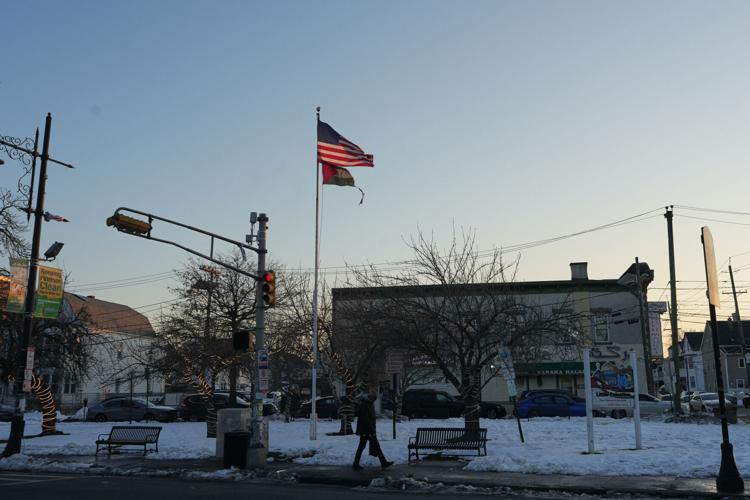
A man walks near flags of the United States and Palestine as the sun sets in "Palestine Way," a section of Main Street in Paterson, N.J.
Know your rights message
Coinciding with Ramadan, some Muslim groups have issued know-your-rights guidance for navigating immigration enforcement interactions, including for mosques. The Muslim Public Affairs Council, for example, created a safety guide.
MPAC official Dahlia M. Taha said the included guidance for imams aims to help them address congregants' fears without causing panic or spreading misinformation.
Questions from imams, she said, have included: Can houses of worship be subject to enforcement operations? How to reassure people without giving legal advice? How to address immigration anxiety while keeping Ramadan spiritually centered?
"There is a deep sense of community and peace that always comes with Ramadan," said Taha, adding that many mosques are well-attended and families are gathering.
Nonetheless, "people are carrying fear, anxiety, and uncertainty alongside our faith," she said. "Devotion and concern are existing side by side. I think everyone is just exhausted."
Ibrahim Dyfan, executive director of Masjid Al Shareef, a 2,000-strong mosque in Long Beach, California, said his community, like other Muslim congregations, is coping with stress related to rising Islamophobia, immigration enforcement and the Middle East conflicts.
The mosque also boosted security for prayer services during Ramadan, he said.
"All we can do is continue praying and fasting," he said. "This, like everything else, will pass. At the same time, we also need to pay attention to what is happening around us, and take the necessary precautions."
Islamophobia in politics
A wave of anti-Muslim language intensified in Republican campaigns early this election year, most prominently in Texas, which held its primaries Tuesday. Gov. Greg Abbott, who clinched the GOP nomination for a fourth term, helped lead efforts to stop a Muslim-centered planned community near Dallas.
In Congress, several bills have been introduced recently targeting Shariah — the framework that guides Muslims, including on prayer and ethical conduct. Rep. Randy Fine, R-Fla., in a recent social media post, compared Muslims unfavorably to dogs, prompting the Council on American-Islamic Relations and some Democratic members of Congress to call for his resignation.
Muslim American leaders view the vitriol as election-year scaremongering. Their alarm was only partially eased by recent election victories for Muslim candidates, notably Zohran Mamdani becoming mayor of New York.
"Every election year, you see an increase in anti-Muslim bigotry in certain parts of the country, where politicians see Muslims Americans a useful political football," said CAIR's national deputy director, Edward Ahmed Mitchell. "We expect that — but it's so much worse than usual this time."
War worries emerge
In Paterson, according to Rania Mustafa, many families worry about relatives in conflict-wracked parts of North Africa and the Middle East, including those in Gaza struggling to access sufficient food supplies.
But she is proud of her community's perseverance.
"Despite what's going on in the world, Ramadan reminds us of the strength and resilience of our community," she said. "People are still gathering for prayer, sharing meals, checking on one another, and supporting families who are struggling."

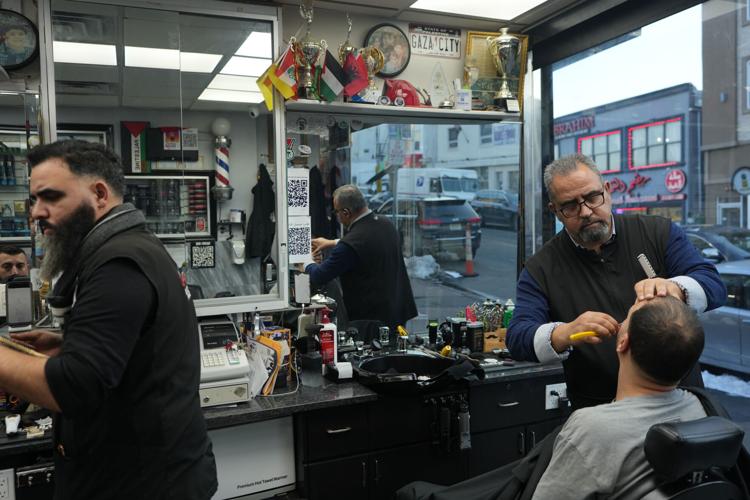
Raed Odeh, the owner and top barber of the Palestine Hair Salon, shaves a man Feb. 27 in Paterson, N.J.
As the sun set on a section of Paterson's Main Street renamed "Palestine Way" — flanked by Palestinian and U.S. flags — people arrived at homes and restaurants to break the fast on a recent evening. Some rushed to pastry shops, others headed to the Palestine Hair Salon.
Raed Odeh, the salon's owner and top barber, lamented how the Middle East's tumult and the U.S. immigration crackdown were dampening what should be a joyful month.
"This is not only affecting those who don't have documents, this is also affecting everyone else around," said Odeh, Paterson's deputy mayor, as he shaved a client's beard.
Like other city leaders, he urged the release of Leqaa Kordia, a Palestinian woman and Paterson resident who has been held in an immigration jail for a year after attending a protest in New York. Recently, Kordia said she suffered a seizure, an episode she linked to "inhumane" conditions inside the detention facility.
At a time of turmoil, Odeh said he shares the hope of many — regardless of their ethnicity or religion — during Ramadan: "Of course, everybody is hoping for peace."


Riveting images of faith and spirituality: 30 of AP's best religion photos of 2025

A reveler holds her dog as she participates in the annual Easter Parade and Bonnet Festival in front of St. Patrick's Cathedral, in New York, April 20, 2025. (AP Photo/Andres Kudacki, File)

A nun holds a photo of Pope Francis while attending his funeral, in St. Peter's Square at the Vatican, April 26, 2025. (AP Photo/Andreea Alexandru, File)

The body of Pope Francis is carried into St. Peter's Basilica to lie in state for three days, at the Vatican, April 23, 2025, (AP Photo/Emilio Morenatti, File)

Pilgrims ride through dusty terrain, on their way to the shrine of El Rocio during the annual pilgrimage, near Aznalcázar, Spain, June 6, 2025. (AP Photo/Emilio Morenatti, File)

An Indian volunteer carries an idol of elephant-headed Hindu god Ganesha to immerse in an artificial pond, in Mumbai, India, Aug. 28, 2025. (AP Photo/Rajanish Kakade, File)

A weather vane in the form of an angel on top of the spire of the Saints Peter and Paul Cathedral is silhouetted against the sun showing solar activity zones, photographed by a solar telescope, in St. Petersburg, Russia, on Aug. 21, 2025. (AP Photo/Dmitri Lovetsky, File)

Father Paisios is followed by cats as he walks at the Simonopetra, or Simonos Petra Monastery, home of the all-male autonomous community of Agion Oros, or Holy Mountain, on the peninsula of Mount Athos, in northern Greece, April 14, 2025. (AP Photo/Thanassis Stavrakis, File)

Darleen Hall worships during a service at New Mount Pilgrim Missionary Baptist Church, in Chicago, Sept. 7, 2025. (AP Photo/Carolyn Kaster, File)

A congregant of the Re'ese Adbarat Debre Selam Kidist Mariam Church, an Ethiopian Orthodox Tewahedo church, stands during a service, in Washington, D.C., April 5, 2025. (AP Photo/Jessie Wardarski, File)

Participants carry a portable shrine, or mikoshi, into the sea during a purification rite at the annual Kurihama Sumiyoshi Shrine Festival at Kurihama, Yokosuka city, south of Tokyo, July 27, 2025. (AP Photo/Eugene Hoshiko, File)

A Tamil Hindu priest takes part in a procession during the Thaipusam festival at Batu Caves, on the outskirts of Kuala Lumpur, Malaysia, Feb. 11, 2025. (AP Photo/Vincent Thian, File)

Iranian Shiite Muslims mourn in a ceremony on the eve of Ashoura, the death anniversary of Prophet Muhammad's grandson, Hussein, in Tehran Iran, July 5, 2025, (AP Photo/Vahid Salemi, File)

An Aymara Indigenous spiritual guide blesses a statue of baby Jesus with incense after an Epiphany Mass at a Catholic church in La Paz, Bolivia, Jan. 6, 2025. (AP Photo/Juan Karita, File)

Blood stains a religious icon of the Virgin Mary and child inside the Mar Elias Greek Orthodox Church, during a memorial service, a day after a suicide bombing, in Dweil'a on the outskirts of Damascus, Syria, June 23, 2025. (AP Photo/Omar Sanadiki, File)

Pope Leo XIV arrives on his pope mobile before celebrating a Mass for the Jubilee of Families, in St. Peter's Square, at the Vatican, June 1, 2025. (AP Photo/Andrew Medichini, File)

Worshippers gather for Easter Mass inside the ruins of St. George Melkite Catholic Church, damaged by Israeli airstrike, in Dardghaya, southern Lebanon, April 20, 2025. (AP Photo/Hassan Ammar, File)

A Christian pilgrim rests her head while praying during Easter Sunday Mass at the Church of the Holy Sepulcher, in Jerusalem's Old City, April 20, 2025. (AP Photo/Mahmoud Illean, File)

A portrait of the late Pope Francis is projected onto a water fountain at Magic Water Circuit, in Lima, Peru, April 21, 2025. (AP Photo/Martin Mejia, File)

Girls, wearing crowns made of flowers, dance during the 'Sanziene' midsummer festival at the Dimitrie Gusti Village Museum, in Bucharest, Romania, June 24, 2025. (AP Photo/Andreea Alexandru, File)

A masked monk stands behind a curtain, assisting a dancer in preparing for a traditional performance, during Gyalpo Losar, the Sherpa community's New Year celebration, at Shechen Monastery, in Kathmandu, Nepal, Feb. 25, 2025. (AP Photo/Niranjan Shrestha, File)

Ultra-Orthodox Jewish children dress up in costumes during school ahead of the Jewish holiday of Purim, in Jerusalem, March 12, 2025. (AP Photo/Ohad Zwigenberg, File)

A woman wades into the waters of Ramirez Beach as part of a ritual honoring the African sea goddess Yemanja, in Montevideo, Uruguay, Feb. 2, 2025. (AP Photo/Matilde Campodonico, File)

Naga Sadhus or Naked Hindu holy men take a bath at the Sangam, the confluence of three sacred rivers the Yamuna, the Ganges and the mythical Saraswati, on Vasant Panchami, during the Kumbh Mela in Prayagraj, Uttar Pradesh state, India, Feb. 3, 2025. (AP Photo/Channi Anand, File)

Greek Orthodox faithful hold up a wooden crucifix after it was retrieved in the Golden Horn during the Epiphany ceremony, in Istanbul, Turkey, Jan. 6, 2025. (AP Photo/Khalil Hamra, File)

A man rides a horse through a bonfire as part of a ritual in honor of Saint Anthony the Abbot, the patron saint of domestic animals, in San Bartolome de Pinares, Spain, Jan. 16, 2025. (AP Photo/Manu Fernandez, File)

Palestinians sit at a large table surrounded by the rubble of destroyed homes and buildings as they gather for iftar, the fast-breaking meal, as the sun sets, on the first day of Ramadan, in Rafah, southern Gaza Strip, March 1, 2025. (AP Photo/Abdel Kareem Hana, File)

People with skull make up on their faces, march during the Paseo de las Animas parade as part of the Day of the Dead celebrations, in Merida, Mexico, Oct. 31, 2025. (AP Photo/Martin Zetina, File)

A view of the funeral of Pope Francis in St. Peter's Square at the Vatican, April 26, 2025. (AP Photo/Alessandra Tarantino, File)

Revelers take part in the Devils and Congos Festival, in Portobelo, Panama, May 3, 2025. (AP Photo/Matias Delacroix, File)

Followers from the Layene brotherhood gather near a sacred grotto where they believe their prophet received divine inspiration, in Ngor, Senegal, Jan. 30, 2025. (AP Photo/Annika Hammerschlag, File)
Fam reported from Cairo. AP journalists Deepa Bharath in Los Angeles and David Crary in New York contributed.
___
Associated Press religion coverage receives support through the AP's collaboration with The Conversation US, with funding from Lilly Endowment Inc. The AP is solely responsible for this content.