
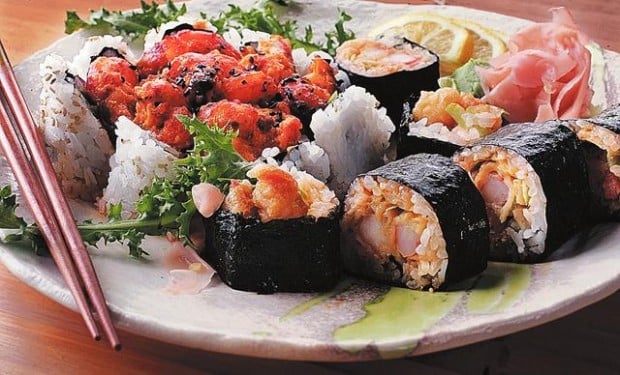
They're hip, they're fun, and they're brimming with raw fish. But just because you like your tuna cooked instead of almost wriggling doesn't mean you can't enjoy the sushi bar craze.
Here's a little secret: Up to half of the menu items in most sushi bars contain not a shred of raw fish. The food is healthful, the flavors are bright and clean, and you get to play with your dinner. What's not to like?
"At first, just the Japanese came," said Tony Kawaguchi, chef at Sushi Katsu in Akron, Ohio. "Now the local people support me. It's an American food now."
But it's a food many Americans still haven't tried. That's why we went searching for sushi that even sushi-haters could love. We found a ton of great food along with tips on how to order, how to tip, and what to do with that blob of green paste on your plate.
First, the green paste: It's wasabi (wah SAW bee), and it's spicy-hot. It is the grated and dried root of a type of horseradish plant. Real wasabi is very expensive, so in this country — and even in many sushi bars in Japan — horseradish is used as a substitute. You are expected to pour some soy sauce into the tiny dish provided, and, with your chopsticks, mix in some of the wasabi. Then, dip each piece of sushi in the sauce before eating it. Go easy at first on the wasabi or your eyes will water from the heat. Start with a blob no bigger than a pencil eraser.
People are also reading…
Near the wasabi on your plate will be a mound of pale-pink pickled ginger. The thin slices are for nibbling on between bites, to cleanse your palate. They're sour-sweet and addictive.
By the time you get your plate with wasabi and pickled ginger, you will have already ordered. This can be a confusing process in a sushi bar. Although the chef is right in front of you, customers are usually expected to order from the server who takes your drink order. Do so, unless the chef hands you a small paper menu and a pencil. At some sushi bars, and in others at busy times, diners merely mark their choices on the paper menu and hand it back to the chef. If you'd like to speak to the server anyway, just say so.
How to place orders:
Consulting with the server or the chef is a good idea for first-timers. Ask for recommendations of nonraw sushi. The server and chef will be glad to help, although in some sushi bars you'll have to rely on the server alone because the chef doesn't speak much English.
That's a shame, because the banter between the sushi chef and his customers is an integral part of the experience. In Japan, the sushi chef is expected to be both dignified and convivial.
Dining at a sushi bar is a social occasion. The interaction between customers and chef often leads to interaction among the diners, especially when the sushi chef has as big a personality as Chai Pung at Golden Dragon in Cuyahoga Falls, Ohio. Pung shouts, laughs and jollies his customers through their meals. Regulars keep their personal chopsticks on a rack behind the sushi bar, like the personalized beer mugs at some taverns.
But back to the food. On the menu you will find a bewildering array of soups, appetizers, sashimi, sushi, maki, bento and combination plates. Sashimi is raw fish alone. Sushi is raw or cooked seafood and perhaps other ingredients with gently salted and vinegared rice. Bento is a compartmentalized box that holds a number of different items.
Many nonraw items:
Skip to the maki rolls, where most of the nonraw choices can be found. Maki are sushi rolls wrapped in thin sheets of dried seaweed, called nori. The seaweed is practically flavorless. It helps hold the ingredients together. Each maki roll is cut into about five to seven slices by the chef. One or two maki rolls should fill you up.
Another good choice would be a hand roll, which is a maki roll shaped into a cone for easier eating out of hand.
Most local sushi bars serve several items that are similar from restaurant to restaurant. Among these favorites are a few nonraw choices. Try a spider roll, which is sushi rice and nori encasing soft-shell crab. Or try a California roll, which is sushi rice and nori wrapped around avocado, crabmeat and cucumber.
Here are some other nonraw choices:
Philadelphia roll — The name usually means a filling of smoked salmon and cream cheese.
Tempura shrimp roll — Batter-fried shrimp and perhaps vegetable slivers are encased in rice.
Spicy crawfish or shrimp — Cooked shellfish in a mildly spicy mayonnaise sauce is rolled into the sushi.
Volcano roll or crazy roll — Grilled shrimp or crawfish in a slightly spicy sauce is poured over a California roll.
Alaska roll — Smoked salmon and avocado are tucked inside.
Round off your meal with a bowl of miso soup or an order of edamame beans. These are listed as appetizers, but Japanese sushi meals do not come in courses. Sip the soup, and snack on the beans throughout dinner.
The soup — a comforting seafood broth swirling with clouds of miso (fermented soybean paste) and punctuated with cubes of tofu — may be sipped directly from the bowl, although a spoon is usually provided. Edamame are immature, green soybeans steamed in their pods. Break open the pods and pick out the beans inside with your fingers.
You may eat the sushi with your fingers, too, or with the chopsticks that are provided. Just remember to eat each piece in a single bite. Trying to daintily nibble a piece of sushi can be hilariously messy.
About the bill, tips:
Sushi can be expensive, especially if you like the less filling raw selections. The heartier maki rolls cost about $5 to $10 each, though, so dinner can be had for less than $20.
At the end of the meal, ask the server for the bill, and tip 20 percent. The server and the chef will split the tip. Or if you're paying with cash, leave the server's tip on the tray with the bill and place the chef's tip in the jar that is found on every sushi bar.
One last bit of instruction: Have fun. That's what sushi bars are for.
Some terms to know when you order:
Sashimi: Raw fish
Sushi: Vinegared rice that is used as a platform for — molded around — raw or cooked fish and vegetables to form sushi rolls.
Maki roll: A sushi roll wrapped in a thin sheet of dried nori seaweed.
Hand roll: A sushi roll wrapped with nori into a cone shape for easy eating out of hand.
Wasabi: A grated spicy-hot root that is formed into a green paste and mounded on the diner's plate. The diner mixes a small amount with soy sauce in a small dish that's provided, and dips each bite of sushi into the sauce.
Pickled ginger: Paper-thin, pale-pink slices mounded next to the sushi as a palate cleanser between bites. Nibble on a slice whenever the mood strikes.
Bento: A handy dinner box divided into tiny compartments to hold a variety of sushi and other foods.
Crab: Sometimes it's real snow, king or soft-shell blue crab, but often — depending on the sushi roll — it's surimi, a faux crabmeat (made from Alaskan pollock and crab) that's popular in Japan.
Tamago-yaki: A layered, airy omelet cut into geometric shapes and served as part of a sushi selection or by itself.
White fish: Usually red snapper, but occasionally halibut.