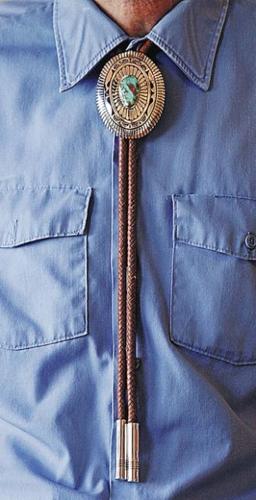
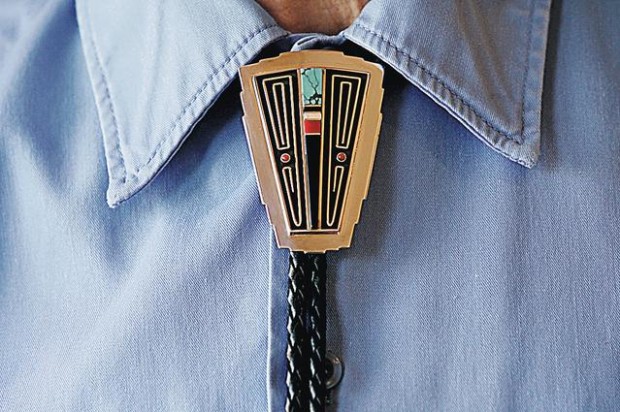
"You say 'bolo,' and I say 'bola.' "
That's Mark Bahti, owner of Bahti Indian Arts, 4300 N. Campbell Ave., speaking about Arizona's official neckwear, the bola tie.
And he should know.
Bahti, as did his father Tom before him, works with American Indian craftspeople and artists throughout the Southwest to acquire jewelry, paintings, rugs and other artifacts for his store.
"Vic Cedarstaff is credited with inventing (the bola tie) shortly after World War II," Bahti said.
This was a time when Arizona culture was a-changin' — from a sparsely populated Western state that dressed according to its own sartorial standards to an up-and-coming Western state that felt it had to don the sophisticated fashions of the folks back East in order to compete.
People are also reading…
Open-neck shirts gave way to suits and ties in the state's power circles, regardless of the desert heat and despite objections from longtime residents.
Enter the bola tie, Arizona's answer to the Windsor knot. It became the state's official neckwear in 1971, and for several years bola ties were everywhere — even in the Big Apple and Europe.
But as bolas gained popularity, their style went from Western chic — leather thong with silver and turquoise — to really kitschy — vinyl or even Mylar tie with a scorpion embedded in plastic.
Now bolas are making a modest comeback. Men in their 40s and 50s are taking a look at inherited bola collections and deciding "these are very cool," Bahti said.
As a result, Bahti is seeing increased interest in the bolas he sells.
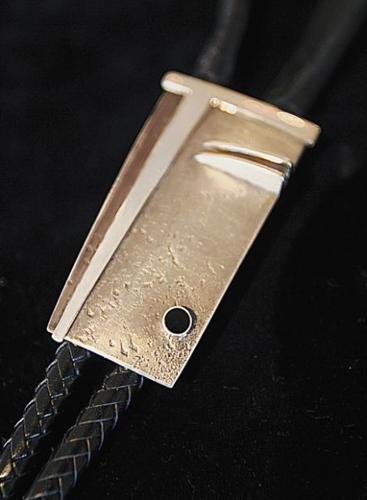
These, like the other jewelry he offers, are works of art, definitely dressier ties. They are, Bahti said, "the black tie equivalent" of bolas.
Men are buying them for dressy events such as the Silver and Turquoise Ball in April at the Arizona Inn. But they're also buying them when they are going back East for business or for an arts or social event.
It's a distinctive way to say, "This is where I'm from."