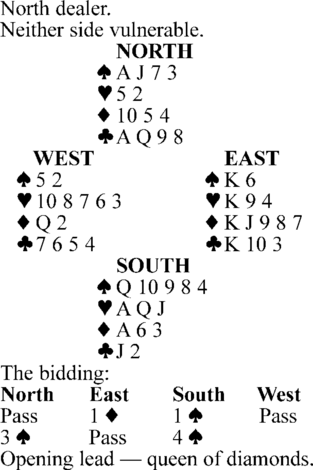
It's usually easy for declarer to play a hand perfectly if he's allowed to see all four hands. But at the table, declarer sees only two hands. Nevertheless, he is expected to achieve the best result possible on virtually every hand he plays.
There are almost always clues to point declarer in the right direction. These clues might come from the bidding, the play, or a combination of both. For example, take this deal where South gets to four spades and West leads the diamond queen.
If declarer plays strictly from force of habit, he goes down one. He wins the diamond and takes a trump finesse. East wins, cashes two diamonds and returns a heart. Declarer finesses successfully but winds up a trick short when he later attempts a club finesse that fails.
The correct line of play is not really difficult. South sees 25 high-card points between his own hand and dummy, and also notes West's queen-of-diamonds lead.
People are also reading…
It certainly seems reasonable to assume that East, for his opening bid, holds the four missing kings, and declarer should adapt his method of play accordingly.
South should win the diamond lead with the ace and play a trump to the ace, deliberately rejecting the finesse. He then leads a heart to the jack and a club to the ace (again rejecting a finesse), followed by a heart to the queen.
With everything going along smooth as silk, declarer now cashes the ace of hearts, discarding a diamond from dummy, and his work is done. He loses only a spade, a diamond and a club, and he has the satisfaction of knowing that he played the hand as though all 52 cards were face-up on the table.