Don Bolles was lured to the Hotel Clarendon on June 2, 1976, with a promise of information about a corrupt land deal involving prominent Arizona politicians.
As an Arizona Republic reporter who had worked to uncover corruption in the state, he couldn’t resist the meeting though he told his editor he had strong doubts about what would come of it.

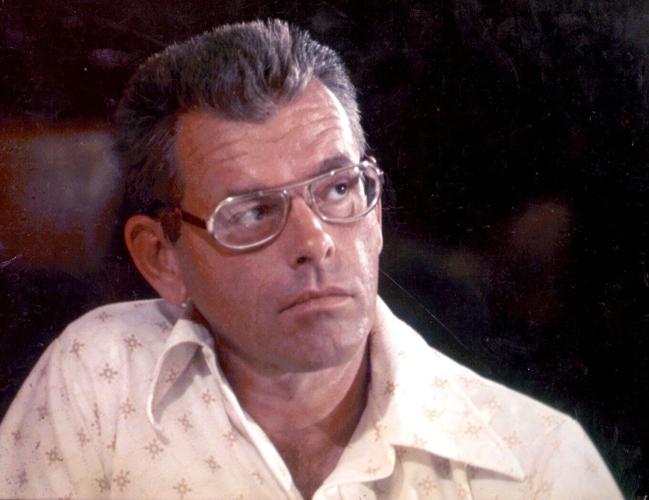
Republic Reporter Don Bolles died in 1976 after being injured in a car bombing.
His instincts were right. It was a ruse. It was designed to get him parked at the hotel so a bomb could be placed under his vehicle.
Six sticks of dynamite exploded below Bolles’ feet as he left the hotel.
The crime triggered multiple investigations and trials. Police detectives, amateur sleuths and journalists have poured through the mountain of records related to the murder.
And 50 years later, details are still emerging about who wanted him dead.
People are also reading…
The Republic has begun a search for more answers, securing approval from the Arizona Attorney General’s Office to release 150 boxes of documents related to the investigation. Those documents were moved from the possession of the attorney general and into the state archives in 2010. They were restricted from public view for 50 years and accessing required special permission.
The killing of a reporter in broad daylight brought national attention to a city that was attempting to grow while keeping a small-town feel.
The publisher of The Arizona Republic had hired Bolles and other reporters with the aim of rooting out corruption, making the city attractive for businesses and families. The mob-style killing shattered that wholesome image.

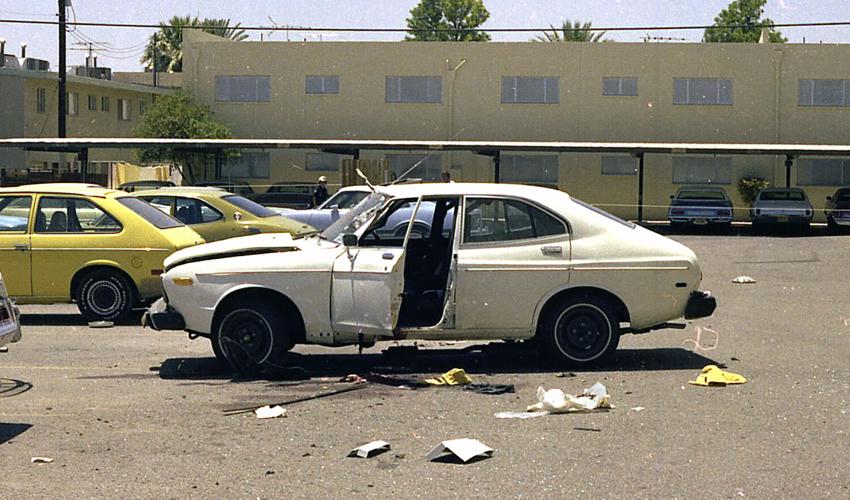
A 1976 Phoenix Police Department photo of the scene in the parking lot of the Clarendon Hotel where reporter Don Bolles was mortally injured after his vehicle was bombed.
It also galvanized journalists around the country who descended on Phoenix to investigate the types of corruption that Bolles had reported about. The clarion call: Kill one reporter and an army of journalists will show up to continue the work.
At the time, the intentional killing of a reporter was unheard of in the United States. It was something that happened in foreign countries where freedom of the press wasn’t valued.
In the years since, it has become more common. A man stormed a newsroom in Maryland in 2018, angry about its coverage of him. He shot five reporters dead. A man who was the subject of a Las Vegas investigative reporter’s work stabbed him to death outside his home in 2022.
Bolles died 11 days after the bombing, enduring an excruciating hospital stay that had doctors severing his legs and an arm in an attempt to save his life.
Bolles was able to speak to bystanders who arrived at the bombing scene. But once at the hospital, he was never able to talk again.
He was able to gesture responses to questions from police. He identified a photo of the man who lured him to the Hotel Clarendon with the promise of providing details on a potential story: John Adamson.
The police investigation and criminal prosecutions of those accused of involvement spilled into the 1990s. Prosecutors charged three men with orchestrating the bombing. Whether anyone ordered it remains an open question.
One year after the last man convicted in the case died in prison in 2009, the records related to the case were moved to the state archives.
The Republic's examination of the documents are part of a commitment to both the legacy of Bolles — and the truth.

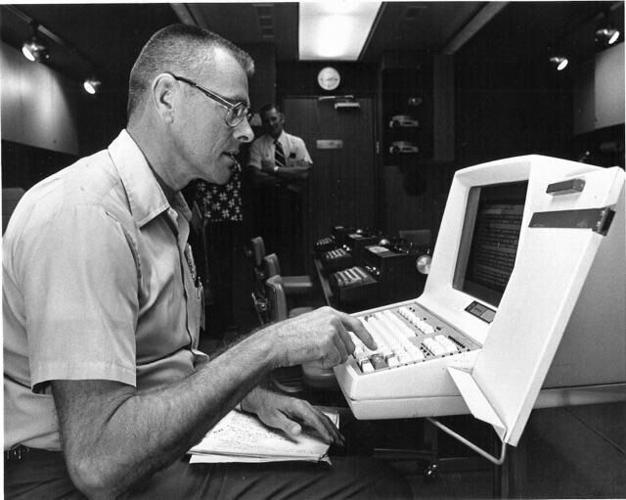
Reporter Don Bolles works on a story in The Arizona Republic newsroom in the 1970s.
'I know what I'm up against'
The bombing of Bolles came during a rise in mafia-style executions and explosions in the Phoenix area. Bolles had made a career of covering the mob influence in the city.
The manner of death seemed designed to send a message. Someone wanted Bolles killed with an attention-getting explosion, not a quick bullet to the head.
Beyond the shock of the attack itself, Bolles, who was covering the Arizona Legislature at the time, seemed an unlikely target.
In The Republic’s newsroom, after word came that a reporter’s car was blown apart, staffers thought the target was an investigative reporter named Al Sitter. When he walked into the newsroom, unaware of the bombing, he didn’t understand why everyone looked at him with surprise.
Bolles had been an investigative reporter and had examined mafia involvement in various industries in the early 1970s.
His 10-part series, “The Menace Within,” sought to expose mob involvement in various businesses. The Republic prominently promoted the work, with ads in the paper declaring that it aimed to “send the criminal packing so that Arizonans could continue to enjoy a safe and pleasant life.”
Back then, Bolles had worried about his safety.
A state Democratic Party official told Bolles he drove by The Republic's newsroom and saw him peering under his car while it was parked downtown on Second Street.
Bolles told him that was routine. “I always check to see if anybody’s been fiddling with it,” he told the man, “because I know what I’m up against.”
By 1976, Bolles was assigned to cover the Legislature. He told some people it was his choice to step away from investigative reporting. But other friends said the move wasn’t his idea. Likely, it was a mix of both.
Still, he didn’t confine himself to simply covering the daily goings-on at the Capitol.
In March 1976, Gov. Raul Castro had nominated a liquor baron named Kemper Marley to a post on the commission that regulated horse racing and dog racing tracks in Arizona.
Bolles wrote a story, based on past reporting from The Republic, about how Marley had benefited himself when he previously was given access to any kind of state power.
The story cost Marley, who was Castro’s largest campaign donor, the seat on the board.
This angered Marley and he wanted Bolles killed, according to the story that Adamson — one of the men hired to blow up Bolles’ car — told police.
Investigators never brought charges against Marley, who continually insisted he had nothing to do with the bombing. He died in 1990.
It wouldn’t seem like losing an unpaid regulatory post would merit such a response. But two additional facts could explain it.
A close friend of Marley was looking to own a dog track and wanted Marley as an investor. Marley could not legally have both a financial interest in a racetrack and sit on the racing commission.
But, he could have skirted the rules and become a silent partner.
Another Marley associate was looking to open a racetrack in Lake Havasu City. And, according to that associate’s financial adviser, he was counting on Marley's position on the board to help make that happen.
Suddenly, that volunteer position on the racing board could be worth a great deal of money.
Marley's liquor company could sell to the tracks. He could have a silent interest in a venue that, at the time, provided Arizona’s only legal form of gambling. He could control what dogs raced and possibly fix races.
And a seat on the board would let him help determine who operated the tracks.
Those details about Marley’s potential motive come, in part, from documents reviewed by The Republic in April. They are part of a record the state has sequestered with restricted public access for 16 years.
The Republic sought access to the documents in summer 2025 and was granted it eight months later, in April.
Though nothing in the documents, so far, has upended what was known about who was responsible for the bombing, they have added texture and context.
It is why The Republic will continue to look through the boxes of documents over the coming months.
Reporters also will spend time during this — the 50th anniversary year of the bombing — examining and reexamining other Bolles documents to see what more can be learned about the assassination of an Arizona journalist.
'A dark mark on Arizona’s heritage'
Bill Shover, who was The Republic’s community relations man at the time of the bombing, said hearing Bolles’ name brings him back to that era. “So many memories,” he said during a recent phone interview days before his 97th birthday.
Shover remembered sitting at Bolles’ hospital bed as he writhed in pain. Officers asked him to be there in case Bolles woke up and could answer questions about the bombing.
Shover found himself serving as a buffer, speaking to national reporters who visited St. Joesph’s Hospital — a five-minute drive from the Clarendon — and informing them that, no, they could not enter to see Bolles.
On the day of the bombing, Shover collected Bolles’ notes and files and put them in a cabinet inside a closet near his office in downtown Phoenix. No one was allowed to see them, Shover said. Police needed a subpoena for access.
Shover said The Republic had a good relationship with the detectives working to solve the case.
“They took his injury as a personal thing,” Shover said, “like he was one of them.”
Bolles had worked to stop organized crime activity in Arizona, Shover said, and he was told some unsavory characters had left Phoenix to avoid scrutiny.
Shover said he thought the correct people were implicated in the bombing. “I don’t think police missed a thing."
George Weisz, who led the Arizona Attorney General’s Office investigation that brought a second trial of the men suspected of involvement in the case, said he appreciated that Bolles’ story was still being told.
“I’m glad that 50 years later Don is rightfully being remembered not only for how he died," Weisz said, “but for how he lived.”
In 1976, Weisz was a student at the University of Arizona working on a master’s thesis about organized crime. He spoke with Bolles by phone several times and, he said, the two were going to meet face-to-face in June of that year.
Weisz said there was a crusading aspect to the way Bolles approached his work.
“He did his stories to educate the public about crime and corruption hoping they would rise up and take action,” he said.
The initial investigation of Bolles’ killing in 1976 and 1977 resulted in convictions for three of the men accused of orchestrating the bombing. But two of those convictions were overturned on appeal. By the mid-1980s, the case was at a stalemate.
That is when Weisz asked then-Arizona Attorney General Bob Corbin if he and others in the office could take a fresh look at the case.
Weisz said investigators looked at all possible leads, including those that pointed fingers in different directions than the original investigation.
“There were lots of theories out there,” he said. “But we don’t follow theories. We follow evidence."
Weisz knew the work his investigative team did. He also read reports from the original investigation.
Both teams of investigators, he said, were “dedicated to find justice for Don and his family. That was foremost in our minds.”
In the retrials in the early 1990s, a jury returned a conviction against one man, Max Dunlap, who was accused in orchestrating the bombing. Another jury exonerated the man accused of detonating the bomb, James Robison.
Despite the mixed verdicts, Weisz was sure the investigation found those responsible for the death of the reporter.
“That day was a dark mark on Arizona’s heritage,” Weisz said. “But hopefully we remember the things that (Bolles) did that made him not only an outstanding journalist but also an outstanding human being.”
'Even if you kill the journalist, you won’t kill the story'
Weisz also was part of a group of journalists who descended upon Phoenix after the bombing, committed to continuing Bolles’ work.
That collection of reporting, produced by 38 journalists from 28 newspapers across the United States, became known as the Arizona Project. The reporters produced 40 stories that ran over 23 days.
Barbara Cochran, president of the Fallen Journalists Memorial Foundation, was editor of The Washington Star and sent a reporter to Arizona for the project.
Their stories looked at land fraud, the influence of organized crime and business owners skirting the law. The work sought to send the message, Cochran said, that “even if you kill the journalist, you won’t kill the story.”
That project’s legacy was not necessarily the stories themselves, but the idea of other journalists picking up the mantle for one who fell.
“The purpose of the Arizona Project was to carry on Don’s work,” Weisz said, “and provide an insurance policy for reporters everywhere.”
The Arizona Daily Star ran the series. The Arizona Republic did not run the series, saying in a front-page note to readers that some of the articles repeated prior Republic reporting. And parts that were new could not be verified.
“Some of the previously unpublished material contains statements and allegations for which The Republic and The Gazette have not yet been able to obtain sufficient documentation and proof to justify publication,” an unsigned letter to readers said.
The fact that Bolles’ own paper didn’t run the project inspired by his death was vexing to those who worked on it, Weisz said. “It still makes no common sense.”
'It’s time to open these records'
Through the years, every report, transcript, note, photo and phone message related to the decades-long investigation into the car bombing of Bolles was preserved in folders and placed inside cardboard boxes housed at the state’s archives.
Access to those materials, stored in some 150 cardboard banker’s boxes, is restricted.
Under an agreement reached in 2010 between the Arizona Attorney General’s Office and the archives division of the Arizona State Library, the documents could only be viewed by “bona fide historians,” “serious researchers” and attorneys or law students.
The Republic learned that some materials were under seal — specifically recordings of wire taps — in 2022.
In July 2025, the archives notified The Republic of a memorandum of understanding reached between the Attorney General’s Office and the archives. The Republic sought to fill out an application for the records, but there was another hitch.
Neither agency could find a signed copy of the original 2010 agreement. The current attorney general, Kris Mayes, signed a fresh one in 2025.
The Republic filed the formal request to view the documents in August 2025.
The archives granted permission in April.
“The passage of time has not diminished the importance of Don Bolles to Arizona or journalism, nor has it revealed everything he and his enemies knew,” said Greg Burton, executive editor of The Arizona Republic. “It’s time to open these records. It’s time for a full accounting of Arizona’s handling of its investigation. Half a century later, it’s time to fully shine a light on everything we can know about the murder of Don Bolles."
Two reporters and an editor spent the better part of three days in April and May going through the first 10 boxes of materials made available.
The archives previously were reviewed by Jeremy Duda, a longtime Arizona political reporter and author of “Murder in the Fourth Estate,” a recently published book that chronicles the investigation and trials surrounding the bombing.
Duda looked at the archives while they were still being processed. His book quotes from grand jury transcripts that were supposed to be under seal.
The Republic did not find any smoking-gun document that laid blame for the bombing at anyone different than the men who have long been implicated.
However, the documents do add context to an investigation that started in an asphalt parking lot outside the Hotel Clarendon and ended with the final proceedings in the case in the early 1990s.
Law enforcement reports seen in the initial boxes have come from the Phoenix Police Department and the FBI.
There are transcripts of interviews of figures in the case. Those included inmates housed with people accused of involvement in the Bolles bombing.
Some of the inmates bolstered prosecutors’ theories about the men. Others gave information that pointed fingers elsewhere.
Police reports also document tips called in by Republic reporters. Some passed on information received through calls. One columnist phoned police with an educated hunch that Marley ordered the bombing.
There are color photos that police took at the scene of the bombing.
There are tape recordings on cassettes and microcassettes. Officials at the archives said those were not available for review as no qualified person on their staff could ensure the tapes could be played without destroying the aged recordings in the process.
The collection, under terms of a memorandum of agreement between the agencies, was to be split into two sections.
One grouping consisted of what the agreement called “attorney work product.”
The other set of documents, related to wire taps and grand jury proceedings, was deemed confidential and under seal.
Those records, according to the agreement, could only be opened by court order.
Physical artifacts from the bombing — including bomb fragments and personal belongings of Bolles — also were restricted to historians and researchers. But those also needed approval from the Bolles family to be made available for inspection, the agreement said.
The Republic has been given access to the boxes bit by bit.
The news outlet was given a list of materials within each of the boxes. The Republic then selected which boxes reporters wished to view first. The Attorney General’s Office reviewed the boxes to ensure any materials not subject to review were removed.
The archives set down a procedure for examining the material.
Only one box could be opened at a time. And only one folder within that box could be taken out at any time. Republic journalists were cautioned to be careful with the documents. Picking up a stack and tapping them on a table to straighten them was forbidden.
And because the materials were deemed restricted, the archives tried not to allow any other public appointments to view other archival documents on the days Republic journalists were present. A divider was put up to shield them from view the one time another person was in the reading room.
The Republic viewed 10 boxes in April. Access was granted to six additional boxes in late May.
At that pace, the review of the materials should continue through the rest of 2026.


 Tim Steller's column: Renaming U of A's Chavez building? Let's do Marley, too